


Channel Letter Bending Machine vs. Manual Bending: Which Is Right for Your Sign Business?
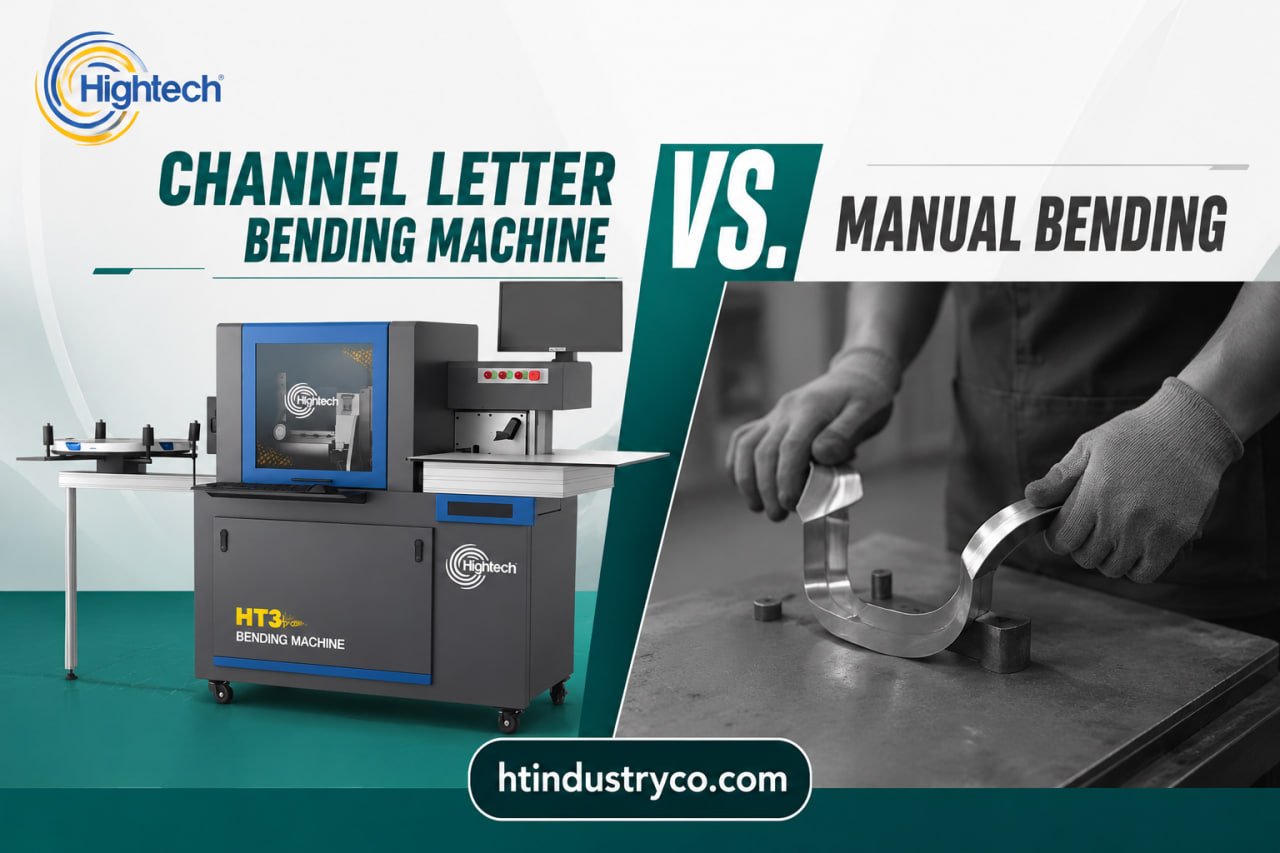
Table of Contents
If you fabricate channel letters, the way you bend your aluminum returns quietly decides your margins. Every illuminated storefront letter (powered by LED Modules), every backlit logo on an office tower, starts the same way: a flat strip of channel letter material shaped into the “return” that forms the side wall of the letter. How you bend that return — by hand or by machine — determines how fast you ship, how much material you waste, and how many people you need on payroll to keep up.
This guide compares manual channel letter bending against automatic and CNC bending machines, walks through the real return-on-investment math, and helps you match the right method to the size of your shop.
Quick Answer: Machine vs. Manual at a Glance
|
Factor |
Manual Bending |
Automatic / CNC Machine |
|---|---|---|
| Production speed | Slow, labor-paced | Very fast, continuous |
| Accuracy | Depends on operator skill | Consistent, software-controlled |
| Material waste | Higher (human error) | Minimal |
| Labor required | High (skilled hands per set) | Low (one operator oversees) |
| Upfront cost | Low | Higher, offset by ROI |
| Best for | Small shops, low volume, custom one-offs | Regular and high-volume production |
What Is Manual Channel Letter Bending?
Manual bending shapes the letter return using hand tools and a letter brake rather than a powered, programmed system. Despite the name, it isn’t bare-handed work — the operator secures the aluminum strip in a brake or jig and bends it to follow the contour of each letter, notching and flanging corners as they go.
How it works in practice: the operator reads the letter pattern, marks the strip, manually notches the inside corners so the return can fold cleanly, bends each segment, and flanges the edge for clinching to the letter back. Every letter is a sequence of hands-on steps.
Where manual bending still makes sense:
Very low volume, where a machine would sit idle most of the week.
Thicker materials or unusual custom one-offs that benefit from a hands-on, artisanal touch.
Tight startup budgets where the upfront machine cost isn’t yet justified.
Locations without reliable power, since manual tools need no electricity.
The hidden costs. Manual bending leans entirely on skilled labor — and skilled benders are expensive and hard to hire. Quality rides on the operator’s experience, so results vary, and human error means wasted aluminum and re-work. As order volume climbs, a manual workflow becomes the bottleneck that caps how much your shop can ship.
What Is a Channel Letter Bending Machine?
A channel letter bending machine automates the feeding, slotting, bending, and cutting of the return in a powered, programmed cycle. Instead of marking and bending by hand, the operator loads a design file, the machine reads it, and the return comes out shaped, notched, and ready to assemble.
There are two broad tiers worth understanding:
Automatic benders use motorized systems to handle most of the work. They dramatically cut production time and remove the operator skill dependency, making them ideal for shops with steady order flow.
CNC benders are the most advanced tier — computer-controlled and reading design files directly from sign-making software. They deliver the tightest precision, handle complex curves and scripts that frustrate manual benders, and minimize waste. A CNC machine’s automatic notching and flanging makes the clinching process fast and repeatable.
A key practical advantage of modern machines is ease of operation. The fear that automation means a steep learning curve is largely outdated; one-click, software-driven control means a non-specialist can run the machine after short training, freeing you from the scramble to hire scarce skilled benders.
Head-to-Head Comparison
Speed and Throughput
Accuracy and Consistency
Manual bending introduces variation: every letter is only as precise as the operator’s hand and attention at that moment. Automatic and CNC systems measure and execute the same bend the same way every time, so returns align perfectly with CNC-cut faces and backs. That consistency is exactly what clients demanding professional, durable branding are paying for.
Material Waste and Cost Efficiency
With aluminum costs elevated, waste is a direct hit to your margin. Manual error means scrapped strips and redone letters. Software-controlled machines use just the material the design calls for, keeping waste — and cost — to a minimum.
read more: Automatic Channel Letter Machine
Labor Cost and Headcount
This is where automation makes its strongest case. Manual bending ties your output to how many skilled people you can hire and retain. A capable automatic machine reframes that equation entirely: Hightech’s HT PRO channel letter bending machine
, for example, is designed to replace up to 20 manual workers, with one operator overseeing the cycle. The payroll you no longer carry is the clearest line item in your ROI.
The Real ROI: Does Automation Pay for Itself?
The honest objection to a machine is the upfront price. But the right comparison isn’t machine cost versus zero — it’s machine cost versus the ongoing cost of the labor it replaces.
A simplified worked example. Suppose two skilled benders cost your shop roughly $6,000–$8,000 per month combined in wages and overhead. If a single automatic machine lets one operator do that work, you’re recovering a large share of that monthly cost from day one. Against a machine in the typical price band for this equipment, the payback period often lands inside the first year — and everything after that is margin. Add reduced material waste and the ability to take on larger orders you previously had to turn away, and the case compounds.
For wholesalers and high-volume shops, the ROI argument extends past cost savings into competitiveness: automation is increasingly the baseline for keeping up with the market’s pace, not a way to get ahead of it.
(Run your specific numbers — wages, monthly volume, and target machine — before deciding. Hightech can help you build an estimate for your shop.)
How to Choose Based on Your Business Size
Small Shop or Startup
If you produce letters occasionally and budget is tight, a manual setup is a reasonable starting point. When orders begin outpacing your hands, the HT1 Channel letter bending machine is a natural first machine — it offers automatic calibration, software-controlled cutting-depth adjustment, and a 360-degree milling cutter that cuts at various angles from both front and back, working with all types of aluminum strips and profiles.
Mid-Size Production Shop
For shops with regular order flow, a fully automated machine removes the labor bottleneck. The HT3 channel letter bending machine is purpose-built for this: a fully automated feed, slot, bend, and cut process under one-click computer control, completing letter returns in a single cycle with precise alignment to CNC-cut faces and backs.
read more: bending machine maintenance
High-Volume Wholesaler
For demanding, large-scale production, the HT PRO handles feeding, slotting, bending, and cutting with one-click control, is engineered to replace up to 20 manual workers, runs with stainless steel and all aluminum types, and is CE-certified. The HT6 Channel Letter Bending Machine (fully automated cutting-to-bending in a single CNC cycle, CE-certified) and the heavy-duty HTZ5 Channel Letter Bending Machine
— with integrally cast fixtures that prevent pinch marks and a servo-driven, grinding-grade ball screw and linear guide for smooth, accurate feeding of wide and thick materials — round out the top of the range.
Why Sign Makers Choose Hightech
Scientific design and precision: machines engineered for repeatable, software-controlled bends that match CNC-cut faces and backs every time.
Easy operation: one-click control removes the dependence on scarce skilled labor and shortens training to days, not months.
Broad material compatibility: aluminum, stainless steel, and profiles, with CE-certified models for quality and safety.
Global support network: a worldwide agent and service presence with North American and overseas contact points means parts, training, and troubleshooting — reducing the downtime risk of buying equipment from abroad.
read more: high performance sheet metal bending
Find the Right Machine for Your Application
Frequently Asked Questions
Is an automatic machine worth it for a small shop?
How long does it take to learn the software?
How much labor can one machine replace?
Is manual better for thick aluminum?
What about shipping, installation, and support?
Latest contents


Prefer a callback? Share your details and requirements below.
Your details will only be used to respond to this request.