


How to Choose a Laser Cutting Machine
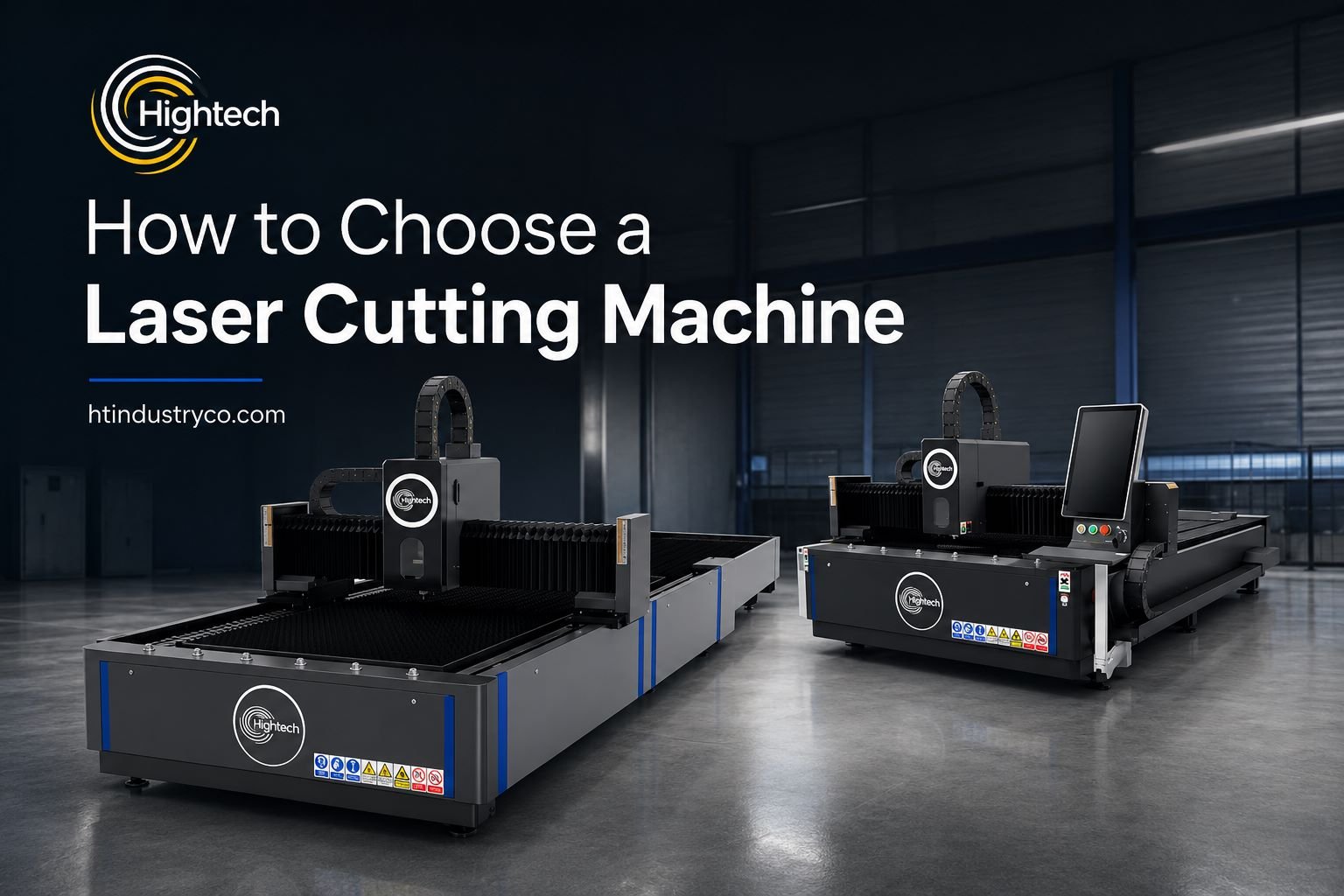
Table of Contents
Choosing a laser cutter is not a matter of buying the highest wattage or the largest bed you can afford. The right machine is the one that fits the materials you process, the part sizes you actually receive, the quality customers expect, and the production volume you need to sustain. A good buying decision also accounts for utilities, software, safety, service, consumables, and the cost of downtime.
HT Industry’s range illustrates why that fit matters. Its fiber laser cutting machines cover compact and standard flatbeds, sheet-and-tube machines, larger formats, and exchange-table systems, while its CO2 laser cutting and engraving machines cover non-metal applications. Use this laser cutting machine buying guide to build a practical shortlist before requesting quotations and sample cuts.
Quick Fact
HT Industry’s lineup includes fiber flatbeds, exchange-table and sheet-and-tube systems, larger-format metal cutters, and CO2 cutting and engraving machines. Start by defining your main material, recurring workpiece size, and throughput; these requirements narrow the right machine class before you compare laser power or price.
Start With Your Application Requirements
Material Type and Maximum Thickness
Start with the material that generates most of your revenue, then define the thickest material you cut routinely. Fiber laser is the practical starting point for metal-focused work such as carbon steel, stainless steel, aluminum, brass, copper, and galvanized sheet. HT Industry’s fiber range is positioned for these applications, while models such as the HT 3015 ST are offered for sheet metal and tube processing with multiple laser-power configurations.
CO2 laser systems are the stronger fit for acrylic, wood, MDF, plywood, leather, fabric, paper, cardboard, and similar non-metals. HT Industry offers compact models such as the HT CO2-6040 and HT CO2-7050 Z as well as larger HT CO2-1390 and HT CO2-1530 formats. A higher-power fiber laser does not replace CO2 for acrylic or wood; wavelength and material response matter more than headline wattage. Mixed-material shops should prioritize the material group that drives the most recurring revenue or outsourcing cost.
Sheet, Tube, and Workpiece Dimensions
Measure the largest recurring workpiece, not the largest job you might someday accept. Standard sheet formats often point buyers toward a 3000 × 1500 mm class machine, such as the HT FC-1530. Smaller workshops can consider the HT FC-1325 with a 1300 × 2500 mm working area, while larger sheets may justify the HT FC-2040 exchange-table model at 2000 × 4000 mm or the HT 4015H at 4000 × 1500 mm.
If round, square, or rectangular tube is a regular product category, a sheet-and-tube machine can reduce transfers between separate machines. If tube work is occasional, however, paying for an integrated tube system may not improve ROI. Confirm tube diameter, length, profile, chuck capacity, and loading method against your real parts before ordering.
Production Volume and Required Throughput
Throughput changes the value of automation. A low-volume custom shop may be well served by a single-table flatbed where the operator can load material while programming the next job. A higher-volume factory should calculate how much spindle—or more accurately, laser—time is lost while material is unloaded and loaded. HT Industry’s HT FC-2040 exchange-table machine is designed around a two-table workflow so one table can be prepared while the other is cutting. The benefit is not simply speed on a datasheet; it is a reduction in non-cutting time between sheets.
Estimate parts per shift, sheet utilization, changeover frequency, and operator availability. Ask suppliers to demonstrate cycle time with representative nesting files, not only maximum traverse speed.
Cut Quality, Tolerance, and Edge-Finish Requirements
Define acceptable kerf, tolerance, hole quality, dross, heat tint, engraving detail, and downstream finishing needs. HT Industry lists ±0.02 mm repeated positioning for the HT FC-1530 and ±0.03 mm positioning accuracy for the HT 4015H, but published figures are only a starting point. Material, thickness, focus, nozzle condition, gas, and parameters affect real results. Request sample cuts from your CAD files and inspect the hardest features.
Choose the Right Laser Technology
When a Fiber Laser Is the Better Choice
Choose fiber when the core workload is metal and productivity, fine detail, reflective-metal capability, and low optical maintenance are priorities. Fiber’s shorter wavelength is well matched to metals. A general fabricator can start with a 3000 × 1500 mm flatbed such as the HT FC-1530; larger-sheet or higher-throughput buyers can consider the HT FC-2040 exchange table or 4000 × 1500 mm HT 4015H. Shops needing sheet and tube can evaluate the HT 3015 ST.
Power should match your everyday thickness mix. More kilowatts help on thicker material but also raise investment and facility requirements.
When a CO2 Laser Is the Better Choice
Choose CO2 when the business mainly cuts or engraves acrylic, wood, MDF, plywood, leather, fabric, paper, cardboard, or similar non-metals. It is particularly useful for signage, displays, and engraving. HT Industry’s lineup shows the range of formats: the HT CO2-7050 Z uses 700 × 500 mm, the HT CO2-1390 uses 1300 × 900 mm, and the HT CO2-1530 expands to 1500 × 3000 mm.
For a fuller technology comparison, see HT Industry’s fiber laser vs. CO2 laser guide. The practical rule is simple: buy for the material family that drives recurring revenue, not for the technology that sounds more advanced.
What to Look for in a Laser Cutting Machine
Working Area and Bed Size
Bed size should cover normal stock with margin for positioning and nesting. Oversizing adds floor space and cost; undersizing creates extra setups and waste. Compare the HT FC-1325, FC-1530, FC-2040, and 4015H against the sheet sizes your suppliers deliver. For CO2, compare compact 6040/7050-class machines with larger 1390 or 1530 formats.
Cutting Speed, Acceleration, Accuracy, and Repeatability
Maximum speed is not the same as production speed. Tight contours, small holes, thick material, frequent piercing, and short moves make acceleration and control tuning just as important. Ask for cutting-time comparisons on the same nested file, including pierce strategy and assist gas. Accuracy tells you how closely the machine can reach commanded coordinates; repeatability tells you how consistently it returns to them. Both matter when parts must interchange across batches.
Laser Source, Cutting Head, and Motion Components
Compare the laser source, cutting head, servo system, guides, racks, frame, and lubrication as a package. The HT 4015H, for example, lists a Raycus 6000 W source, BLT 421H head, CypCut 4000E control system, servo drives, and automatic lubrication. Component brands matter, but so do integration and serviceability. Ask which critical parts are stocked and how failures are diagnosed.
CNC Controller, Nesting Software, and File Compatibility
Confirm the controller imports your engineering files and the nesting workflow supports lead-ins, micro-joints, common-line cutting, remnants, layers, and parameter libraries. Ask whether software licenses, updates, remote support, and the industrial computer are included. Request a live CAD-to-cut demonstration rather than judging the interface from screenshots.
Assist Gas, Chiller, Extraction, and Utility Requirements
A laser cutter is part of a system. Fiber cutting may use oxygen, nitrogen, or compressed air; HT Industry lists all three on its compact fiber models. High-power systems also need adequate chilling, electrical service, gas delivery, and extraction. CO2 machines need cooling and effective fume removal. Before ordering, confirm voltage, phase, connected load, compressor capacity, gas pressure and purity, exhaust airflow, ambient conditions, and grounding. See HT Industry’s fiber laser machine installation requirements guide.
Laser Cutting Machine Selection Guide by Buyer Profile
Small Shop or Sign-Making Business
Prioritize versatility and manageable overhead. A metal-sign shop may prefer the compact HT FC-1325, while an acrylic, wood, and engraving business can choose among the HT CO2-6040, CO2-7050 Z, or CO2-1390 by part size. Avoid idle industrial capacity; preserve budget for extraction, training, software, and working materials.
General Sheet-Metal Fabricator
A 3000 × 1500 mm flatbed is a common practical format because it matches widely used sheet sizes. The HT FC-1530 fits this profile. Select laser power around the thicknesses you cut every week, then validate the combination of speed, edge quality, assist-gas cost, and power consumption with samples. If you are uncertain about table configuration, HT Industry’s guide to single table vs. exchange table fiber laser machines can help frame the throughput trade-off.
High-Volume Production Facility
Focus on utilization, automation readiness, and service response. An exchange-table system such as the HT FC-2040 can reduce loading and unloading idle time in continuous production. Ask about loading automation, nesting, monitoring, scrap handling, gas supply, and preventive maintenance. Evaluate cost per finished part and available production hours, not purchase price alone.
Thick-Plate or Mixed-Format Operation
Thick plate demands enough laser power, piercing capability, gas delivery, stable motion, and a bed sized for heavy material. HT Industry’s 4000 × 1500 mm HT 4015H is listed with a 6000 W Raycus source, while the HT 3015 ST is offered with multiple power options and adds sheet-and-tube processing. For mixed-format work, decide whether one multifunction machine improves utilization or creates a bottleneck. Require sample cuts at the thickest routine gauge and verify loading capacity, edge quality, piercing time, and consumable use.
Frequently Asked Questions
Should I choose a fiber laser or a CO2 laser cutter?
Choose fiber for metal-focused cutting and CO2 for acrylic, wood, MDF, leather, fabric, paper, and other non-metals. If your revenue is split, calculate which material family has the highest recurring volume and outsourcing cost, then buy the machine that removes the bigger constraint first.
What working area or bed size should I choose?
Choose a bed that covers the largest sheet you process regularly. HT Industry examples range from 1300 × 2500 mm on the HT FC-1325 to 3000 × 1500 mm on the HT FC-1530, 2000 × 4000 mm on the HT FC-2040 exchange-table machine, and 4000 × 1500 mm on the HT 4015H.
What operating costs should I budget for beyond the purchase price?
Include electricity, assist gas or compressed air, cooling, extraction, protective lenses and nozzles, filters, lubrication, software, preventive maintenance, spare parts, operator labor, freight, installation, training, and the financial cost of downtime. Compare cost per finished part under your expected duty cycle.
Do I need a sheet-and-tube laser cutting machine?
Only if tube is a meaningful and recurring part of your workload. A machine such as the HT 3015 ST can consolidate sheet and tube processing, but a sheet-only flatbed may offer better value when tube jobs are rare or can be outsourced economically.
What accuracy and repeatability should I look for in a laser cutter?
Start from the tolerance your parts require, then leave process margin for material and thermal variation. Published machine figures are useful for screening; for example, HT Industry lists ±0.02 mm repeated positioning on the HT FC-1530. Final approval should come from measured samples made from your actual files and materials.
What safety features and compliance requirements should I check before buying?
Check enclosure and interlock design, emergency stops, viewing protection, extraction, electrical safety, fire precautions, documentation, and the requirements of your local regulator and insurer. Confirm what safety equipment is included and what facility controls you must supply.
What should I ask a laser cutting machine supplier to prove before I buy?
Ask for sample cuts using your files and materials, measured accuracy, realistic cycle times, a full component list, utility requirements, software scope, warranty terms, spare-parts lead times, commissioning plan, training coverage, service response process, and an itemized quotation. A supplier should be able to explain why the recommended machine fits your workload rather than simply steering you toward the highest specification.
Latest contents


Prefer a callback? Share your details and requirements below.
Your details will only be used to respond to this request.