





Laser welding machines help fabricators create fast, precise seams with a small heat-affected zone and limited finishing. Hightech offers handheld, table, jewelry, QCW, and YAG configurations for workshops and industrial production. Selection depends on alloy, thickness, joint design, volume, finish, power supply, and automation.
Compare Laser Welding Machine Types
Hightech’s five machine families cover portable thin-metal work, handheld fabrication, fixtured production, and precision pulsed welding. Compare process style, capacity, cooling, workholding, and support.
| Machine type | Best fit | Representative products | Compare |
| 4-in-1 handheld fiber | General fabrication and mobile welding | HT FW 1500 / 2000 / 3000 | Power, thickness, wire feed, cooling |
| Jewelry welding | Repair and small precision parts | HT JW MD 100 / 200; CB 200 / 300 | Pulse control, viewing, workspace |
| Fiber table | Fixtured, repeat production | HT FWT-1500 | CCD positioning, fixtures, cycle time |
| QCW | Fine welds and controlled heat | QCW Mini; HT QCW 750Y | Pulse energy, dual mode, portability |
| YAG | Pulsed repair and precision fabrication | HT-YG 300 / 500; MG models | Worktable, CCD, depth range |
4 in 1 Fiber Laser Welding Machine
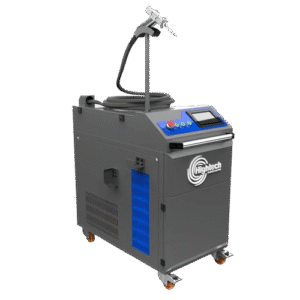
The 4-in-1 fiber laser welding machine range includes HT FW 1500, 2000, and 3000 handheld models with water cooling and wire feeding for spot, butt, overlap, edge, and T-weld work. Hightech lists screening limits of 4 mm stainless/carbon steel and 3 mm aluminum for 1500 W; 6/6/5 mm for 2000 W; and up to 8 mm stainless and carbon steel for 3000 W. These industrial laser welding machines suit higher-throughput fabrication.
Fiber Laser Jewellery Welding Machine
Hightech’s Fiber Laser Jewellery Welding Machine range includes compact HT JW MD 100 and 200 models and cabinet HT JW CB 200 and 300 machines. They target localized repairs, settings, decorative pieces, and small components where controlled heat and visual accuracy matter. Compare pulse energy, viewing system, workspace, and cooling.
Fiber Laser Table Welding Machine
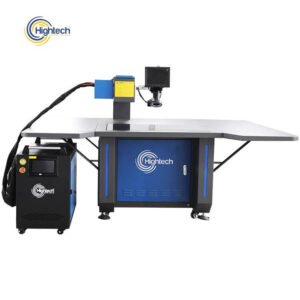
The HT FWT-1500 fiber table Welding Machine is a fixed 1500 W machine for repeatable welding of thin and delicate parts. Its page highlights CCD viewing, double-pendulum operation, and compatibility with aluminum, stainless steel, titanium, and galvanized sheet. It suits fixtured signage, decorative work, precision assemblies, and repeat batches.
QCW Laser Welding Machines
QCW laser welding machines provide controlled pulsed energy for precision jobs. The air-cooled 300 W QCW Mini weighs about 13 kg and lists 0.3–1.2 mm penetration. The 750 W HT QCW 750Y lists up to 30 J pulse energy, 0.1–3 mm penetration, and stationary or handheld operation. Consider QCW for fine parts, repairs, jewelry, titanium, and heat-sensitive work.
YAG Laser Welding Machines
Hightech’s YAG Laser Welding Machines range includes 300 W and 500 W standard and MG models. The HT-YG300W supports handheld and table welding, CCD positioning, and a listed 0.1–2.5 mm depth range. YAG systems fit mold repair, channel letters, signage, and pulsed precision fabrication.
Choose a Laser Welder by Material
Material grade, coating, reflectivity, fit-up, shielding gas, filler wire, and joint geometry all influence results.
Stainless Steel Laser Welding Machine Applications
Stainless steel can produce narrow, clean seams with limited distortion when fit-up and parameters are controlled. Choose handheld HT FW models for general fabrication or table, QCW, jewelry, and YAG systems for smaller detailed parts. Size power for the thickest routine job.
Aluminum Laser Welding Machine Applications
Aluminum reflects energy and conducts heat quickly, so surfaces, focus, shielding, and alloy-specific testing matter. Hightech lists aluminum limits of 3 mm on HT FW 1500 and 5 mm on HT FW 2000; HT FWT-1500 targets thinner precision work. Verify strength and crack sensitivity with the exact alloy.
Carbon Steel, Galvanized Steel, Copper, Brass, and Other Metals
Carbon steel suits general handheld fabrication. Galvanized steel needs venting to manage zinc vapor. Copper and brass are reflective and conductive, so use a validated configuration such as suitable QCW equipment. Titanium, gold, and silver generally benefit from localized pulsed control. Approve every process through production-representative samples.
Why Choose Hightech for Laser Welding Machines?
Hightech lets buyers compare portable, handheld, fixed-table, QCW, YAG, and jewelry equipment. The company states it provides worldwide shipping, training, a one-year warranty, spare-parts support, and lifetime technical assistance. Confirm regional service, electrical needs, safety provisions, and warranty exclusions in writing.
Request a Quote for a Laser Welder for Sale
For an accurate laser welding machine price, send material grades, thickness range, joints, drawings, daily volume, finish standard, country, voltage, and automation needs. Request recommended power, cooling, wire feeding, shielding, safety equipment, and sample-weld evidence. Ask for itemized costs covering options, freight, duties, installation, training, lead time, and support.
Frequently Asked Questions
How do laser welding machines work?
A focused beam melts the joint edges, which cool into a seam. Shielding gas or filler wire may be used for the material and joint.
Are laser welding machines any good?
Yes, for fast, accurate, repeatable welding with limited distortion. Good results still require proper fit-up,
parameters, safety controls, and training.
What Is the Cost of a Laser Welding Machine?
laser welding machine price vary depending on power, brand, cooling system, and automation. Entry-level machines are suited for small workshops, while high-powered, fully automated systems are designed for industrial-scale operations.
What are the downsides of laser welding?
Drawbacks include higher initial cost, strict laser safety, sensitivity to gaps and surface condition, and optics or cooling maintenance.
How thick of metal can laser welders weld?
Capacity varies. Hightech lists 4/4/3 mm stainless/carbon/aluminum for HT FW 1500, 6/6/5 mm for HT FW 2000, and 8 mm stainless/carbon for HT FW 3000. Validate with samples.
When should a buyer choose industrial or automatic laser welding machines?
Choose them for repetitive, high-volume parts that can be fixtured consistently. Portable systems suit varied parts, repairs, and large assemblies.
What laser power is recommended for my material thickness and production volume?
Select power from sample welds on the thickest routine material, then check duty cycle and daily throughput. Do not oversize for a rare job.
Can one laser welding machine weld both stainless steel and aluminum?
Selected Hightech fiber systems can, but each alloy needs separate parameters, shielding, cleaning, filler strategy, and trials.
What is the difference between a pulsed laser welding machine and a continuous-wave system?
Pulsed systems deliver controlled bursts for localized precision. Continuous-wave systems provide sustained power for faster seams and deeper production welding; QCW bridges these modes.
What factors should I compare before choosing a laser welder?
Compare alloys, thickness, gaps, power, operating mode, cooling, fixtures, wire feed, portability, automation, safety, electricity, service, warranty, and samples.
How does laser welding compare with TIG or MIG welding?
Laser can be faster, cleaner, and lower-distortion. TIG and MIG may tolerate gaps better and remain practical for thick or varied field work.