Showing all 2 resultsSorted by latest

QCW laser welding machines are built for precise metal joining where controlled heat, pulse energy, and repeatability matter more than maximum continuous seam speed. Hightech Industry Group’s 750W QCW family combines quasi-continuous-wave fiber output with stationary and handheld operation for spot welds, short seams, repair, and hard-to-reach joints. Published specifications include up to 30 J pulse energy, 0.2–50 ms pulse width, and 1–1000 Hz frequency. Compare the configurations below, then request sample welding and a quote for your alloy, thickness, joint, and production target.

Compare QCW Laser Welding Machine Options

Hightech’s laser welding machines range includes handheld, fixed-table, jewelry, QCW, and YAG equipment. Its published 750W QCW models are dual-mode systems for controlled-heat precision work.

ModelPublished configurationKey specificationsBest fit
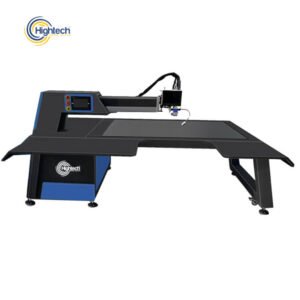
HT750W QCW laser welding machineStationary worktable with CCD camera and red-light positioning, plus handheld operation750W; 1080 nm; 30 J; 0.2–50 ms; 1–1000 Hz; 0.1–3 mm published penetration; 5–8 m fiber; about 200 mm vertical travelBuyers wanting the most detailed published table and positioning specifications
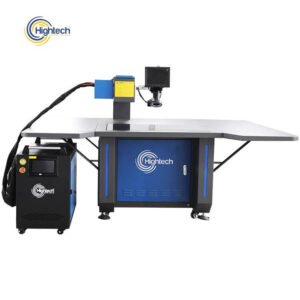
HT QCW 750Y laser welding machineStationary and handheld operation with CCD-equipped table mode750W; 1080 nm; 30 J; 0.2–50 ms; 1–1000 Hz; 0.1–3 mm published penetration; 5–8 m fiberPrecision shops comparing a flexible QCW fiber laser welder and confirming options by quotation

Quasi-Continuous Wave Laser Welding Machine for Precision Work

A quasi-continuous wave laser welding machine delivers long, high-peak-power pulses while controlling average heat input. It suits small weld zones, repair, and heat-sensitive parts where distortion or discoloration must be limited. The HT QCW 750Y laser welding machine combines camera-assisted stationary work with handheld access through a long delivery fiber.

Quasi-CW Laser Welding Machine Types: Portable, Tabletop, Galvo, and Multi-Axis

Portable or handheld delivery suits repairs and irregular parts, while a tabletop station improves stability and visual alignment. Galvo scanning moves the beam rapidly across a small field; XY, XYZ, rotary, or multi-axis stages create programmed seams. The published HT750W QCW laser welding machine emphasizes handheld and fixed-table use with CCD and red-light positioning. Buyers needing galvo or multi-axis automation should confirm the scan head, travel, fixtures, controller, and guarding.

QCW Laser Welder Features and Benefits

Hightech lists a sealed laser module that does not require optical realignment and a pump-source design that avoids the cavities, crystals, xenon lamps, and reflector mirrors used in traditional YAG systems. The company states electricity use of about 1 kWh per hour. Dual-mode operation supports bench and handheld work, while frequency up to 1000 Hz is positioned as a productivity benefit. Practical advantages include lower routine optical maintenance, flexible access, controlled heat, and one platform for varied precision jobs.

QCW Laser Welding System Applications and Materials

Metals: Stainless Steel, Aluminum, Copper, Titanium, Gold, and Alloys

HT pages explicitly list stainless steel, galvanized sheet, iron plate, and titanium; the laser-welding category also identifies gold and silver. Aluminum, copper, nickel alloys, precious metals, and dissimilar combinations may be sensitive to reflectivity, conductivity, cracking, or intermetallic formation. Approve them through sample welds using the exact grade, thickness, surface condition, and joint gap.

Applications: Electronics, Batteries, Jewelry, Medical Devices, and Precision Parts

Typical applications include electronic housings and contacts, battery tabs, jewelry assembly and repair, medical instruments, sensors, thin enclosures, tooling repair, and precision parts. QCW is attractive when the weld must be small, repeatable, and visually clean. Battery, medical, and safety-related production also requires appropriate process validation, extraction, guarding, traceability, and quality testing.

Qcw laser welding machine parts and service support

Laser Source, Welding or Scan Head, Optics, Fiber, Cooling, Controls, and Fixtures

The equipment scope should identify the laser source, welding or scan head, optics and protective lenses, delivery fiber, cooling, controls, motion stages, fixtures, camera or aimer, enclosure, and safety interlocks. Request a recommended-spares list with part numbers, lead times, and replacement instructions. Hightech states that spare parts are available for supported models and can be shipped internationally.

Qcw laser welding machine manual, setup, and maintenance documentation

Documentation should cover installation, utilities, safety, operation, parameters, maintenance, and troubleshooting. The manual should explain startup, shutdown, focus setting, fixture alignment, recipe creation, lens inspection, cooling checks, alarms, and safe access. Hightech states that manuals, training videos, and remote guidance are available; confirm the exact package in the quotation.

Why Choose Hightech for QCW Laser Welding Machines

Hightech’s QCW range is centered on 750W dual-mode machines designed for precision welding. The HT750W and HT QCW 750Y combine a fixed workstation with CCD-assisted positioning and handheld operation through a 5–8 m delivery fiber, so one system can support stable bench work as well as larger, irregular, or hard-to-reach parts. Published parameters include up to 30 J pulse energy, a 0.2–50 ms pulse width, a 1–1000 Hz welding frequency, and maximum penetration of 0.1–3 mm. These specifications provide a practical platform for controlled spot welds, short seams, precision repair, jewelry, and other heat-sensitive applications.

Hightech also emphasizes lower routine ownership demands. Its QCW product pages describe a fully sealed laser module that does not require optical realignment, a pump-source design that avoids cavities, crystals, xenon lamps, and reflector mirrors, and energy consumption of about 1 kWh per hour. The machines are promoted for stainless steel, galvanized sheet, iron plate, titanium, and precision metals such as gold and silver. Buyers can also request operating manuals, training videos, remote guidance, spare parts, worldwide delivery, a one-year warranty, and lifetime after-sales technical support. Confirm the final accessories, voltage, service scope, and sample-weld acceptance criteria in the quotation.

QCW Laser Welding Machine Price and Cost

QCW laser welding machine price varies with laser source, peak power, pulse energy, head, vision, axes, table, rotary fixtures, cooling, enclosure, extraction, safety package, voltage, software, and spares. Freight, duties, installation, training, sample development, warranty, and local support affect total cost. Operating expenses include electricity, cooling, protective lenses, maintenance, downtime, and fixture changes.

Frequently Asked Questions

What is a QCW laser welding machine?

It is quasi-continuous-wave fiber laser equipment that produces long, high-peak-power pulses at controlled average power. This concentrates energy for precise spot and short-seam welding with limited heat input.

How does quasi-continuous-wave laser welding work?؟

The system sets pulse width, repetition frequency, peak power, and average power. Each pulse melts a controlled area; repeated or overlapping pulses form a spot pattern or seam while limiting the heat-affected zone.

What is the difference between QCW and continuous-wave laser welding?

QCW uses pulsed high-peak power for localized heat control and precision. Continuous-wave welding supplies sustained power and generally favors faster, deeper continuous seams and higher-throughput fabrication.

Which materials and applications are suitable for a QCW laser welder?

Candidates include stainless steel, titanium, galvanized and ferrous metals, gold, silver, and validated aluminum, copper, nickel-alloy, or dissimilar combinations. Uses include electronics, batteries, jewelry, medical devices, repair, and precision parts.

Can QCW laser welding machines be automatic or CNC controlled?

Yes. QCW output can be integrated with galvo scanning, XY or XYZ stages, rotary axes, vision, robotics, or CNC-style motion. Reliable fixtures and part location are essential.

What affects QCW laser welding machine price and cost?

Key factors include power, pulse energy, source brand, beam delivery, axes, vision, cooling, enclosure, safety, fixtures, freight, duties, installation, training, warranty, spares, and operating expenses.

How do I select the right QCW laser welding system?

Match the system to material, thickness, joint geometry, heat sensitivity, weld size, production volume, work envelope, automation, utilities, safety, sample-weld results, and service support.