Showing all 4 resultsSorted by latest
What Is a YAG or Nd:YAG Laser Welding Machine?
A YAG laser welding machine focuses controlled laser pulses on a small joint area, melting the metal without direct tool-to-part contact. “YAG” is commonly used as shorthand, while “Nd:YAG” identifies the neodymium-doped yttrium aluminum garnet crystal in the laser source. Localized heat input makes an Nd:YAG laser welder useful for precise spots, short seams, and detailed repairs. Results still depend on the alloy, fit-up, surface preparation, shielding, pulse settings, and positioning method.
Compare YAG Laser Welding System Configurations
A YAG laser welding system should be selected by operating format, not wattage alone. Buyers comparing laser welding machines should confirm the exact layout and included options on the current quotation.
Desktop, Manual, Handheld, and Table Configurations
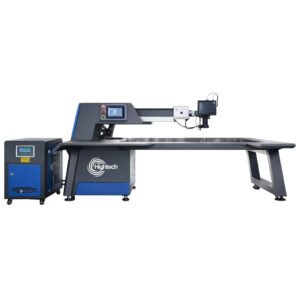
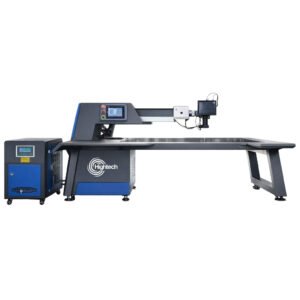
“Desktop” is often used loosely for fixed or table-based equipment, but the published 2100 × 1700 mm worktable is larger than a compact benchtop unit. Handheld access suits varied parts and repairs; table operation supports steadier workholding and repeatability. Hightech publishes 10× CCD positioning for the HT-YG models and HT500W MG.
Standard and MG Model Options
| Model | Power / wavelength | Published format | Pulse / depth | Worktable & positioning |
| HT-YG300W | 300W / 1064 nm | Handheld welding; table welding | 110 J; 0.1–2.5 mm; 1–50 Hz | 2100 × 1700 mm; 10× CCD |
| HT-YG500W | 500W / 1064 nm | Handheld welding; table welding | 110 J; 0.1–4 mm; 1–60 Hz | 2100 × 1700 mm; 10× CCD |
| HT300W MG | 300W model class | Confirm on current quotation | Confirm on current quotation | Confirm on current quotation |
| HT500W MG | 500W / 1064 nm | Combined chassis, platform, mechanical arm, chiller | 180 J; 0.1–4 mm; 1–60 Hz | 2100 × 1700 mm; 10× CCD |
Automatic and Industrial Integration Options
For repeat production, ask about dedicated fixtures, rotary devices, programmable motion, multiple stations, process monitoring, and production-line interfaces. Automation can improve handling and repeatability for consistent parts, but adds programming, guarding, floor space, and maintenance. Treat “automatic” as a configuration to specify and validate, not a guaranteed feature of every model.
For related precision options, compare QCW laser welding machines; for broader handheld fabrication, review 4-in-1 fiber laser welding machines.
Key Benefits and Product-Selection Factors
A precision YAG laser welding machine concentrates heat into a small area, supports accurate spot placement, and provides adjustable pulse control without mechanical contact. Benefits are strongest when joint access and fit-up are consistent. Compare power, pulse energy, depth range, frequency, spot-size adjustment, worktable, travel, cable length, cooling, electrical demand, and positioning visibility. Validate appearance, strength, distortion, and cycle time with sample welds on the actual parts.
Compatible Metals and Industrial Applications
Hightech identifies stainless steel, carbon steel, and titanium as YAG applications, including precision fabrication, signage, localized repair, small assemblies, and controlled spot or seam welding. A YAG laser welder for stainless steel should be tested for grade, thickness, joint design, finish, and shielding. A YAG laser welding machine for aluminum needs closer validation because reflectivity and rapid heat conduction affect the process. Aluminum, copper, brass, coated metals, nickel alloys, and crack-sensitive materials require application-specific trials rather than universal compatibility claims.
YAG Laser Welding Machine Price and Total Cost
YAG laser welding machine price is quotation-based and varies with model, power, format, controls, worktable, cooling, voltage, safety package, accessories, and automation. Total YAG laser welder cost can also include freight, customs, installation, training, sample development, spare parts, and maintenance. Ask what is included, which items are optional, warranty terms, delivery timing, and replacement-part lead times.
Why Choose Hightech for YAG Laser Welding Machines?
Hightech lists factory-direct supply, worldwide shipping, a one-year warranty, and lifetime technical support. Support can include remote installation, setup and operation guidance, troubleshooting, maintenance help, and demo or production videos. Spare parts can be shipped internationally, while selected machines may be customized for voltage, working area, power, language, accessories, or special requirements. Local or in-person service depends on region and scheduling.
Compare Available Models and Request a Quote
Start by comparing the 300W and 500W power classes, then confirm whether the job needs handheld access, table positioning, a mechanical-arm layout, dedicated fixtures, or automation. For an accurate recommendation, provide the material and alloy, thickness, joint type, weld size, part dimensions, production volume, required finish, available utilities, destination country, and photos or drawings. Whenever possible, request a sample-weld test. Request a YAG laser welder quote or contact Hightech Industry Group to verify the current model configuration, included accessories, lead time, and delivered cost.
Frequently Asked Questions
Are YAG and Nd:YAG laser welding machines the same?
YAG is commonly used as shorthand, while Nd:YAG specifies the neodymium-doped YAG crystal. Compare the actual source, pulse controls, positioning, cooling, and machine layout.
What metals can an Nd:YAG laser welding machine weld?
Hightech lists stainless steel, carbon steel, and titanium. Other metals require alloy-specific testing because reflectivity, conductivity, fit-up, surface condition, and cracking risk affect results.
Can YAG systems weld stainless steel and aluminum?
Stainless steel is a published Hightech YAG application. Aluminum needs closer validation of alloy, cleanliness, reflectivity, heat conduction, shielding, settings, and joint design.
When should a buyer choose a YAG spot welder?
Choose a YAG laser spot welding machine for localized precision joins or repairs where controlled pulses and accurate positioning matter. Long continuous seams or higher-throughput fabrication may be better served by another laser process.
Should I choose a manual or automatic YAG laser welding machine?
Manual or handheld operation suits varied parts, repairs, and lower-volume work. An automatic YAG laser welding machine is more appropriate when parts are consistent and fixturing, programmed motion, repeatable handling, and higher throughput justify the added integration.
What affects YAG laser welder cost?
Cost depends on the model, power class, manual or automated format, worktable, motion and viewing systems, cooling, accessories, safety equipment, customization, freight, installation, training, support, and spare-parts package.
Which YAG laser welding machine parts require maintenance or replacement?
Requirements are model-dependent. Ask about pump-source components, protective optics, filters, cooling and chiller items, seals, fixtures, and safety components, then confirm intervals and part lead times.
How do I choose the correct YAG laser welding machine configuration?
Match the system to alloy, thickness, joint type, weld size, access, part dimensions, throughput, operator method, positioning needs, automation, utilities, safety, and sample-weld results. Use the published specifications as a shortlist, not the final process guarantee.