


Single Table vs Exchange Table Fiber Laser Machines: Which Is Right for Your Shop?
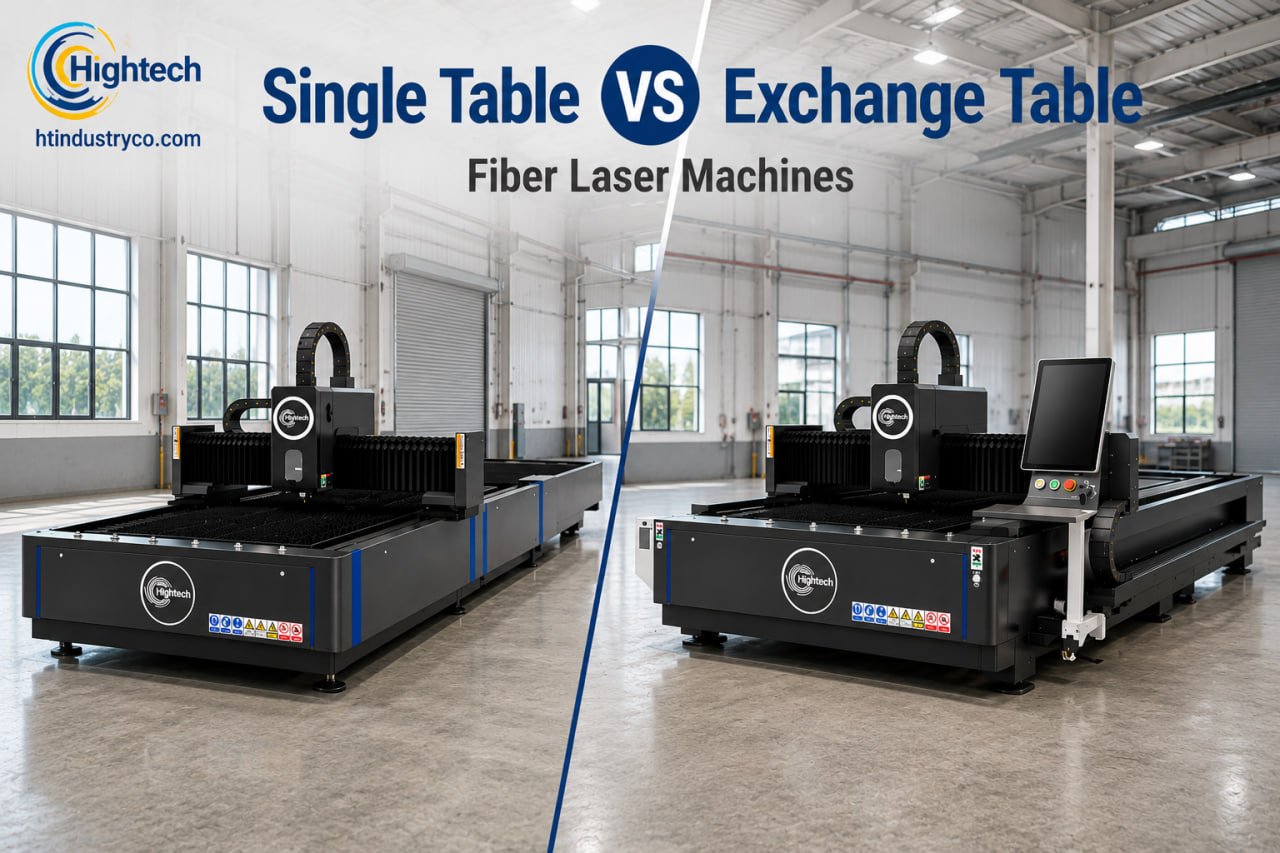
Table of Contents
Choosing between single table and exchange table fiber laser machines is less about which design is “better” than where production time is lost. Both can use comparable laser sources, cutting heads, controls, and nesting software. The main difference is what happens between cycles.
A single-table machine stops while the operator removes parts and scrap and loads the next sheet. An exchange-table machine uses two platforms so one can be prepared while the other cuts. This can raise output, but it also increases cost, space needs, and complexity.
HT Industry’s fiber laser cutting machines include compact and standard flatbeds as well as the HT FC-2040 Exchange Table Fiber Laser Cutting Machine. The right choice depends on production volume, average cycle time, sheet-handling workflow, available space, and the value of reducing laser idle time.
Quick Comparison: Single Table vs Exchange Table Fiber Laser Machines
|
Decision factor |
Single table |
Exchange table |
|---|---|---|
| Cutting performance | Comparable when laser power and motion components are equivalent | Comparable when laser power and motion components are equivalent |
| Overall throughput | Lower when loading and unloading occupy a large share of each cycle | Higher potential because sheet changeover can overlap with cutting |
| Initial investment | Usually lower | Usually higher |
| Floor space | More compact and easier to place | Requires additional length and clear loading zones |
| Operator workflow | Operator waits for cutting to stop before accessing the sheet | Operator can unload and stage the next sheet outside the active cutting zone |
| Maintenance | Fewer moving table components | Additional table, rails, drives, sensors, and exchange mechanism |
| Best fit | Low-to-medium volume, high-mix jobs, limited space | Repeat batches, multi-shift work, and production constrained by changeover time |
What Is a Single Table Fiber Laser Machine?
A single-table fiber laser uses one bed, where each sheet is loaded, cut, and unloaded. HT models such as the HT FC-1530 Fiber Laser Cutting Machine and HT FC-2040 Fiber Laser Cutting Machine use this flatbed workflow. The FC-1530 page lists a 3,000 × 1,500 mm work area, 60 m/min processing speed, 0.4G acceleration, and ±0.02 mm repeat positioning for common industrial metals.
This design is often a practical entry point because it is simpler to install, easier to fit into an existing layout, and less expensive. Its limitation appears when the laser finishes quickly but waits while the operator changes sheets.
What Is an Exchange Table Fiber Laser Machine?
An exchange-table machine has two work platforms, often called shuttle, dual, or pallet tables. One table is inside the cutting area while the other is outside for unloading and loading. When the cutting program finishes, the platforms swap positions and the next job can begin with much less non-cutting delay.
HT positions the FC-2040 Exchange Table for continuous production. Its page lists a 2,000 × 4,000 mm work area, 700 kg table load, 60 m/min cutting speed, 0.4G acceleration, ±0.05 mm positioning accuracy, and ±0.02 mm repeat positioning.
Key Differences Between Single Table and Exchange Table Machines
Cutting Speed vs Overall Throughput
With the same laser power, motion hardware, and settings, cutting time for the same nest should be comparable. The exchange table improves time around the cut. Its advantage is greatest when cutting cycles are short and manual changeovers are long, and smaller when sheets take a long time to cut.
Loading, Unloading, and Laser Idle Time
On a single table, cutting and sheet handling happen sequentially. On an exchange table, much of the handling overlaps with cutting. Record average cutting and changeover times for representative jobs. Saving most of an eight-minute changeover matters greatly on a 12-minute cut, but much less on a 90-minute cut.
Purchase Price and Total Cost of Ownership
A single-table machine generally costs less initially. An exchange table adds structure, motion components, guarding, and installation work. Compare the complete cost: financing, freight, extraction, gas, labor, maintenance, spare parts, and the value of added capacity. The premium is justified when added contribution margin exceeds added annual ownership cost.
Floor Space and Material-Handling Requirements
A single table is easier to place. An exchange table needs room for both platforms, travel, operator access, staging, scrap removal, and forklift or crane movement. Map the complete cell, including the chiller, collector, gas system, electrical cabinet, material racks, and maintenance clearance.
Labor Efficiency and Operator Workload
An exchange table reduces operator waiting and creates a steadier loading rhythm. It does not automatically eliminate labor: sheets, parts, and scrap still need handling, often at a faster rate. The benefit is strongest when one operator can safely support several processes or when loading is assisted by lifting equipment.
Maintenance and Mechanical Complexity
A single table has fewer motion components. Exchange systems add rails, drives, sensors, alignment points, and interlocks. Preventive work includes clearing debris, checking lubrication and alignment, and verifying sensors. The added maintenance is manageable, but it belongs in uptime and spare-parts planning.
Safety, Enclosures, and Operator Access
Exchange tables separate loading from active cutting, but do not replace guarding, extraction, interlocks, training, and local compliance. Open exchange-table machines are possible, but access and exposure risks must be addressed. Confirm the included doors, light curtains, extraction zones, cameras, and emergency stops.
Automation and Future Scalability
A single table can use manual loading, cranes, or lifting devices. An exchange table is a useful step toward automation because it standardizes material transfer. Confirm support for loaders, unloaders, storage towers, part sorting, scheduling, and unattended operation. A cheaper machine can become costly if it cannot scale.
When a Single Table Fiber Laser Machine Makes More Sense
Best Applications and Production Profiles
A single table often fits start-ups, small fabricators, sign makers, maintenance departments, prototype operations, and high-mix job shops. It also makes sense when cuts are long, sheets change infrequently, handling is already fast, or space is limited. The HT FC-1530 is a standard-format option; confirm the exact flatbed FC-2040 configuration with HT.
Signs Your Shop Does Not Need an Exchange Table Yet
Stay with a single table when utilization is inconsistent, operators can keep up, bottlenecks are in programming or downstream work, or extra capacity would not create sales. A second table will not fix poor nesting, missing material, slow quoting, weak extraction, or insufficient laser power.
When an Exchange Table Fiber Laser Machine Is Worth It
Best Applications and Production Profiles
An exchange table is most valuable for repeat production, contract manufacturing, enclosures, HVAC components, industrial signage, and other full-sheet work. It is especially attractive in multi-shift facilities where idle minutes accumulate. The HT FC-2040 Exchange Table’s 2,000 × 4,000 mm format targets wide-sheet, continuous workflows.
Signs Loading and Unloading Are Limiting Output
Consider upgrading when the laser sits idle during sorting and loading, changeovers drive overtime, or work is outsourced despite strong demand. Track beam-on time, ready time, changeover minutes, delays, and completed sheets. When changeover is a significant, repeatable share of scheduled time, the business case is measurable.
Single Table vs Exchange Table by Shop Type
Job Shops and High-Mix, Low-Volume Production
Job shops often benefit from the lower cost and flexibility of a single table because programming, material changes, inspection, and customer-specific setup can dominate the cycle. An exchange table may still pay off when the shop runs many short nests or has enough recurring work to keep the machine continuously scheduled.
Contract Manufacturers and Repeat Batch Production
Contract manufacturers can use the second table to standardize loading, reduce queue time, and protect delivery schedules. The advantage is strongest when materials, sheet sizes, and nests repeat. A disciplined workflow can have the next sheet, program, gas selection, and downstream routing ready before the current sheet ends.
Multi-Shift and High-Volume Facilities
For multi-shift operations, the exchange-table premium is spread across more operating hours. Even a modest gain per changeover can accumulate into meaningful weekly capacity. These facilities should compare the FC-2040 Exchange Table with other HT exchange-table or automation-ready models according to sheet width, power requirement, enclosure, loading method, and verified cycle-time tests.
Which Fiber Laser Table Configuration Should You Choose?
Choose a single table when capital or space is limited, production is variable, or loading is not the constraint. Choose an exchange table when utilization is high, jobs repeat, changeovers are measurable, and added output can be sold. Use how to choose a fiber laser cutting machine and the best fiber laser cutting machine buyer’s guide to compare power, working area, utilities, controls, service, and expansion plans.
For a final quote, provide standard sheet sizes, materials, thicknesses, daily volume, CAD files, edge requirements, floor plan, handling equipment, and shift pattern. Request timed samples and a written specification for the exact configuration. Choose the design that lowers cost per part without moving the bottleneck elsewhere.
Frequently Asked Questions
How much production time can an exchange table save?
Savings depend on the ratio of handling time to cutting time. Measure current unloading and loading minutes per sheet, then calculate how much can overlap with the next cutting cycle. Short cutting cycles with long manual changeovers produce the largest percentage gain.
Which table type is better for a small fabrication shop?
A single table is usually the more practical starting point because it costs less and occupies less space. An exchange table can still make sense for a small shop with strong repeat demand and a documented loading bottleneck.
Does an exchange table reduce labor requirements?
It can reduce operator waiting and improve labor productivity, but it does not remove the work of loading, sorting, and scrap handling. Staffing savings depend on the wider cell layout and whether material handling is mechanized.
Are exchange-table fiber lasers more expensive to maintain?
They can have somewhat higher maintenance needs because the exchange mechanism includes more moving parts and sensors. Routine cleaning, lubrication, alignment checks, and access to spare components help protect uptime.
Is a shuttle table the same as an exchange table or dual table?
In most fiber-laser purchasing discussions, shuttle table, exchange table, pallet changer, and dual table describe the same basic two-platform concept. Confirm the actual motion sequence and loading access because designs vary.
Can an open fiber laser machine use an exchange table?
Yes, an open machine can be built with an exchange-table mechanism. The installation still needs appropriate guarding, controlled access, extraction, training, and compliance with applicable laser-safety requirements.
When should a shop move from a single table to automated loading and unloading?
Move toward automation when utilization is consistently high, manual handling limits output, labor availability is a constraint, material formats are standardized, and the projected savings justify the loader, storage, software, integration, and service costs.
Latest contents


Prefer a callback? Share your details and requirements below.
Your details will only be used to respond to this request.