


How to bend aluminum channel letters
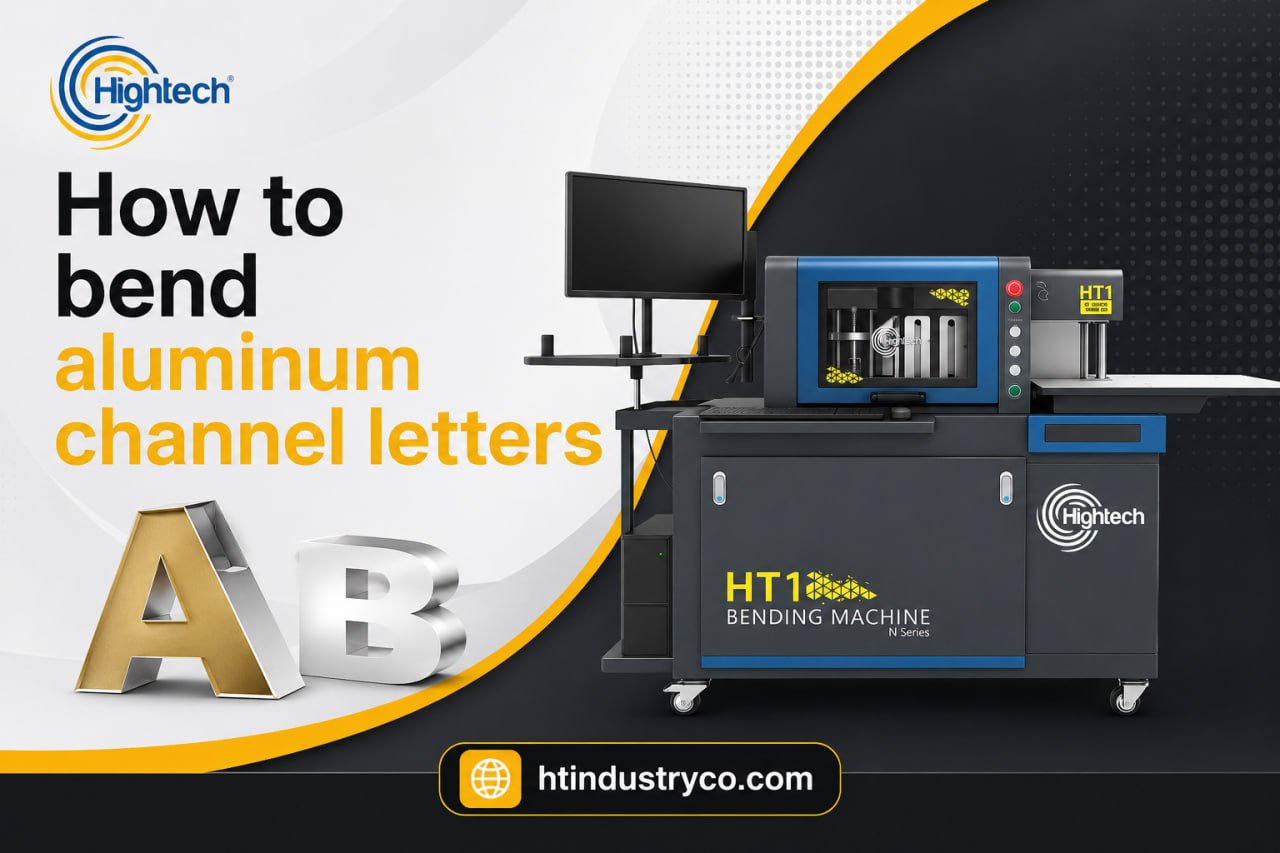
Table of Contents
How to Bend Aluminum Channel Letters: Complete CNC Automated Workflow for Sign Shops
Key Takeaways at a Glance
Three core stages drive every channel letter: automated notching, flanging, and CNC bending — each one a point where defects either get eliminated or multiplied.
CNC automation reads your DXF file directly, translating digital artwork into precise notch positions and bend angles with no manual measuring or marking.
Consistency is the real ROI: automated bending delivers identical results across hundreds of letters, eliminating the rework and scrap that erode margins.
.040″ 3003-H14 aluminum is the industry standard, and a capable CNC bender handles a range from roughly .032″ to .063″.
Speed compounds: what once took an experienced fabricator hours by hand can be completed in minutes, freeing skilled labor for higher-value work.
Why Modern Sign Shops Choose CNC Bending
For decades, channel letter fabrication was a craft measured in patience. A skilled technician would mark, notch, and hand-bend aluminum coil one corner at a time, relying on muscle memory and a good eye to keep every letter consistent. The results could be beautiful, but they were slow, hard to scale, and only as reliable as the person at the bench on any given day.
CNC channel letter bending changed that equation. By converting your digital artwork directly into machine instructions, an automated bender removes the guesswork from the most error-prone parts of the process. The shop owner is no longer betting production deadlines on whether a single fabricator is having a good day. This shift toward automation sits at the center of HT Industry’s philosophy — Hightech. Built to Lead. — where scientific design and output stability replace manual variability.
This guide walks through the complete automated workflow: notching, flanging, and bending. Along the way, we’ll cover material selection, what to look for in a machine, and the genuine return on investment that drives sign shops worldwide toward CNC equipment.
Step 1 — Automated Notching: The Key to Zero-Defect Corners
Common Notching Errors That CNC Eliminates
Manual notching introduces a familiar set of failures. Notches placed slightly off-position throw the corner angle out of true, leaving gaps that complicate later assembly and trim-cap attachment. Notches cut too deep weaken the corner and can crack under bending stress; cut too shallow, and the aluminum bunches at the fold instead of folding flat. Inconsistent notch geometry across multiple letters produces a sign where each character looks subtly different — the kind of flaw a client notices immediately on an installed storefront.
Automated notching removes these problems at the source. Because the cut positions are calculated from the same digital file every time, the hundredth letter is identical to the first. That repeatability is the foundation of the output stability that distinguishes professional-grade equipment.
Step 2 — Flanging: Building the Perfect Attachment Base
Once the body of the letter is shaped, the flange does the quiet but critical work of holding everything together. The flange is the small lip folded along the edge of the aluminum return — the surface where the letter face (or back) ultimately attaches. A clean, square, consistent flange means trim cap snaps on smoothly and the finished letter holds its shape; a sloppy flange means fighting with assembly on every piece.
In an automated workflow, flanging is integrated into the same continuous operation as notching and bending. The machine forms the flange to a uniform depth along the entire length of the coil, so there are no thin spots, no wandering edges, and no manual reforming required. This consistency directly translates into faster downstream assembly, because every letter presents the same predictable attachment surface.
read more: Tutorials of HT1-N series Channel letter bending machine
Flange Depth Standards
Flange dimensions follow established industry conventions, typically a narrow lip in the range of a quarter-inch, sized to accept standard trim cap. What matters most is not just hitting a target dimension but holding it consistently across the entire run and across every letter in a set. A CNC bender maintains that uniformity automatically, where a hand fabricator must constantly check and correct. The result is an attachment base that behaves identically on the first letter and the last — exactly the wide applicability that lets one machine serve block letters, logos, and detailed scripts alike.
Step 3 — CNC Bending: Sharp Angles & Smooth Radiuses
This is the stage where the letter takes its final form. The bending head folds the aluminum coil along the notch lines for sharp corners and curves it continuously for the smooth radiuses found in script lettering and rounded characters. The remarkable part of CNC bending is how it handles both in a single seamless pass.
Because the machine works directly from the letter outline, it transitions automatically between a tight corner and a flowing curve without operator intervention. A capital “R,” for instance, contains a sharp angle at the leg, a smooth bowl, and a curved tail — and the bender executes all three from one DXF file. The HT PRO Channel Letter Bending Machine controls the bend radius precisely, so the curves match the original artwork rather than approximating it. This is scientific design expressed in motion: the digital intent of the designer is reproduced faithfully in metal.
Choosing the Right Aluminum Gauge for Your Machine
The Automation Advantage — Speed, Consistency & Real ROI
The case for CNC bending rests on three pillars, and each one shows up directly on a shop’s balance sheet.
Speed is the most visible. Work that consumed an experienced fabricator’s full attention for hours can be completed in a fraction of the time, and the machine does not tire, take breaks, or slow down on the fiftieth letter. That throughput lets a shop accept larger orders and tighter deadlines without adding headcount.
Consistency is the most valuable, even if it is less obvious at first. Every dollar spent reworking a malformed letter or scrapping miscut coil is pure loss. Automation drives that waste toward zero by producing identical results across an entire run. Fewer rejects, less wasted channel letter material, and faster assembly all flow from the same source.
Labor leverage ties the two together. Because the machine handles the precision, a shop no longer depends on hiring or retaining a master fabricator to maintain quality. Skilled people can be redeployed to design, finishing, and installation — the higher-margin work that actually wins clients. Taken together, these factors are why automated bending typically pays back its investment quickly for any shop producing channel letters in volume.
What to Look for in a CNC Channel Letter Bending Machine
Not all benders are equal, and the differences matter over years of daily use. Look first for direct file compatibility — the machine should read standard design files like DXF without elaborate conversion. Evaluate the gauge and material range to be sure it covers the work you actually take on. Assess build quality and rigidity, because a frame that flexes under load will never hold tolerances over a long run. Prioritize genuinely simple operation, so the machine empowers your whole team rather than only your most experienced hand.
Finally, weigh the support behind the equipment as heavily as the equipment itself. A bending machine is a production asset, and downtime is expensive. HT Industry backs its machines — including the HT6 Channel Letter Bending Machine — with a service network of 38 agents serving more than 9,000 customers across 110 countries, supported by a team of over 1,300 engineers and technicians. That reach is what quality assurance looks like in practice: help that is reachable wherever your shop operates.
HT Industry offers a full range of models to match your production level:
- HT1 Channel Letter Bending Machine — ideal entry-level option for small shops
- HT3 Channel Letter Bending Machine — mid-range model for growing production
- HT6 Channel Letter Bending Machine — professional workhorse for high-volume shops
- HT PRO Channel Letter Bending Machine — advanced model with enhanced DXF compatibility
- HTZ5 Channel Letter Bending Machine — top-tier model for maximum throughput
Material Science — Why Gauge, Temper & Width Matter
Behind every clean bend is a set of material properties working in your favor — or against you. Gauge, as discussed, governs how readily the aluminum coil folds and how rigid the finished letter will be. But temper is equally important. The temper designation describes how the metal has been work-hardened, and it determines how the aluminum behaves at the moment of the bend. A temper that is too hard resists forming and risks cracking at sharp corners; too soft, and the metal may not hold its shape cleanly. The widely used 3003-H14 alloy and temper strikes a reliable balance for channel letter work, which is why it has become the default across the industry.
Coil width is the third variable, and it directly sets the depth of the letter return — the dimension that gives a channel letter its three-dimensional presence and houses the LED illumination inside. For installations requiring side lighting effects, a Sidelight Single Edge Aluminum Coil is the purpose-built choice. For standard returns, the Single Edge Aluminum Coil provides consistent geometry run after run. Choosing the right coil width up front means the finished letter has the depth the design calls for, with room for proper lighting. When gauge, temper, and width are matched correctly to the job, a quality CNC bender reproduces the design with confidence, run after run.
Before bending begins, precise face cutting is equally critical. HT Industry’s CNC Routers and Blade Cutters prepare letter faces to exact tolerances, ensuring they align perfectly with the automated bending parameters for a flawless finish.
For a finished letter assembly that requires adhesive bonding, review two-part AB adhesive basics and validate compatibility with the actual materials and finish.
Conclusion — Scale Your Production with Confidence
Find the Right Machine for Your Application
Frequently Asked Questions (FAQ)
What is the minimum bend radius for aluminum channel letters on a CNC machine?
Can a CNC bender handle both sharp corners and script fonts?
What is the standard return depth for channel letters?
What aluminum gauge should I use with an automated bender?
Latest contents



Prefer a callback? Share your details and requirements below.
Your details will only be used to respond to this request.