

Best Laser Marking Machines for Industrial Product Manufacturers
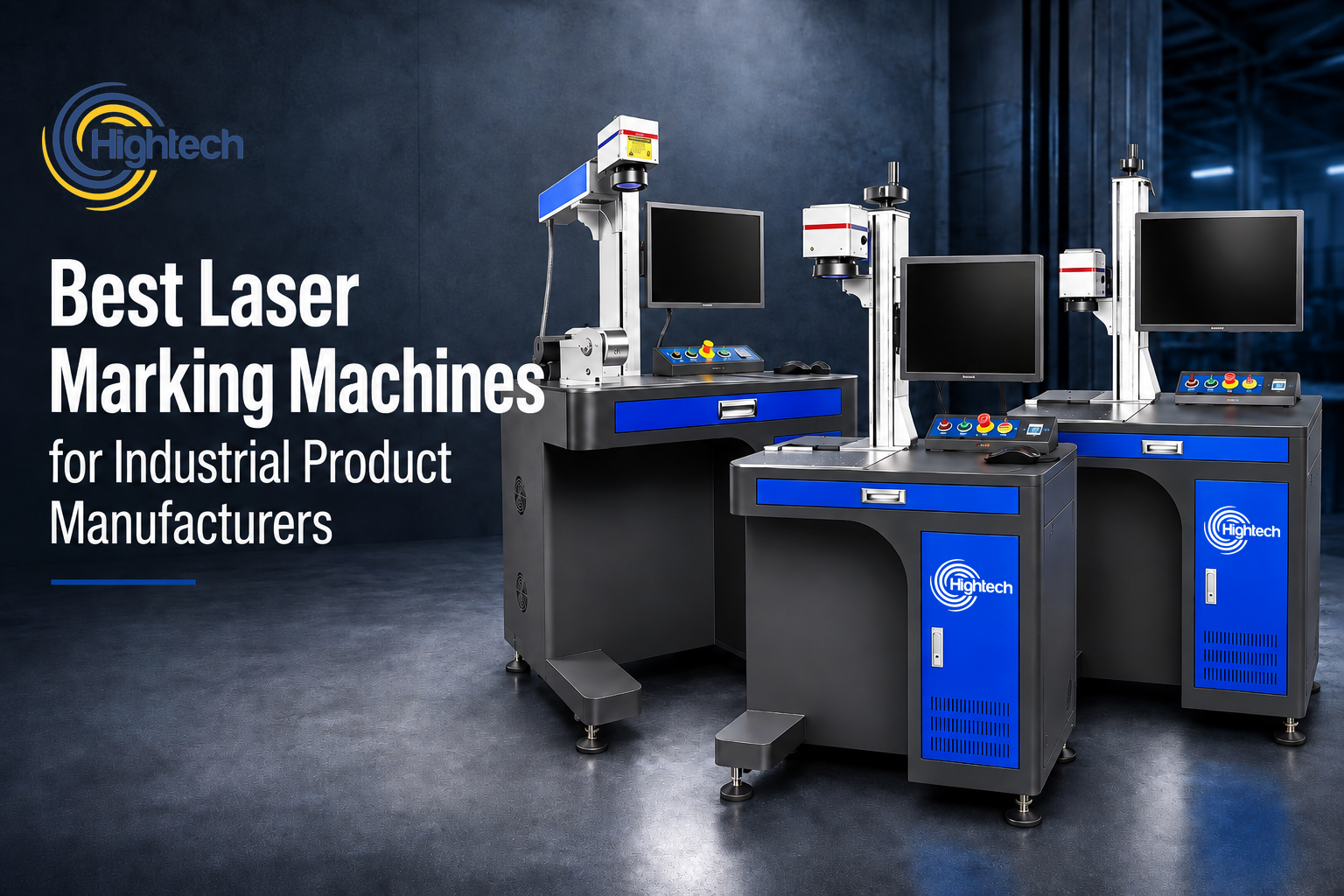
Table of Contents
For OEMs and industrial product manufacturers, the best laser marking machine is not simply the most powerful or the lowest-priced option. It is the system that creates a readable, permanent mark on your exact material at the required production speed, with the right software, fixture, safety setup, and supplier support. HT Industry offers four core laser marking machines for industrial buyers: fiber, MOPA fiber, UV, and CO2 laser marking machines. Each one fits a different combination of substrate, mark type, accuracy, and production workflow.
Quick Answer: Which Laser Marking Machine Is Best for Industrial Manufacturing?
There is no universal best laser marker for every factory. The right choice depends on material, mark durability, cycle time, code readability, and whether the machine will be used as a stand-alone workstation or integrated into a production process.
|
Industrial use case |
Best HT machine type |
Why it fits |
|---|---|---|
|
Metal OEM parts, nameplates, tools, serial numbers, QR codes |
Fiber laser marking machine |
Fast, permanent metal marking with low consumables; suitable for steels, aluminum, copper, brass, jewelry metals, ceramics, and selected plastics/rubber after testing. |
| Black marking on anodized aluminum, color marking on stainless steel, sensitive metal finishes | MOPA laser marking machine | Variable pulse control supports blackening, color effects, precision stripping, fine engraving, and delicate electronics or semiconductor applications. |
| Heat-sensitive plastics, electronics, glass, medical parts, fine detail | UV laser marking machine | 355 nm UV marking is suited to fine, high-reliability marks where reduced heat impact and small line width matter. |
| Organic and non-metal materials such as wood, leather, plastic, two-color board, packaging or signage materials | CO2 laser marking machine | CO2 laser marking provides high-speed marking on many non-metal and organic substrates; it is not the default choice for bare metal marking. |
Best Laser Marking Machine Types by Industrial Use Case
The right laser marking technology depends on your material, required mark, and production workflow. Compare the following options to identify the most suitable starting point for your application.
Best Starting Point for Metal OEM Parts: Fiber Laser Marking Machine
For most metal OEM parts, a fiber laser marking machine is the best starting point. Define whether the application needs a visible identifier, material removal for engraving, or a machine-readable code before selecting the configuration.
The Hightech workstation combines a galvanometer scanning head, an adjustable marking column, a locating platform, and a rotary-axis arrangement. Source and scanner configurations should be specified in the quotation rather than treated as interchangeable components.
Choose fiber when the primary materials are iron, steel, aluminum, copper, brass, gold or silver jewelry, ceramics, and test-qualified plastics or rubber. Always validate the final mark on the real substrate, because surface finish, coatings, oxide layers, and alloy composition affect contrast and depth.
For industrial spare parts marking, define the part number, revision, serial or batch information, and the surface available for identification. Check whether the mark will be applied before or after coating, machining, cleaning, or assembly. Approve samples after the relevant downstream processes; a clear mark on an unfinished sample does not establish service-life readability.
For automotive suppliers, choosing a laser marker for automotive components requires sample tests and a check of cycle time, serialization, and verification needs.
Best Technology to Evaluate for Controlled Surface Effects: MOPA Fiber Laser Marking
MOPA is a type of fiber laser technology that provides additional control over pulse characteristics. At the technology level, it is worth evaluating when the specification calls for color effects on stainless steel, dark marks on suitable anodized aluminum, or carefully controlled surface processing. The result depends on the source, available pulse settings, material, and process recipe.
The Hightech MOPA laser marking machine has a galvanometer scanner, double-red-dot focusing aid, a locating-hole work bed, and a 500 mm lifting column. A rotary axis is optional.
Before selecting it for a specialized finish, request the source model, adjustable pulse range, software configuration, and a demonstration on production parts. Define acceptable contrast, surface change, and repeatability. Do not assume that the MOPA name alone proves a particular black, color, coating-removal, or electronics-processing result.
It may not be necessary to specify MOPA for straightforward serial numbers where a standard fiber system already passes the production test. Compare the accepted result and complete cycle time before paying for additional process flexibility.
Best Candidate for Sensitive Materials and Fine Detail: UV Laser Marking Machine
A UV laser marking machine is worth evaluating when small features, surface sensitivity, or unwanted heat effects limit other processes.
The Hightech UV configuration uses a 355 nm wavelength, 3–10 W power, and a 100 × 100 mm marking range. Its specifications include a marking-line width of ≤0.01 mm, marking depth of ≤0.01 mm, minimum character size of 0.2 mm, and marking-line speed of 7,000 mm/s.
EZCAD software supports data extraction, automatic serial numbers, and production dates, with compatibility for formats from software such as AutoCAD, CorelDRAW, and Photoshop. Applications include flexible PCB marking, glass surface marking, plastic buttons, electronic components, and metal surface coatings.
Because plastics vary by resin, pigment, filler, flame retardant, and color, UV applications should always be sample tested. Specify the actual formulation and finish rather than asking whether the machine can mark “plastic.” For PA6, for example, provide the grade, color, additives, and any glass reinforcement, then compare mark quality on representative parts.
A fine line-width specification is not a guaranteed readable code size. Test the complete character or code at its intended dimensions, focus, location, and production speed.
Best for Organic and Non-Metal Materials: CO2 Laser Marking Machine
A CO2 laser marking machine is a suitable option for many organic and non-metal materials. The Hightech system is intended for compatible leather, wood, plastics, and two-color boards. It uses a CO2 laser, a scanning galvanometer, a beam-expanding focusing system, height adjustment, and multiple lens options.
Its technical parameters include a marking-line speed of ≤12,000 mm/s, a 0.09 mm marking-line width, 0.012 mm working accuracy, and 0.01–2 mm marking depth. Actual contrast, depth, and production rate depend on the material, artwork, focus, and settings.
Choose CO2 when the main materials are organic, polymeric, or non-metal. Do not choose CO2 as the default for bare metals unless the application uses appropriate coatings or additives. For metal OEM parts, fiber or MOPA will usually be the better starting point.
For moving products, treat conveyor synchronization, triggering, and data transfer as a separate integration requirement. A quoted marking-line speed does not establish the conveyor speed or finished products per minute.
Laser Marking Machine Comparison Matrix
|
Machine type |
Best materials |
Typical industrial uses |
Key advantages |
Limitations / validation notes |
Best buyer fit |
|---|---|---|---|---|---|
|
Fiber |
Iron, steel, aluminum, copper, brass, jewelry metals, ceramics, selected plastics/rubber after testing | Metal part IDs, serial numbers, QR/Data Matrix codes, nameplates, tools, components | Permanent marks, fast cycle time, low consumables, 30 W and 50 W options, EZCAD control, rotary axis option | Surface finish and coating affect contrast; plastics and rubber require testing | OEMs marking metal parts at recurring production volume |
|
MOPA |
Anodized aluminum, stainless steel, sensitive metal finishes, electronics and semiconductor materials after testing | Black marking, color marking, precision stripping, fine engraving, electronics marking | Pulse-duration and frequency control; strong for controlled surface effects and fine-detail applications | Higher process tuning requirement than standard fiber; color results depend on material and settings | Engineering teams needing controlled contrast, black marks, color effects, or delicate metal marking |
|
UV |
Heat-sensitive plastics, glass, electronics, circuit boards, medical components, packaging materials after testing | Fine codes, logos, production dates, serial numbers, delicate part marking | 355 nm wavelength, fine line width, reduced heat impact, automatic serial-number/date support | Smaller marking range and lower power than fiber; plastic formulations must be validated | Manufacturers of electronics, medical components, precision plastics, and high-detail parts |
|
CO2 |
Wood, leather, plastic, two-color boards, packaging, signage-related non-metals, other solid materials | Branding, labels, product IDs, watermarks, flight marking, packaging and organic-material marking | High marking speed, flexible formats, multiple lens options, ventilation-friendly design | Not the default for bare metals; fume extraction and substrate testing are important | Factories marking non-metal, organic, packaging, or signage materials |
Which Industrial Marking Machine to Choose for Your Factory?
Use the following procurement framework before requesting a quote. It will help HT Industry recommend a machine configuration and will also help your internal engineering, production, and purchasing teams compare options consistently.
Start with material compatibility. Identify the exact substrate, coating, surface finish, color, thickness, and any downstream treatment. Build the shortlist from the material and required effect, then qualify the selected laser on actual production parts. Mixed-material factories may need separate processes.
Define the mark type and durability requirement. Specify whether the mark is text, logo, serial number, production date, QR code, Data Matrix code, UDI, coating removal, annealing, ablation, color marking, or deep engraving. Also define what the mark must survive: abrasion, cleaning, heat, coating, sterilization, outdoor exposure, or handling.
Match power, pulse control, lens, and marking area to production needs. Higher power is not automatically better. Compare sample quality, required detail, engraving depth, and complete job time. State the selected source, lens, marking field, and working distance in the quotation.
Evaluate cycle time and fixture requirements. A machine that creates a perfect mark slowly may still fail in production. Confirm part loading, part orientation, batch fixtures, rotary marking, line-side conveyors, operator workflow, and whether the mark must be applied before or after assembly.
Confirm software, serialization, and barcode capabilities. Ask the supplier to demonstrate your actual data format, sequence rules, code generation, file import, and inspection process. Confirm how duplicate, missing, or incorrect serial numbers will be handled. Do not assume that installed marking software includes database connectivity or barcode verification.
Plan safety, fume extraction, and operator training. Review the enclosure, interlocks, extraction, operating procedures, maintenance access, and electrical requirements for the complete installation. Confirm the safety arrangements for the machine as supplied, including any rotary or automated handling configuration.
Validate supplier support, spare parts, warranty, and training. Procurement should compare more than purchase price. Ask about installation support, remote guidance, training videos, manuals, spare-parts availability, warranty terms, software support, and response process after the machine is commissioned.
For a broader selection framework, see how to choose the right marking machine.
Industrial Laser Barcode Marking: Readability and Accuracy
For QR codes, Data Matrix codes, and serial numbers, select a laser marker that delivers correct, readable information within the required production cycle.
Test the actual material, surface finish, code size, and longest expected data string. Confirm that the encoded information matches the production record and remains readable after relevant cleaning, coating, or wear.
A successful scan does not establish a formal quality grade. If your customer requires verification, agree the inspection method and acceptance criteria before testing. Include loading, marking, inspection, and unloading in the cycle-time assessment.
Find the Right Machine for Your Application
Frequently Asked Questions
What is the best laser marking machine for OEM production?
For most metal OEM parts, a fiber laser marking machine is the best starting point because it creates permanent, high-contrast marks with low consumable cost. If the application requires black marking on anodized aluminum, color marking on stainless steel, or finer pulse control, MOPA is often the better choice. For heat-sensitive plastics, electronics, glass, and medical components, evaluate UV laser marking. For wood, leather, plastic, two-color boards, and organic or packaging materials, evaluate CO2 laser marking.
Is fiber, MOPA, UV, or CO2 laser marking best?
It depends on the substrate and required mark. Fiber is the baseline choice for many metal parts. MOPA is a specialized fiber option for pulse-controlled black/color marking and sensitive metal finishes. UV is preferred for fine detail and heat-sensitive materials. CO2 is preferred for many non-metal and organic materials.
Which laser marking machine is best for QR codes, Data Matrix codes, and serial numbers?
Fiber, MOPA, and UV machines can all be used for high-resolution machine-readable codes when matched to the material. The best option depends on code size, contrast, scan grade, cycle time, and durability after downstream processes. Buyers should validate code readability after cleaning, coating, heating, abrasion, or sterilization where relevant.
Can an industrial laser marking machine connect to a PLC?
Some industrial systems support PLC integration, but the interface and functions depend on the controller and configuration. Request the connection documentation and demonstrate job selection, start, ready/busy, completion, faults, and variable-data transfer before purchase. Confirm the integration scope for the selected Hightech machine in writing.
How should I choose a laser marker for PA6 or another engineering plastic?
Provide the exact grade, color, additives, reinforcement, finish, and required marking effect. Compare sample results for contrast, detail, surface change, and durability. UV can be a candidate, but the material name alone is insufficient to select the source or guarantee the result.
Are laser marking machines maintenance-free?
No complete production system should be selected on that assumption. Ask for the maintenance schedule, optical-cleaning requirements, extraction-filter replacement, cooling requirements, and spare-part lead times. Also account for fixture wear, inspection equipment, and software support when comparing downtime and running cost.
Latest contents


Prefer a callback? Share your details and requirements below.
Your details will only be used to respond to this request.