


how to choose the right marking machine
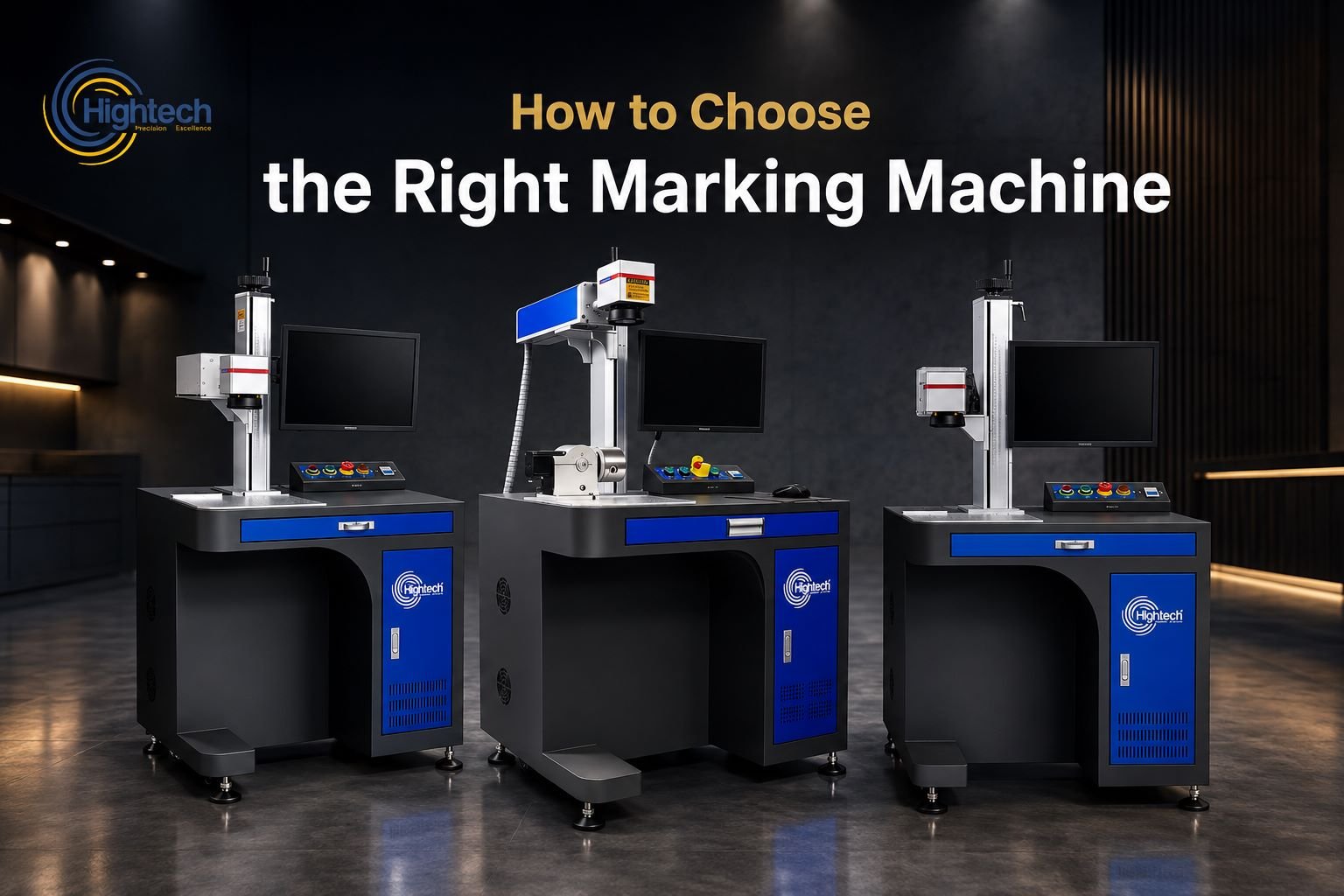
Table of Contents
Choose an industrial marking machine by matching four things: the exact material and surface, the required mark result, the complete production cycle, and the integration environment. For many steel, stainless-steel, aluminum, brass, and copper applications, start by evaluating a Hightech fiber laser. Compare MOPA when wider pulse control, suitable anodized-aluminum black marking, color effects, or precise coating removal matter. Evaluate UV for fine, low-heat marks on sensitive plastics and electronic components, and CO2 for compatible organic and nonmetal materials. Confirm the choice with actual-part sample tests, measured cycle time, and readability or durability checks.
How to Select a Marking Machine Start With the Application
Before comparing models, prices, or power levels, write a complete application specification. It should describe the actual part, required mark, production workflow, factory environment, and acceptance criteria. This gives the supplier enough information to recommend a technology and test realistic samples.
Identify the Material, Coating, and Surface Condition
Start with the exact base material—not just “metal” or “plastic.” Record the alloy or polymer grade, additives, color, thickness, and heat sensitivity. Also note anodizing, paint, plating, oxide layers, protective film, surface roughness, polish, reflectivity, and contamination.
These variables change how laser energy is absorbed and therefore affect contrast, depth, edge quality, and heat impact. Plastics with similar names can react very differently because of pigments and additives. Coated parts may require controlled layer removal rather than interaction with the base material. For this reason, sample testing on production material is essential, especially for plastics, anodized aluminum, and painted or coated components.
Define the Mark Content, Size, Contrast, Depth, and Permanence
Specify whether the machine must produce fixed text, serial numbers, dates, batch codes, logos, 1D barcodes, QR codes, or Data Matrix codes. Provide the overall marking field, minimum character height or code-cell size, and the viewing or scanning distance.
Then define the visual and functional result. Do you need a dark surface mark, a light mark, color, coating removal, shallow engraving, or deeper material removal? State the required resistance to abrasion, cleaning chemicals, heat, sunlight, corrosion, and the expected service life. A cosmetic logo and a traceability code exposed to harsh service conditions require different acceptance standards.
Check Part Geometry, Mark Location, and Accessibility
Flat, consistently positioned parts are usually simpler than curved, tapered, oversized, heavy, or irregular workpieces. Record the mark location, available clearance, height variation, and whether the part can be moved safely under a stationary marking head.
Cylindrical parts such as rings, tubes, bottles, and tool handles may need a rotary axis so the surface remains in focus while the part turns. Large or heavy components may require a movable head, custom fixture, or additional Z-axis travel. Also confirm that marking will not weaken a thin wall, damage a sealing face, alter an electrical contact, or affect another functional surface.
How to Choose a Marking Technology
Industrial marking methods include laser, dot peen, scribe, impact, and inkjet. Contact methods can create deep, highly durable marks but may generate noise, apply mechanical stress, and require tooling. Inkjet is fast and suitable for many production lines, but it uses consumables and the mark may not offer the permanence of direct-part marking. Laser marking is noncontact, supports fine graphics and variable data, and avoids routine marking-tool replacement, although it requires appropriate guarding and fume control.
Within Hightech’s laser marking machines range, the practical choice is among fiber, MOPA, UV, and CO2 sources. Buyers who need more background can also review the types of laser marking machines before shortlisting a product.
|
Technology |
Best starting fit |
HT Industry product facts |
|---|---|---|
|
Fiber |
General metal identification | 30/50 W; air cooling; EZCAD; up to 7,000 mm/s published speed |
|
MOPA |
Controlled metal surface effects | 1064 nm; 2–500 ns pulses; 1–4,000 kHz frequency range |
|
UV |
Fine, heat-sensitive applications | 355 nm; 3–10 W; 100 × 100 mm field; ≤0.01 mm line width |
|
CO2 |
Many plastics and organic materials | Air cooling; adjustable positioning; up to 12,000 mm/s published speed |
The right laser marking machine depends mainly on the material, required mark quality, and production process. fiber laser marking machine are a practical choice for durable identification and engraving on metals such as steel, stainless steel, aluminum, brass, and copper. MOPA laser marking machine offer greater control over pulse duration and frequency, making them suitable for specialized applications such as black marking on anodized aluminum, color effects on stainless steel, and precise coating removal.
For heat-sensitive plastics, coated surfaces, electronics, and small components, UV laser marking machine can provide fine details with limited thermal impact.CO2 laser marking machine are generally better suited to nonmetal materials, including selected plastics, acrylic, wood, paper, leather, and packaging products.
Published power, marking area, and speed specifications are useful for comparison, but they do not determine actual performance on their own. Material composition, surface condition, mark depth, contrast, field size, loading method, and verification requirements all affect the final result. For this reason, buyers should test their actual parts and confirm mark quality, readability, durability, and cycle time before selecting a machine.
Marking Machine Selection Criteria: Compare Performance and Production Fit
Once the likely technology is known, convert the application into measurable selection criteria. Comparing machines on price or wattage alone can hide major differences in optics, working area, integration, usability, safety, and support.
Marking Speed, Cycle Time, Production Volume, and Duty Cycle
Advertised marking speed describes beam movement under defined conditions; it is not the same as finished-parts per hour. Time the entire sequence: load the part, locate it, focus, retrieve or generate data, mark, verify, unload, and change fixtures or recipes.
A high-mix workshop may value fast changeovers and flexible fixtures more than maximum throughput. Batch production may suit an operator-loaded benchtop or enclosed station. Continuous lines may require conveyors, sensors, PLC handshakes, automatic code generation, and an industrial duty cycle. Leave capacity for realistic peaks and future growth.
Resolution, Accuracy, Repeatability, and Code Readability
Fine text and machine-readable codes depend on spot size, beam quality, lens selection, field size, focus, surface condition, contrast, and process stability. A larger field can be useful, but it may reduce the achievable detail compared with a smaller, optimized field.
Define an acceptance standard before buying. For codes, specify minimum grade or scan performance and test marked samples with the scanner or vision system used in production. For visual marks, approve contrast, dimensions, edge quality, and position tolerance using representative parts—not only a supplier photograph.
Marking Area, Lens, Focus, and Part Positioning
Choose a marking field that fits the job with sensible margin, but avoid oversizing it without considering detail. Confirm focal distance, available working height, Z-axis adjustment, autofocus needs, and whether part-height variation will move the surface outside the usable focus range.
Fixtures should locate parts repeatably and prevent incorrect orientation. Rotary devices are important for circumferential marks, while positioning lights or camera systems can help with variable geometry. Ask whether the selected lens, rotary axis, fixture, and working area are included in the quotation or priced as options.
Manual, Benchtop, Enclosed, or Production-Line Integration
A manual or benchtop machine can be economical and flexible for low-volume work, but the operator must position parts consistently and follow laser-safety procedures. An enclosed workstation adds guarding, interlocks, and more controlled fume capture. Inline systems can add conveyors, robots, part-present sensing, automatic triggering, and verification.
Consider footprint, loading ergonomics, access for maintenance, and future automation. A machine that fits today’s manual process should not become a dead end if volume increases.
Software, Variable Data, and Factory-System Connectivity
Confirm that the software can import the required artwork and create serial numbers, dates, batch codes, barcodes, and QR codes. Hightech lists EZCAD for its fiber and MOPA systems, while the UV product page describes compatibility with common design workflows and automatic serial-number and production-date functions.
For connected production, verify database import, barcode-scanner input, user permissions, recipe control, audit trails, PLC interfaces, and possible MES or ERP communication. Ask for the exact supported protocols and a demonstration using your data flow; “integration-ready” can mean different things across suppliers.
Safety, Fume Extraction, Cooling, Power, and Facility Requirements
Laser systems require wavelength-appropriate protection, guarding, interlocks, emergency stops, controlled access, and documented operating procedures. Fume extraction must match the material because marking can release smoke, particulates, coating residues, or irritating vapors.
Check cooling method, electrical supply, grounding, ambient temperature, humidity, dust exposure, compressed-air needs, and clearances for loading and service. Hightech’s listed fiber and CO2 models use air cooling, but the final facility plan should follow the exact quoted configuration and local safety requirements.
Maintenance, Training, Technical Support, Spare Parts, and Warranty
Compare support as carefully as hardware. Ask about lens and filter care, extraction-filter replacement, preventive maintenance, software updates, remote diagnostics, operator training, manuals, response times, and spare-parts availability.
Hightech states that its machines include a one-year warranty and lifetime after-sale technical support, with remote setup, training, troubleshooting, software, and maintenance guidance. Buyers should still request the final terms in writing, including exclusions, shipping responsibility, onsite availability, regional coverage, and the procedure for diagnosing and replacing a failed component.
Which Marking Machine Is Right for My Application?
Use the application—not a universal ranking—to build the shortlist. The following starting points reflect Hightech’s four verified technologies, but a sample-marking test should confirm the final choice.
Metal Parts, Tools, Nameplates, Electronics, and Fabricated Components
Start with standard fiber for efficient, repeatable identification on steel, aluminum, brass, copper, and many alloys. Evaluate MOPA when the job needs anodized-aluminum blackening, stainless-steel color effects, precision layer removal, or greater control over a sensitive surface. UV may be relevant for exceptionally fine marks or heat-sensitive coated electronic parts.
Plastics, Acrylic, Coated Products, and Heat-Sensitive Components
Compare UV and CO2 first. UV is a strong candidate for fine detail and limited heat impact; CO2 is a practical option for many plastics, acrylic, wood, paper, leather, and packaging materials. Test for contrast, discoloration, melting, foaming, edge quality, odor, residue, and resistance to cleaning or handling.
Cylindrical, Curved, Large, or Irregular Workpieces
For rings, tubes, bottles, tools, and other round parts, confirm rotary-axis compatibility and usable diameter range. Curved or uneven parts may need focus compensation, additional Z-axis travel, or segmented marking. Heavy parts may be easier to process with a movable head or purpose-built fixture rather than repeatedly lifting the workpiece.
High-Mix Workshops Versus High-Volume Production Lines
High-mix shops benefit from flexible recipes, quick-change fixtures, straightforward operator control, and enough working range for different parts. High-volume lines need error-proofing, automatic data transfer, sensors, cycle control, verification, and reliable integration. In both cases, calculate capacity from the full production cycle and preserve margin for new products or larger order volumes.
Frequently Asked Questions
Does higher laser wattage always produce a better mark?
No. Power can improve process capability or throughput, but it does not replace the correct wavelength, pulse characteristics, optics, focus, and settings. Excessive energy can damage heat-sensitive materials, enlarge features, or reduce fine detail. Select wattage only after defining the material, mark result, and cycle-time target.
What information should be provided to get an accurate machine recommendation and quote?
Provide actual material samples where possible, plus part drawings and photos, mark artwork, field size, code requirements, desired contrast and depth, daily volume, target cycle time, utilities, safety expectations, integration details, shipping destination, and required training or service. Include the scanner or verification standard for machine-readable codes.
How should warranty and technical support be compared?
Compare the coverage period, excluded components, support channels and hours, remote and onsite availability, training, software support, spare-parts lead times, shipping responsibility, and the process for diagnosis and replacement. Obtain these commitments in writing and confirm whether regional service depends on location or scheduling.
Which industrial marking machine should I choose
Choose by exact material, required mark, complete production cycle, and integration. Shortlist Hightech Fiber, MOPA, UV, or CO2 systems and validate real samples.
how to choose the right laser marking system for steel
Choose a Hightech Fiber laser. It is the most suitable starting option for permanent identification, serial numbers, Data Matrix codes, logos, and engraving on most steel parts.
how to choose the right laser marking system in electronics
Choose a Hightech UV laser for fine marking on heat-sensitive plastics, circuit boards, and small electronic components. For metal housings and connectors, choose Fiber or MOPA.
Which marking machine should I choose for aluminum?
Choose a Hightech Fiber laser for standard serial numbers, logos, and identification marks on aluminum. Choose MOPA for black marking or coating removal on suitable anodized aluminum.
Which industrial marking technology is best for a high-mix production line?
Choose a configurable Hightech laser system with saved marking recipes, quick-change fixtures, variable-data support, and easy product changeovers. Select the laser source according to the materials processed on the line.
Latest contents


Prefer a callback? Share your details and requirements below.
Your details will only be used to respond to this request.