

What Are the Different Types of Laser Marking Machines?
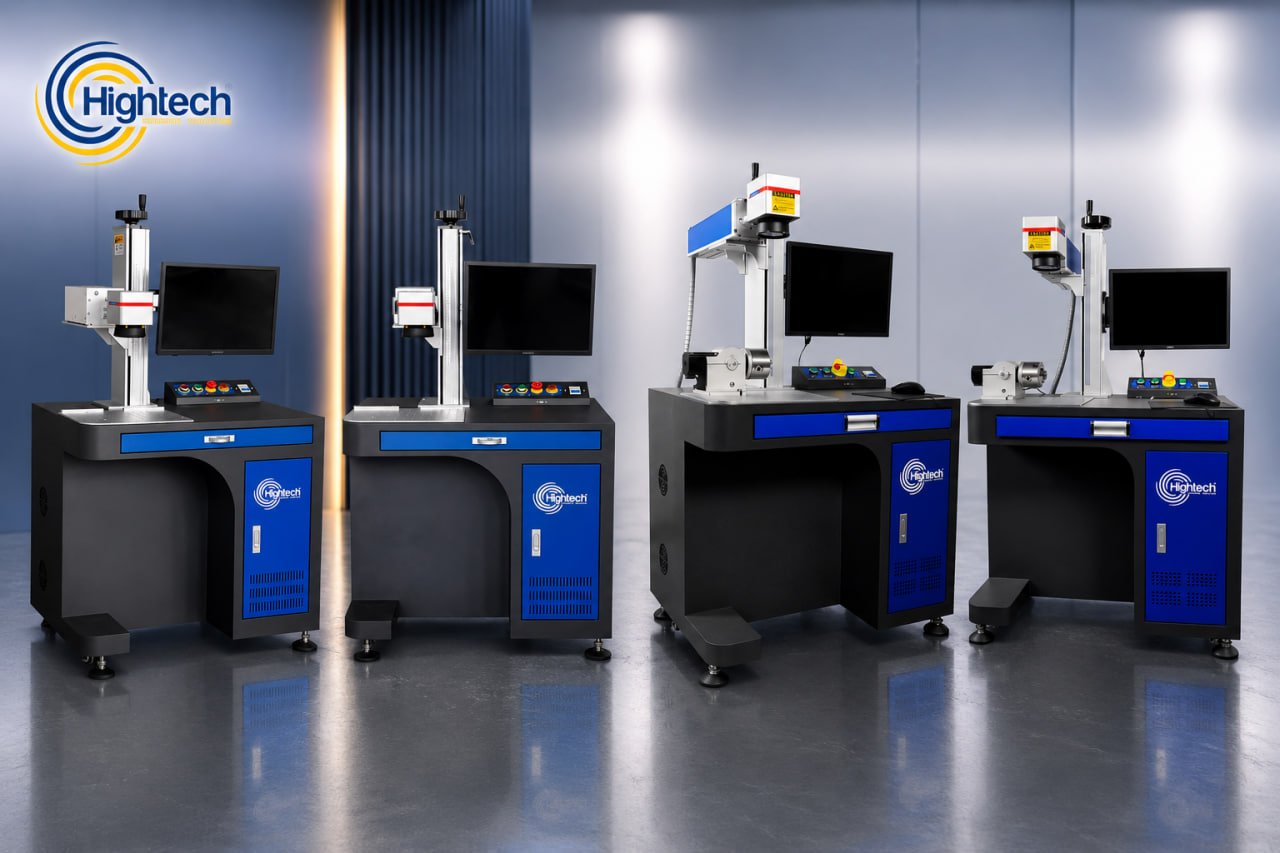
Table of Contents
Laser marking machines create permanent text, logos, serial numbers, barcodes, and traceability codes without inks, labels, or direct tool contact. However, laser markers use different technologies. The best machine depends on wavelength, target material, required contrast or depth, and the heat a part can tolerate.
HTIndustryCo’s current marking-machine range is built around four practical choices: standard fiber, MOPA fiber, CO2, and UV. Fiber and MOPA systems are primarily selected for metals and certain plastics; CO2 systems are strongest on organic and non-metal materials; and UV systems are designed for fine, low-heat marking on sensitive products.
Main Types of Laser Marking Machines at a Glance
Quick comparison by wavelength, materials, strengths, limitations, and typical applications
The table below summarizes the principal laser marking machine types represented in HTIndustryCo’s product range, followed by two additional technologies buyers may encounter in the wider market. Exact results always depend on material grade, coating, color, surface finish, lens, power, pulse settings, and the required cycle time, so sample testing should be part of the purchasing process.
Type / wavelength | Best materials | Key strengths | Main limitations | Typical applications |
|---|---|---|---|---|
Fiber | Steel, stainless steel, aluminum, brass, copper, precious metals; selected plastics | Fast, durable metal marking; low routine maintenance; suitable for engraving and rotary work | Not ideal for wood, leather, clear glass, or many transparent materials | Part IDs, QR codes, tools, jewelry, nameplates, electronic housings |
MOPA fiber | Metals, anodized aluminum, coated components, sensitive plastics | Adjustable pulse duration and frequency; black marking on anodized aluminum; color effects on suitable stainless steel | Higher purchase cost and more process development than standard fiber | Decorative metal work, electronics, fine coating removal, premium branding |
CO2 | Wood, leather, paper, cardboard, rubber, acrylic, many plastics and coated products | Very fast on organic materials; broad non-metal compatibility | Poor absorption on bare metal without a coating or marking compound | Packaging, signage, gifts, leather goods, wood products, two-color board |
UV | Heat-sensitive plastics, glass, ceramics, coated parts, electronic components, some metals | Small spot size, high contrast, minimal heat impact, fine detail | Usually higher cost and lower power than common fiber systems | Microtext, medical/electronic parts, cosmetic packaging, cables, delicate plastics |
Fiber Laser Marking Machines
Fiber laser marking machines are the standard choice for high-speed, permanent marking on metal. Their near-infrared wavelength is absorbed effectively by many metals, allowing the beam to anneal, discolor, ablate, or engrave the surface depending on the settings. Common applications include serial numbers on automotive parts, QR codes on tools, logos on stainless-steel products, identification plates, electrical components, and personalized jewelry.
HTIndustryCo lists its Fiber Laser Marking Machine in 30 W and 50 W configurations, with multiple marking-field options, air cooling, EZCAD control software, and a rotary-axis accessory for cylindrical parts. The published specification lists marking speeds up to 7,000 mm/s and a Raycus source rated for a long operating life. These features make the machine suitable for workshops that need repeatable metal marking without inks or frequent consumable replacement.
A conventional fiber marker is often the best-value option for steel, stainless steel, aluminum, brass, copper, or precious metals. Higher power may improve engraving depth or cycle time, but lens size, focus, hatch spacing, speed, frequency, alloy, and surface finish also affect contrast. Request tests on actual parts for the smallest code, required depth, and acceptable cycle time.
MOPA Fiber Laser Marking Machines
A MOPA laser marking machine is a specialized type of fiber laser. MOPA stands for master oscillator power amplifier. Its key advantage is wider control over pulse duration and repetition frequency, which gives the operator more ways to manage peak energy and heat input. That flexibility matters when a standard fiber laser produces too much melting, inconsistent contrast, or an undesirable surface texture.
HTIndustryCo’s MOPA Laser Marking Machine uses a 1064 nm source with a published pulse-duration range of 2–500 ns and repetition frequencies from 1–4,000 kHz. The machine is promoted for color marking on suitable stainless steel, high-contrast blackening of anodized aluminum, precision stripping of thin anodic layers, deep metal engraving, ITO-coating processing, and delicate electronics work. Its listed line speed is up to 7,000 mm/s, with EZCAD software for process control.
MOPA is attractive for premium branding, electronics, and jobs where appearance matters as much as permanence. It can create dark marks on anodized aluminum and interference colors on suitable stainless steel. Because results vary with alloy, polish, cleanliness, focus, and settings, approve samples before production. MOPA generally costs more than standard fiber but offers a wider process window for sensitive or appearance-critical work.
CO2 Laser Marking Machines
CO2 laser marking machines use a much longer infrared wavelength than fiber systems and are best known for organic and non-metal materials. Wood, leather, paper, cardboard, rubber, acrylic, coated surfaces, and many plastics absorb CO2 energy well. The result may be a darkened surface, a light frosted mark, a melted or foamed texture, or controlled material removal, depending on the substrate.
HTIndustryCo’s CO2 Laser Marking Machine combines a CO2 source with a galvanometer scanning head for fast marking. The product page lists air cooling, marking speeds up to 12,000 mm/s, a minimum character size of 0.15 mm, adjustable positioning, multiple lens options, and compatibility with leather, wood, plastic, two-color board, and other solid materials. This makes it a practical option for packaging codes, wooden products, leather goods, promotional items, signage components, and high-volume non-metal identification.
CO2 is generally not the first choice for bare metal because most uncoated metals absorb the wavelength poorly. Painted, anodized, coated, or compound-treated metal can sometimes be marked, but fiber or MOPA is usually more direct. Effective ventilation is essential for smoke, odors, and material-specific fumes.
UV Laser Marking Machines
UV laser marking machines operate at 355 nm, a short wavelength that is absorbed by a wide range of materials. The smaller focused spot and high photon energy allow very fine features and can reduce the amount of heat transferred into the surrounding area. For this reason, UV marking is often described as “cold” processing, although every application still needs testing for heat, discoloration, cracking, and surface change.
HTIndustryCo’s UV Laser Marking Machine is offered in 3–10 W configurations with a 100 × 100 mm marking range, line widths listed at 0.01 mm or less, repetition frequencies of 8–120 kHz, and marking speeds up to 7,000 mm/s. The product supports common design and production workflows and is positioned for fine, reliable marking with a sealed cabinet and adjustable lifting column.
UV is a strong choice for delicate plastics, coated electronics, glass, ceramics, medical components, cosmetic packaging, thin films, cables, and small parts where fiber could cause melting or charring. It can mark some metals but is rarely chosen for deep engraving. Its value is highest when micro-detail, low thermal impact, and reject reduction matter more than material-removal speed.
How Do the Different Laser Marking Machine Types Compare?
Comparison by material compatibility and wavelength
Material compatibility begins with wavelength. Fiber and MOPA machines work in the near-infrared range and are the main types of laser marking machines for metal. Standard fiber is usually the most economical route for general metal identification and engraving, while MOPA adds pulse flexibility for black anodized-aluminum marks, controlled coating removal, color effects, and sensitive surfaces. UV’s 355 nm wavelength is absorbed more broadly and can produce finer, lower-heat marks on many plastics, glass, coatings, and electronic materials. CO2’s long wavelength is preferred for wood, leather, paper, rubber, acrylic, and other organic or non-metal products.
No compatibility chart is universal. Plastics vary by resin, pigment, filler, and coating, and similar-looking parts can react differently. Define the exact grade, desired contrast, allowable depth, code size, cycle time, and durability, then test real production samples.
Comparison by marking speed, precision, heat impact, maintenance, and cost
HTIndustryCo publishes line speeds up to 7,000 mm/s for its fiber, MOPA, and UV models and up to 12,000 mm/s for CO2. These are scanner specifications, not guaranteed part throughput; actual cycles also include fill density, passes, loading, focusing, extraction, inspection, and rotary motion.
Standard fiber generally offers the most favorable balance of purchase price, throughput, and maintenance for metal. MOPA costs more but gives greater pulse control. UV tends to have the smallest heat-affected area and best fine-detail capability, but its source and optics make it a premium solution. CO2 is highly productive on suitable non-metals and needs effective fume extraction. All four are non-contact technologies with little mechanical tool wear, yet optics must be kept clean and the work area must be protected from dust, smoke, and unstable power.
Frequently Asked Questions
What are the main types of laser marking machines?
The main types are fiber, MOPA fiber, CO2, and UV. Fiber and MOPA are strongest for metals, CO2 for organic and non-metal materials, and UV for fine, low-heat marking. Green, YAG, hybrid, and ultrashort-pulse systems are specialized alternatives.
What is the difference between fiber, CO2, and UV laser marking machines?
The principal difference is wavelength. Fiber operates near 1064 nm and is effective on metals. CO2 typically operates near 10.6 µm and suits wood, paper, leather, acrylic, rubber, and many plastics. UV operates at 355 nm for fine, low-heat marks on sensitive plastics, glass, coatings, and electronics.
Can a CO2 laser marking machine mark metal?
CO2 can mark some painted, anodized, coated, or compound-treated metals, but it is inefficient on bare metal. For direct marking on bare steel, stainless steel, aluminum, brass, or copper, fiber or MOPA is usually better.
What is the difference between laser marking, engraving, and etching?
Engraving removes material to create measurable depth. Etching modifies a shallow surface layer and is sometimes used commercially for light engraving. Because the terms overlap, specify the required depth, appearance, and durability.
Latest contents


Prefer a callback? Share your details and requirements below.
Your details will only be used to respond to this request.