


How to Start a Sign Business: A Complete Step-by-Step Guide
Table of Contents
Starting a sign business can be a practical way to enter the advertising, graphics, and light manufacturing industries. Businesses of nearly every size need signs to identify their locations, promote services, display safety information, guide visitors, or strengthen their branding. This creates opportunities for sign shops serving local retailers, offices, restaurants, contractors, event organizers, property managers, and industrial companies.
However, learning how to start a sign business involves more than purchasing a printer or cutting machine. People researching how to start a sign company must also choose a workable business model, select a focused product range, validate local demand, calculate startup and operating costs, choose equipment that matches their applications, create a reliable production workflow, and build a consistent customer-acquisition process.
This guide explains how to open a sign shop without investing prematurely in machinery and how to build an operation that can expand as demand becomes more predictable.
Why Start a Sign Business?
Signs are essential physical marketing and communication tools. Even as digital advertising grows, businesses still need storefront signs, dimensional letters, wayfinding systems, vehicle graphics, safety signs, and branded interior displays.
A sign business can begin as a relatively focused operation and expand over time. For example, an entrepreneur may initially sell vinyl lettering and simple indoor signs before adding CNC routing, laser cutting, engraving, printing, or channel letter production.
Market Demand
The potential customer base extends across numerous industries. Retail stores need window graphics and storefront signage, construction companies require job-site and safety signs, offices use directional displays, and restaurants need menu boards and branded interior features. Schools, hospitals, warehouses, real estate agencies, event organizers, and property managers also purchase signs regularly.
Businesses also replace signs because of rebranding, relocation, damage, regulatory changes, or seasonal promotions. This mix of new projects and replacement demand can support both one-time orders and repeat commercial relationships.
Demand varies by location, so entrepreneurs should validate their local market before making large equipment purchases. A growing commercial area may create opportunities for exterior signage, while a city with many events and small retailers may generate stronger demand for banners, displays, and temporary promotional products.
Business Opportunities
A sign company can earn revenue from design, fabrication, installation, maintenance, and replacement—not only from selling the finished sign. Offering several related services can increase the value of each project and create additional reasons for customers to return.
Potential opportunities include:
- Storefront and building signs
- Acrylic office signs
- Channel letters
- Directional and wayfinding signs
- Safety and compliance signage
- Engraved identification plates
- Vehicle lettering and graphics
- Event displays and banners
- Dimensional logos and wall lettering
- Sign installation and maintenance
The best opportunity is not necessarily the product with the highest selling price. Consider local demand, production time, material costs, competition, installation requirements, and your ability to deliver consistent quality.
Repeatable work can be particularly valuable. Tenant-panel updates for property managers, identification signs for manufacturers, sign packages for contractors, and branded displays for multi-location businesses may require less selling and setup time after specifications have been standardized. Before purchasing equipment for a perceived opportunity, test demand through customer interviews, outsourced orders, sample projects, or partnerships.
Who Should Start a Sign Business?
Starting a sign business may suit graphic designers, print shop owners, CNC operators, woodworkers, marketers, installers, and entrepreneurs interested in customized manufacturing. Existing businesses can also add signs as a complementary service. For example, a print shop may introduce dimensional lettering, or a woodworking company may use its CNC capabilities to produce routed signs.
Technical experience is helpful but not always required at the beginning. Design, fabrication, electrical work, permitting, and installation can be learned, hired, or outsourced. What matters is understanding which processes you can perform safely and profitably.
A successful owner should be comfortable managing both creative and operational responsibilities. Sign projects frequently require customer consultation, accurate measurements, material selection, proof approval, production scheduling, quality control, and installation coordination. Strong communication is therefore as important as fabrication ability.
Choose the Right Business Model and Sign Niche
Before purchasing equipment, decide what you will sell, who will buy it, and how you will fulfill orders. A focused niche makes it easier to estimate costs, select machines, build expertise, and market the business.
Home-Based, Online, or Retail Sign Shop
A home-based business has lower overhead and may be appropriate for vinyl decals, engraved products, small acrylic signs, and online custom orders. Before operating from home, check zoning rules, lease or homeowners-association restrictions, electrical capacity, ventilation, noise, material storage, and whether customers or delivery vehicles may visit the property. The dedicated guide to starting a sign business from home covers these limitations in greater detail.
An online sign business can reach customers outside the local market when products are standardized, easy to customize, and economical to ship. It must compete on product quality, turnaround time, packaging, customer experience, and digital visibility.
A commercial sign shop provides more production and assembly space and can accommodate larger machines, sheet storage, customer meetings, and installation equipment. It also increases rent, utilities, insurance, and staffing costs. Many owners begin with a smaller operation and move only after confirming steady demand.
How to Choose a Profitable Sign Niche
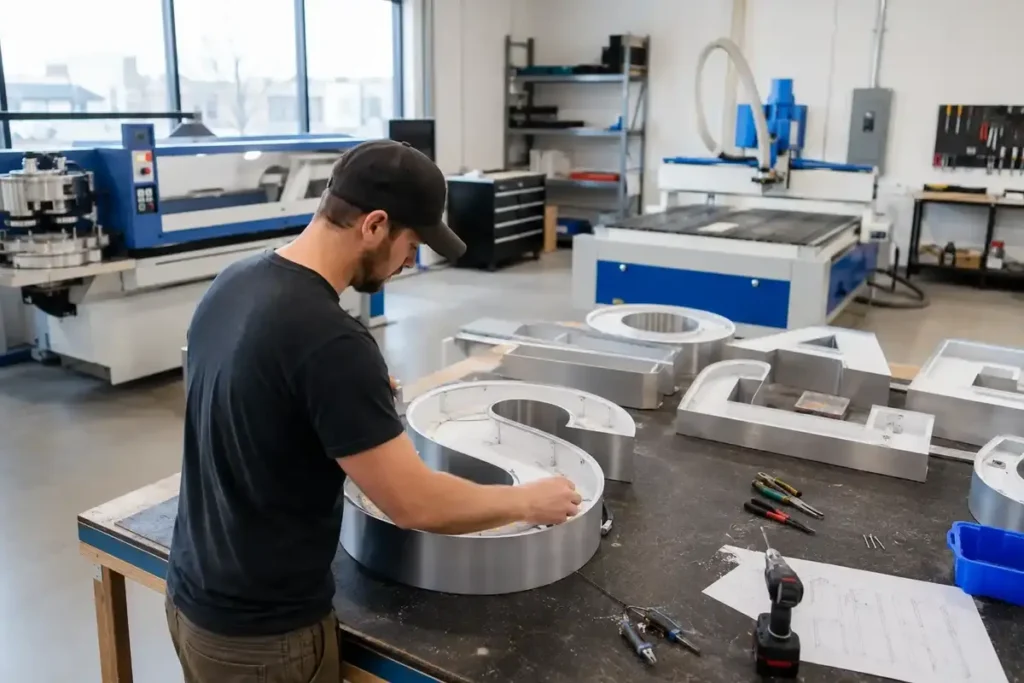
Evaluate potential niches according to local demand, average order value, repeat-order potential, production complexity, material availability, installation requirements, competition, and the capabilities the company can realistically provide. The highest-priced category is not always the strongest opportunity; a lower-value product with repeat demand and a controlled workflow may generate more dependable results.
Acrylic reception signs and engraved identification products may suit a smaller operation because they can be offered in different sizes and are generally easier to package and deliver than large exterior signs. Channel letters may support higher-value commercial projects, but they also require more advanced fabrication, lighting components, project coordination, installation planning, and compliance with applicable requirements.
When starting a sign making business, compare each niche with the available capital, technical skills, workspace, customer-access strategy, and expected order frequency. Select a category that can be marketed clearly and produced consistently instead of trying to serve every possible signage need from the beginning.
Start Focused Before Expanding
A narrow initial product mix makes quoting, purchasing, training, and quality control more manageable. It also produces a clearer portfolio than an unrelated list of services.
For example, a shop might begin with acrylic reception signs, routed letters, and branded wall displays. These products may share design methods, sheet materials, cutting processes, mounting hardware, and finishing tools. Illuminated channel letters can be introduced later, once the company has validated demand and developed the required forming, lighting, assembly, electrical, and installation capabilities.
Starting focused does not restrict long-term growth. It creates a controlled production base from which related products can be added deliberately.
Research Your Market and Identify Your Target Customers
Market research helps prevent investment in products or equipment with insufficient demand. Begin by studying sign companies within your service area. Review their products, customer groups, turnaround times, reviews, positioning, and apparent production capabilities.
Next, identify gaps that your business could realistically address. Perhaps competitors focus on large exterior projects while local businesses struggle to order small custom signs. Alternatively, there may be demand for faster acrylic fabrication, specialized engraving, short-run signs, or reliable installation support.
Speak with potential customers rather than relying entirely on online research. Local retailers, contractors, real estate agents, schools, property managers, and manufacturers can provide useful information about the signs they order, their common problems, and how they select suppliers.
Define your target market clearly. “All local businesses” is too broad for effective marketing. A stronger starting position might be:
- Interior acrylic signs for offices and clinics
- Property and directional signs for real estate companies
- Engraved tags for industrial customers
- Storefront graphics for independent retailers
- Dimensional signs for restaurants and hospitality businesses
A defined audience allows you to create relevant samples, build suitable service packages, and approach prospects with a specific offer.
How Much Does It Cost to Start a Sign Business?
The cost of starting a sign business depends heavily on its business model, facility, products, and production strategy. A home-based operation using a computer, design software, vinyl cutter, basic tools, and outsourced printing may require a considerably smaller investment than a commercial shop with multiple industrial machines.
Typical startup expenses include:
Expense category | Examples |
Business setup | Registration, licenses, professional fees and permits |
Workspace | Deposit, rent, improvements, ventilation and electrical upgrades |
Equipment | Cutting, printing, engraving, finishing and installation tools |
Software | Graphic design, estimating, workflow and accounting programs |
Materials | Vinyl, acrylic, aluminum, wood, adhesives, inks and hardware |
Marketing | Website, samples, local advertising and printed materials |
Operations | Insurance, utilities, packaging, shipping and vehicle expenses |
Working capital | Payroll, materials and overhead before invoices are collected |
Avoid building a budget around machinery alone. Installation tools, computers, material racks, safety equipment, dust or fume control, packaging, electrical work, maintenance, and training can represent a significant part of the investment.
Prepare Three Separate Budgets
Instead of relying on one broad startup-cost estimate, prepare three budgets:
- Initial setup costs: Registration, deposits, facility preparation, machinery, computers, tools, initial inventory, training, website development, and launch marketing.
- Monthly fixed operating costs: Rent, salaried labor, insurance, software, utilities, loan or lease payments, accounting, routine marketing, and other expenses that continue even when order volume is low.
- Direct order-fulfillment costs: Materials, production labor, machine time, outsourced work, packaging, delivery, permits, access equipment, and installation costs associated with individual jobs.
Separating these budgets clarifies how much cash is needed to open, the monthly gross profit required to cover overhead, and the direct cost that must be recovered in each quotation.
Essential Equipment for a Successful Sign Business
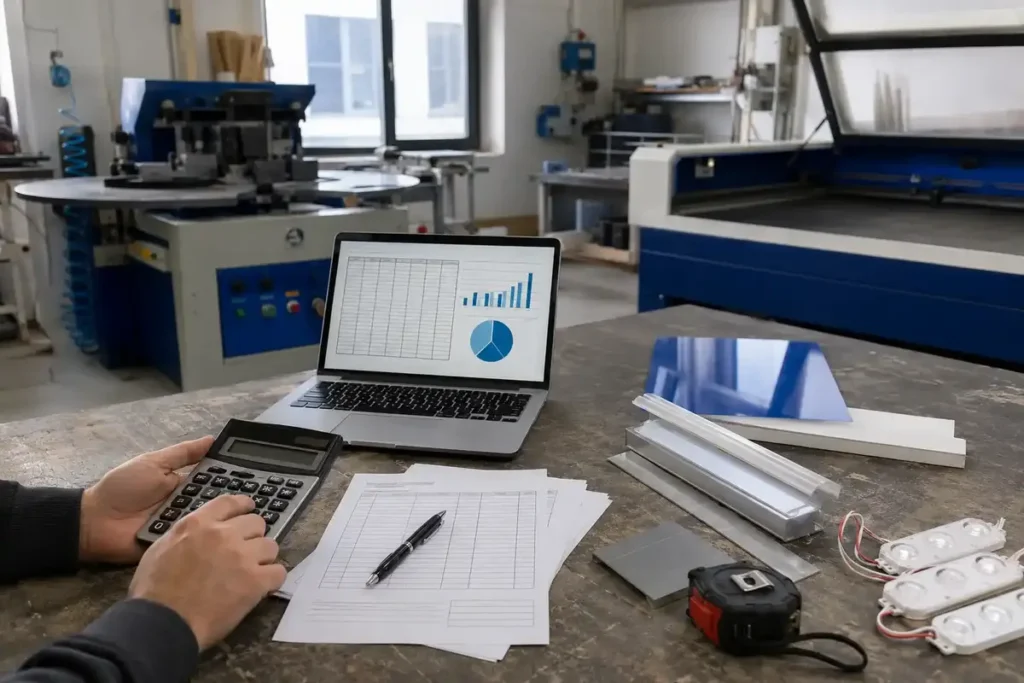
The right equipment depends on the products you intend to manufacture. Buying a machine before defining your niche can leave capital tied up in equipment that is underused or unsuitable for your main materials.
A small shop may begin with a computer, professional design software, a vinyl cutter, application tools, measuring equipment, hand tools, and dependable suppliers. Printers, laminators, CNC routers, laser systems, and specialized fabrication machines can be added according to demand.
If channel letters become a core product, the equipment plan may eventually include cutting systems, channel letter bending machines, fastening tools, LED components, and assembly and testing equipment. These purchases should follow validated order volume rather than the desire to offer every production method immediately.
CNC Routers
A CNC router uses computer-controlled movement to cut, carve, drill, or shape sheet materials. Depending on the machine and tooling, sign makers can use CNC routers for wood, acrylic, PVC, aluminum composite panels, foam, and other substrates.
CNC routing is valuable for producing dimensional letters, shaped panels, engraved elements, cabinet components, and custom sign structures. Table size, spindle power, material-holding method, cutting accuracy, software compatibility, dust collection, and available support should all be considered when choosing a machine.
Businesses planning to produce routed lettering or larger sign panels can explore the available CNC Router Machine Blade Cutters and compare the specifications with their intended materials, production volume, and workspace.
A CNC router may not be necessary on the first day. If routed projects are infrequent, outsourcing them can be more economical. In-house routing becomes valuable when it improves turnaround time, expands product capabilities, or reduces recurring subcontracting expenses.
Laser Cutting and Engraving Machines
Laser machines allow sign shops to cut or engrave detailed shapes with a digital workflow. CO₂ systems are commonly used with non-metal materials such as acrylic, wood, certain plastics, paper, cardboard, leather, and fabric, although material compatibility and safety requirements must always be verified.
These machines can be particularly useful for acrylic lettering, engraved plates, office signs, decorative elements, prototypes, and personalized products. When evaluating a laser system, consider working area, laser power, cooling, extraction, material thickness, software compatibility, safety features, and expected production volume.
Sign makers producing detailed acrylic and engraved products can review CO2 Laser Cutting and Engraving Machines to identify a configuration suited to their applications.
Fiber laser systems serve different applications and are generally associated with suitable metal cutting or marking. A company producing metal letters, backplates, decorative panels, or architectural components may eventually evaluate fiber laser cutting machines. The wider system may also require extraction, cooling, assist-gas delivery, electrical infrastructure, material handling, safety controls, and trained operation.
Design Software and Finishing Tools
Design software is central to the production workflow. It is used to create layouts, prepare vector files, manage dimensions, and generate files for cutters, routers, printers, or laser systems. Choose software that supports the required file formats and works reliably with your equipment.
Finishing equipment may include laminators, saws, drills, sanders, edge-finishing tools, riveters, heat guns, application tables, painting equipment, and assembly tools. Installation work can require ladders, lifts, anchoring tools, electrical testing equipment, safety gear, and suitable vehicles.
Do not overlook ventilation, dust extraction, fire protection, eye protection, and material-handling systems. A productive sign shop must also be safe, organized, and capable of storing sheet materials without damage.
Registering Your Business, Licenses, and Insurance
Choose an appropriate business structure and register the company according to federal, state, and local requirements. Depending on the location and services, requirements may include general business registration, sales-tax registration, zoning approval, contractor licensing, building permits, or electrical credentials. Anyone researching how to start a sign contractor business should pay particular attention to installation permissions, contractor classifications, electrical work, insurance, and permit responsibilities because these requirements may differ from those of a fabrication-only shop.
Rules vary between jurisdictions. Exterior and illuminated signs may require permits before fabrication or installation. Confirm applicable requirements with relevant local authorities and qualified professionals rather than assuming that general registration authorizes every service.
Insurance needs may include general liability, property, commercial vehicle, equipment, workers’ compensation, and professional coverage. Installation introduces additional risks because employees may work at customer properties, use ladders or lifts, and attach structures to buildings. An insurance professional familiar with fabrication and installation businesses can help identify suitable protection.
Create a Business Plan for Your Sign Business
A sign shop business plan should explain your target customers, core products, pricing approach, sales strategy, equipment requirements, production workflow, and financial assumptions. It does not need to be unnecessarily complicated, but it must be realistic.
Estimate fixed expenses such as rent, software, insurance, utilities, and loan payments. Then calculate variable costs including materials, outsourced production, packaging, shipping, installation labor, and transaction fees. Forecast sales conservatively and allow for seasonal changes and delayed commercial payments.
Your plan should also define when equipment or staffing will be added. For example, you might outsource laser cutting until monthly order volume reaches a specific level. Using measurable expansion triggers helps prevent premature spending.
Is a Sign Business Profitable?
A sign business can be profitable when it prices projects accurately, controls material waste, maintains a dependable workflow, and focuses on products with sufficient demand. Profitability depends less on sales volume alone than on the margin remaining after design time, materials, machine use, labor, installation, revisions, overhead, and rework.
Custom products, dimensional signage, commercial packages, installation services, and recurring business accounts may offer stronger revenue opportunities than competing only on low-cost standard signs. However, higher-value projects may also involve more technical work, risk, and customer coordination.
How to Scale a Sign Business
Scaling should increase profitable production capacity—not simply increase the number of products offered. Before expanding, identify the current constraint.
If quotations are delayed, improve estimating templates. If design revisions consume excessive time, strengthen the proof and approval process. If an outsourced process creates recurring delays or margin pressure, compare its annual cost and service risk with in-house production. If a machine is consistently utilized, evaluate workflow improvements, additional shifts, automation, or increased capacity.
A practical scaling sequence is:
- Standardize quotations, job files, and customer approvals.
- Measure profitability by job type and customer segment.
- Build repeat demand within the initial product range.
- Document production and quality-control procedures.
- Bring frequently outsourced processes in-house when the economics support it.
- Add employees around clearly defined roles and bottlenecks.
- Introduce related products that use existing customers, materials, or equipment.
- Pursue larger commercial, wholesale, or multi-location contracts when project controls are ready.
Review order volume, outsourcing cost, labor hours, floor space, infrastructure, working capital, training, maintenance, and expected utilization before buying another machine. Equipment should solve a proven constraint or enable validated demand.
Higher-value commercial work may require stronger project management, installation capability, insurance, credit control, documentation, and supplier coordination. Revenue can grow while cash flow and net profit weaken, so financial controls must expand with production capacity.
Conclusion: Build a Scalable and Profitable Sign Business
Learning how to start a sign business begins with selecting a focused market—not filling a workshop with machinery. Define your customers, choose products that match real demand, estimate the complete cost of production, and decide which processes should initially be outsourced.
As orders become more consistent, suitable technology can help reduce lead times, improve repeatability, and expand production capacity. CNC routers, CO₂ laser machines, printing systems, and specialized fabrication equipment should be added when they support clear production and revenue goals.
Start with a manageable workflow, maintain accurate quality and pricing standards, and reinvest according to measurable demand. This approach allows you to develop a sign business that grows from a small operation into a reliable and scalable manufacturing company.
Find the Right Machine for Your Application
Frequently Asked Questions
How do I start a sign business?
Choose a product niche, research local demand, identify target customers, prepare a budget and business plan, register the company, and purchase essential equipment. Begin with a manageable product range and outsource specialized production until sufficient order volume justifies bringing it in-house.
What equipment do I need for a sign shop?
Basic requirements may include a computer, design software, vinyl cutter, measuring tools, application tools, and finishing equipment. Depending on your products, you may later need a large-format printer, laminator, CNC router, laser engraver, channel letter equipment, or installation tools.
What laser machine is best for making signs?
The best system depends on the materials and applications. CO₂ laser machines are frequently used for cutting and engraving acrylic, wood, and other compatible non-metal materials. Fiber laser systems are more suitable for many metal-processing and marking applications. Always match the machine to the intended material, size, thickness, and production volume.
What types of signs make the most money?
Profitability varies by market and production capabilities. Dimensional signs, channel letters, branded office packages, custom acrylic displays, commercial installations, and recurring business orders can generate attractive project values. The most profitable product is one you can sell consistently, price accurately, and produce efficiently.
Can I start a sign business from home?
Yes, certain products can be manufactured or managed from a home workspace. Before starting, check zoning, lease or homeowners association restrictions, ventilation, noise, electrical capacity, material storage, and customer access. Larger machinery or installation operations may eventually require commercial space.
How do sign businesses find customers?
Sign companies attract customers through local SEO, referrals, direct outreach, social media, paid advertising, networking, partnerships, and visible examples of completed work. Relationships with contractors, designers, property managers, printers, and marketing agencies can also generate recurring projects.
Latest contents



Prefer a callback? Share your details and requirements below.
Your details will only be used to respond to this request.