

Best Fiber Laser Welding Machine: 2026 Buyer’s Guide for Metal Fabricators
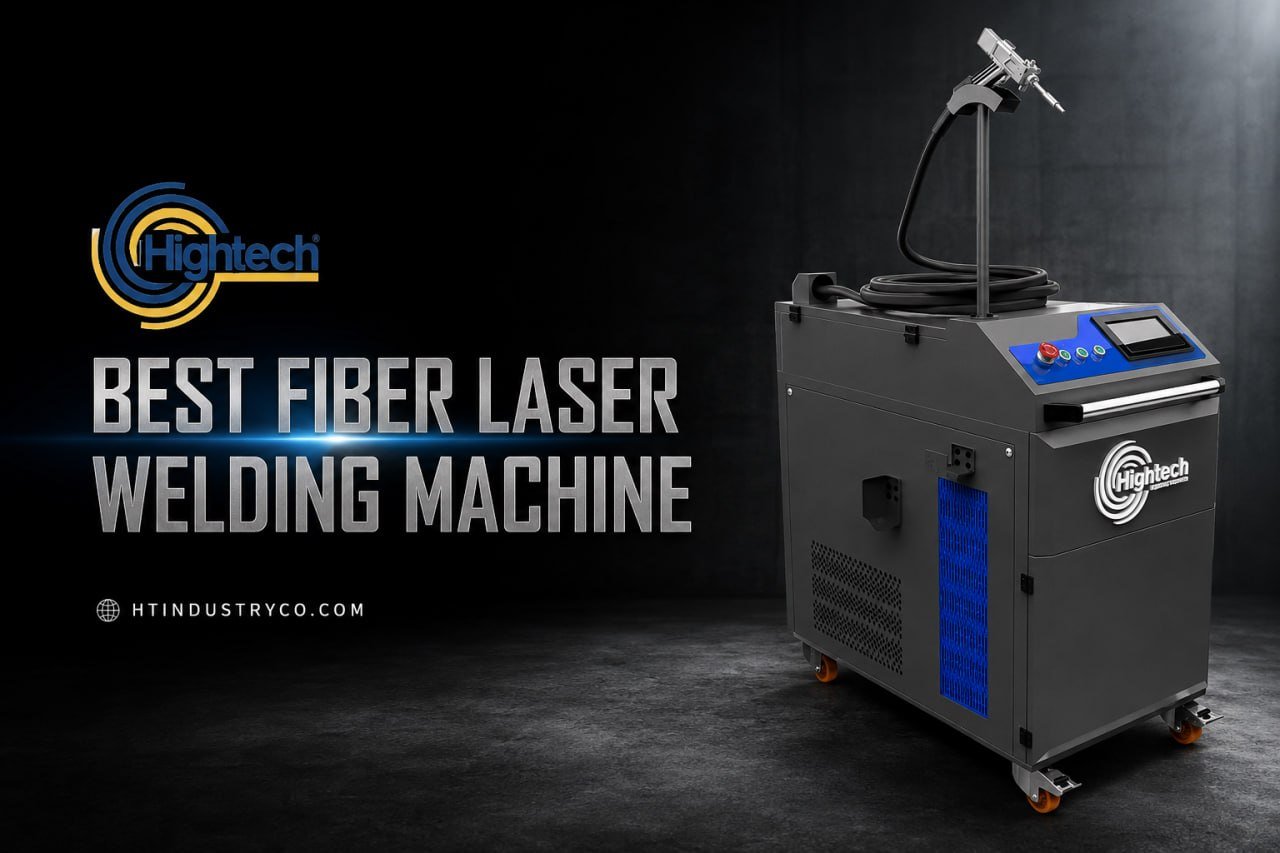
Table of Contents
Choosing the best fiber laser welding machine comes down to four decisions: how much laser power you need, whether a handheld or an automated table system fits your work, which laser source sits inside the machine, and whether your supplier can actually back the purchase with warranty and support. This guide walks through each of those decisions, then matches them to specific Hightech (HT) models — from compact handheld welders for small shops to fixed-table systems built for signage and precision production — so you can move from “which machine fits my materials” to “which model to request a quote on.”
Quick Answer: Which Fiber Laser Welding Machine Is Best?
For most fabrication and signage shops, a handheld fiber laser welder in the 1500W–2000W range (such as the Hightech HT FW 1500 or HT FW 2000) is the best all-round choice — it welds stainless, aluminum, and carbon steel with minimal training. Choose the HT FW 3000 for thick, high-throughput work, the HT FWT-1500 table machine for automated signage and channel-letter production, or a QCW welder for fine jewelry and precision parts.
How to Choose the Best Fiber Laser Welding Machine
Laser Power (Wattage): 1000W vs. 1500W vs. 2000W vs. 3000W+
Wattage is the single biggest factor in how thick a material you can weld and how fast you can do it. More power means deeper penetration and higher speed, but also higher purchase price and electrical demand. A practical way to map power to use case:
- 1000W–1500W: Ideal for thin sheet metal, signage, and general fabrication. Welds materials in roughly the 0.4–8mm range and runs on single-phase power, which keeps installation simple for smaller shops.
- 2000W: The sweet spot for busy fabrication shops that want faster travel speeds and more comfortable penetration on medium-thickness stainless and carbon steel.
- 3000W and above: Built for thick-section work and high daily volume. Best for shops welding heavier structural or industrial components where throughput justifies the investment, like the HT FW 3000.
Laser Source Brand (IPG, Raycus, MAX, JPT) & Beam Quality
The laser source is the heart of the machine and a major driver of beam quality, stability, and lifespan. The leading sources buyers compare are IPG, Raycus, MAX, and JPT. A genuine, authentic source matters far more than a slightly higher wattage on paper — it determines how consistent your welds are over years of use. The HT FWT-1500 table welder, for example, ships with a genuine MAX source rated to a 1070nm wavelength, the standard for fiber welding. When you compare quotes, always confirm the source brand is authentic and ask about its rated operating life.
Wobble Function, Wire Feed & Welding Heads
A “wobble” or oscillation function moves the beam in a pattern (line, circle, or figure-eight) to widen the weld seam, bridge small gaps, and produce a smoother, more even bead — especially useful on aluminum and visible signage welds. The HT FWT-1500 uses a double pendulum (double swing) welding head that supports adjustable patterns such as circle and triangle for strong, aesthetically clean joints. For filling larger gaps or building up material, a wire-feed attachment lets you add filler metal during the weld.
Cooling System (Air vs. Water Chiller) & Duty Cycle
Safety Features & Operator Ease of Use
One of fiber laser welding’s biggest advantages is how approachable it is: no welding certification is required, and most operators can start producing usable welds after about 30 minutes of training. Compared with traditional welding, the weld appearance is flat and typically needs no grinding, efficiency is several times higher, and the main personal protection required is appropriate laser safety glasses. Still, confirm the machine includes built-in interlocks and safety controls, and ensure your workspace has proper ventilation.
Total Cost of Ownership: Price, Consumables & Support
Sticker price is only part of the picture. Total cost of ownership includes consumables (protective lenses, nozzles, gas), electricity, maintenance of optics and cooling, and — critically — the support you receive after the sale. Hightech machines ship with a one-year warranty plus lifetime after-sale technical support, factory-direct pricing, and worldwide shipping with options including DDP door-to-door delivery. For a B2B purchase at this level, that support infrastructure is often what separates a good buy from an expensive mistake.
Best Fiber Laser Welding Machines Compared (2026)
The table below compares the Hightech Laser Welding Machines so you can match a model to your materials, throughput, and budget at a glance. All models weld a broad range of metals and ship with a one-year warranty and lifetime technical support.
|
Model |
Type |
Laser Power |
Weldable Thickness |
Cooling |
Best For |
|---|---|---|---|---|---|
|
HT FW 1500 |
Handheld 4-in-1 |
1500W |
Thin–medium sheet |
Water |
Small shops & signage |
|
HT FW 2000 |
Handheld 4-in-1 | 2000W | Medium sections | Water | Busy fabrication shops |
|
HT FW 3000 |
Handheld 4-in-1 | 3000W | Thick / high volume | Water | Heavy-duty production |
|
HT FWT-1500 |
Fixed table (CCD) | 1500W | 0.4–8mm | Compressor water | Automated signage & channel letters |
|
HT QCW 750Y |
QCW handheld + table | 750W (QCW) | Fine / precision | Water | Jewelry & precision metals |
Best Industrial Fiber Laser Welder — Hightech HT FWT-1500 (Table Series)
Best Handheld Fiber Laser Welder for Small Business
Best 3-in-1 / Multi-Function Welding, Cleaning & Cutting Machine
Hightech’s 4 in 1 Fiber Laser Welding Machine (the HT FW series) combines welding with cleaning and cutting modes in a single unit. For a shop that wants one machine to weld seams, strip rust or oxidation, and make light cuts, this multi-function approach maximizes the return on a single purchase and frees up floor space.
Best High-Power (2000W–3000W+) Fiber Laser Welder
When throughput and thicker materials are the priority, step up to the HT FW 2000 or HT FW 3000. The added power delivers deeper penetration and faster travel speeds for heavier production schedules. These models are best suited to established shops with the electrical infrastructure and volume to make use of the extra capacity.
Best Value / Precision Pick — QCW for Fine Work
For jewelry, electronics, and delicate precision parts, the HT QCW 750Y uses Quasi-Continuous Wave technology — combining the benefits of pulsed and continuous welding — to join gold, silver, stainless, titanium, and other fine metals. One unit includes both handheld and fixed-table functions, giving small precision workshops flexibility without buying two machines. See the full QCW Laser Welding Machines for options.
Find the Right Machine for Your Application
Frequently Asked Questions
What is the best fiber laser welding machine in 2026?
There is no single “best” for everyone — it depends on your materials and volume. For most fabrication and signage shops, a 1500W–2000W handheld such as the Hightech HT FW 1500 or HT FW 2000 offers the best balance of capability, ease of use, and price. For automated signage and channel-letter production, the HT FWT-1500 table machine is the stronger choice, and the QCW 750Y is best for fine jewelry and precision work.
Is a fiber laser welder worth it for a small fabrication business?
How do I import an industrial fiber laser welder to the US (warranty & support)?
Latest contents


Prefer a callback? Share your details and requirements below.
Your details will only be used to respond to this request.