


Industries That Use CNC Routers in Manufacturing
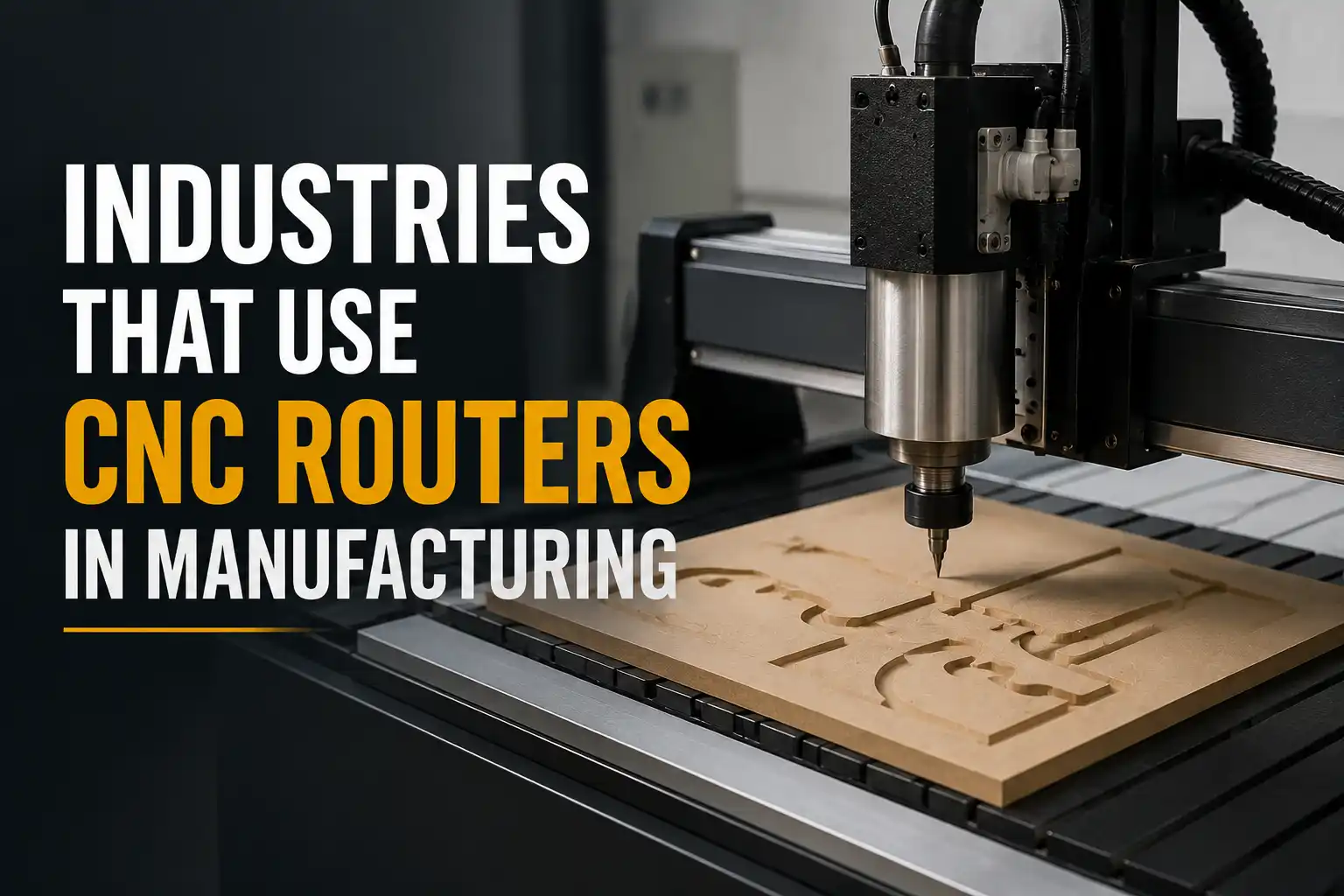
Table of Contents
Understanding the industries that use CNC routers helps manufacturers decide whether this technology fits their products, materials, and production goals. Unlike general CNC machines, CNC routers are especially well suited to cutting, carving, and shaping sheet materials and softer stock at high speed across large work areas. This guide explains where CNC routers deliver the most value, the materials and applications that define each sector, and how to choose a machine that matches your production needs and scales with your business.
Quick Overview: Industries in Which CNC Routers are Used
CNC routers are used across sign making, plastics and acrylic fabrication, aerospace and automotive prototyping, architectural millwork, furniture production, and industrial manufacturing. They cut wood, plastics, composites, foam, and non-ferrous metals with speed and precision, helping manufacturers automate production, reduce waste, and improve repeatability across many sectors.
Key Industries That Use CNC Routers
While CNC routers serve many sectors, a handful stand out for how directly the technology addresses their production demands. Each combines specific materials, precision requirements, and customization needs that CNC routing handles efficiently.
Sign Making and Advertising Production
Sign making is one of the most established CNC router industries. In this field, routers are used to cut dimensional letters, logos, and display elements from materials such as acrylic, PVC, wood, and aluminum composite panels, producing clean edges and highly consistent repeatability. The ability to quickly switch between custom designs makes these machines ideal for advertising work, where short production runs and fast turnaround times are the norm. For sign shops and small-to-medium manufacturers, the HT R3 Q CNC Router Engraving Machine—a versatile CNC router suited to workshop and signage production—offers an efficient solution for handling a wide range of everyday materials and job sizes.
The production challenge in signage is variety: shops rarely make the same part twice, so manual fabrication is slow and inconsistent. A CNC router solves this by reading a digital file and reproducing it precisely every time, whether the run is one piece or fifty. This lets a sign shop quote competitively on custom jobs, reduce wasted material from layout errors, and deliver consistent quality that builds repeat business.
Plastics and Acrylic Fabrication
Plastics fabricators use CNC routers to machine acrylic, polycarbonate, HDPE, PVC, foam, and other compatible substrates into displays, enclosures, fixtures, panels, and custom components. Suitable cutter geometry, spindle speed, feed rate, chip evacuation, workholding, and tool condition are essential because excessive heat can melt some plastics, while unsuitable tooling or clamping can contribute to chipping or cracking.
Routing can produce a clean machined edge, but additional scraping, sanding, polishing, or flame polishing may be required when a transparent or highly polished finish is specified.
Aerospace and Automotive Prototyping
Aerospace and automotive teams rely on CNC routers for prototyping and tooling, cutting composites, aluminum, foam, and tooling boards into prototypes, molds, jigs, and lightweight parts. These sectors demand tight tolerances and consistent repeatability, where CNC multi-axis machining for manufacturing proves its value by accurately producing complex contoured surfaces. For such high-precision applications, an HT R6 CNC Router Engraving Machine delivers the rigidity and accuracy required for demanding prototypes and advanced industrial work.
Architectural and Interior Design Fabrication
Architectural millwork and interior fabrication use CNC routers to produce decorative panels, custom moldings, screens, and feature elements from wood, MDF, composites, and soft metals. The technology lets designers turn intricate digital designs into finished pieces at scale, reproducing the same complex detailing across many parts without the variation of hand fabrication. This combination of customization and consistency is exactly what high-end architectural projects require.
Industrial Manufacturing and Custom Parts Production
In general industrial manufacturing, CNC routers cut custom parts, production-run components, and fixtures from wood, plastics, and non-ferrous metals. Here the priority is throughput and consistent quality across long runs. By automating cutting and shaping, manufacturers reduce labor dependency and bottlenecks while keeping output uniform, which makes routing a backbone technology for scalable custom production.
Furniture and cabinet manufacturing deserve a specific mention here, as they are among the highest-volume users of CNC routers. Cabinet shops use nested-based manufacturing to cut entire sheets of plywood or MDF into doors, panels, and carcass parts in a single automated run, dramatically reducing waste and labor compared with manual cutting. This nesting strategy, where software arranges parts to maximize material yield, is a clear example of how toolpath planning translates directly into lower cost per part and faster production flow.
Choosing the Right CNC Router for Your Industry Needs
CNC router capabilities in different industries vary widely, so the right machine depends on what you produce, the materials you work with, and your production volume. Matching the machine to the job prevents both under-spec bottlenecks and overspending on capability you will not use.
Matching Machine Capability with Production Requirements
Flat sheets, profiles, pockets, drilling patterns, and relief work are commonly produced on 3-axis routers. A rotary fourth axis can support cylindrical work, wrapped toolpaths, or indexed machining on several faces. Complex angled and contoured parts may benefit from 5-axis capability.
Buyers should distinguish between indexed positioning and simultaneous multi-axis cutting. Axis count alone does not determine accuracy or suitability; travel, rotary limits, spindle orientation, machine geometry, rigidity, control functions, CAM support, workholding, and tooling must also match the part.
read more: cnc machine axis types
Understanding Production Volume and Material Types
Production volume and material mix shape the decision as much as part complexity. High-volume shops need rigidity, speed, and durability to run long production cycles, while lower-volume custom shops may prioritize flexibility across many materials. A machine that cuts wood, plastics, composites, and non-ferrous metals well gives a manufacturer room to diversify. Confirming that a router suits your dominant materials and expected output ensures the investment supports your workflow rather than constraining it.
How HT Industry CNC Router Systems Support Multiple Industries
HT Industry offers a complete range of CNC router systems designed to serve different manufacturing sectors, from woodworking and signage production to automotive components, plastics fabrication, and industrial prototyping. The machines are engineered for stability, precision, and high production efficiency, making them suitable for both entry-level workshops and advanced industrial manufacturing environments.
With configurations including 3-axis, 4-axis CNC routers, HT Industry provides flexible solutions that match different levels of production complexity, material types, and workflow requirements. These systems are designed not only for performance but also for long-term reliability and ease of operation, helping manufacturers scale production while maintaining consistent quality.
By choosing the right CNC router system, businesses can improve production efficiency, increase machining accuracy and repeatability, reduce operational bottlenecks, and achieve stronger ROI through optimized workflows.
As a manufacturer of industrial CNC machine systems, HT Industry focuses on matching the right equipment to each customer’s production goals, supporting manufacturers as they grow into new materials, markets, and volumes.
Find the Right Machine for Your Application
Frequently Asked Questions
What industries benefit the most from CNC routers?
Sign making, plastics and acrylic fabrication, furniture and cabinetry, architectural millwork, aerospace and automotive prototyping, and general industrial manufacturing benefit most. These sectors share a need for precise, repeatable cutting of sheet materials and softer stock.
What materials can CNC routers cut in industrial applications?
CNC routers cut wood, MDF, plastics such as acrylic and polycarbonate, composites, foam, tooling board, and non-ferrous metals like aluminum. Material capability depends on the machine’s rigidity, spindle, and tooling.
Are CNC routers suitable for small manufacturing businesses?
Yes. Entry-level and mid-range routers let small shops automate cutting, reduce labor, and take on custom work profitably. They are a common first step for businesses bringing production in-house.
Is investing in a CNC router cost-effective for manufacturing?
For shops with steady or growing demand, yes. A router reduces material waste and labor hours while increasing output and customization, so it typically pays back through capacity gains and lower per-part costs.
What are the most profitable CNC projects to sell?
Custom signage, dimensional letters, acrylic displays, bespoke furniture and cabinetry, architectural panels, and prototyping services tend to be profitable because they command premium pricing for customization while CNC automation keeps production costs low.
Latest contents


Prefer a callback? Share your details and requirements below.
Your details will only be used to respond to this request.