


Fiber Laser vs Plasma Cutting: The 2026 USA Cost Guide
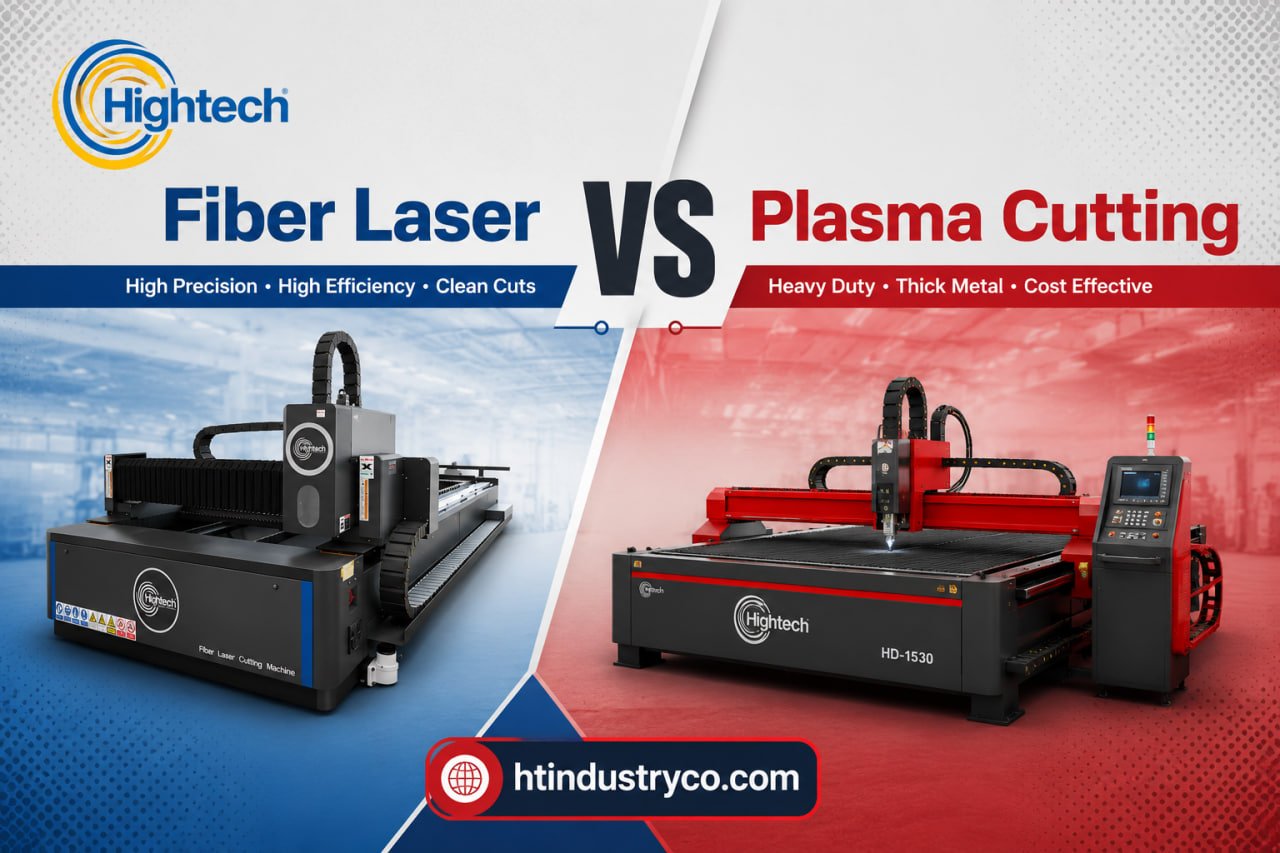
Table of Contents
If you are weighing a fiber laser against a plasma cutter, you are not really choosing between two machines. You are choosing between two cost structures, two material strategies, and two ways of running your shop floor. This guide skips the marketing gloss and gives you the decision the way an experienced fabricator would: by material, by thickness, by surface condition, and by what it actually costs to make the part.
Quick Facts
Fiber laser wins on thin and medium material (roughly under ½”, or 12mm), reflective non-ferrous metals, and any part that needs to come off the table weld-ready. Plasma wins on thick plate (above about ⅝”, or 16mm), dirty or rusted stock, and lower up-front investment. Most shops that cut a wide mix of work end up wanting both — and we cover that hybrid approach below.
The ½-Inch Rule: Where the Crossover Actually Happens
The single most useful number in this entire comparison is the thickness where one technology overtakes the other. For the vast majority of US shops running 3kW to 6kW fiber lasers, that crossover sits in the ½” to ⅝” (12mm–16mm) band.
Laser dominates under ½" (12mm)
Below half an inch, fiber laser is faster, more precise, and cleaner. It produces a narrow, straight kerf with a small heat-affected zone, holds tight tolerances on small holes, and leaves edges that are frequently weld-ready with no secondary work. For sheet-metal and thin-plate fabrication, this is not a close contest.
It is worth knowing that high-power lasers have pushed this boundary far higher than the old rules suggested. Best-in-class fiber lasers now out-cut plasma across a wide thickness range when the power is there — at 60kW, a fiber laser cuts 40mm mild steel roughly 2.5 times faster than a 460-amp plasma system. But those machines are a different capital class. For the wattages most American job shops actually buy, the practical value crossover stays near ½”.
Plasma takes over above ⅝" (16mm)
Once you climb past ⅝”, the economics flip. Hypertherm’s own data shows its X-Definition plasma delivers a surface finish that is generally smoother than fiber laser above 16mm (⅝”) and holds consistent edge quality across the life of a consumable set. On raw speed, the gap is dramatic: a Hypertherm XPR300 can burn through 1″ A36 plate at around 75 inches per minute, where a 6kW fiber laser plods along at 20–30 IPM. On thick plate, plasma simply moves more metal per hour, and that speed is what drives the cost per foot down.
A quick word on the breakpoint
|
Factor |
Fiber Laser (3–6kW) |
Plasma (high-definition) |
|---|---|---|
| Sweet spot thickness | Under ½" (12mm) | ⅜"–2" (10–50mm) |
| Edge quality (ISO 9013 angularity) | Range 1–2 |
Range 2–4 |
| Speed on 1" steel | 20–30 IPM | ~75 IPM |
| Kerf / precision | Narrow, tight tolerance | Wider, some taper |
| Weld-ready off the table | Usually yes | Often needs grinding |
| Up-front cost | 2–5× higher | Lower |
Beyond Mild Steel: Material Matchups
Safety, Enclosures, and US OSHA Considerations
The two technologies carry different facility and safety footprints, and that affects both cost and floor space.
Fiber laser requires a full Class 1 enclosure. The 1064nm beam is invisible and an eye hazard, so industrial fiber lasers are fully enclosed. That protects operators but consumes floor space and adds to the installed cost.
Plasma is open-access but generates its own hazards. No enclosure is needed, but plasma produces UV radiation, fumes, and significant noise. Operators need eye protection, and the shop needs proper fume extraction. Plan for ventilation capacity the same way you would plan for an enclosure’s footprint.
Neither is “safer” in the abstract — they simply require different controls.
Total Cost of Ownership: CapEx vs. OpEx
The sticker price is the trap. Plasma almost always wins on cash out of pocket today — its initial investment is typically two to five times lower than a comparable fiber laser. But buying a production asset on purchase price alone is a rookie mistake. The real question is cost per part over five years.
The relationship is simple to state: plasma is cheap to buy and more expensive to run; fiber laser is expensive to buy and cheaper to run.
Consumables. Plasma’s nozzles and electrodes are fast-wearing — under heavy use, a set can last only 1–3 hours, and a busy shop can spend $5,000–$10,000 a year on them. Fiber laser’s main consumables are nozzles and protective lenses that last weeks to months. The catch runs the other way on repairs: plasma consumables are operator-swappable after brief training, while laser optical or fiber failures require certified engineers and costly downtime.
Energy and gas. Fiber lasers are far more electrically efficient than older cutting technologies, but “low operating cost” claims are often dated. A realistic fully-loaded fiber laser hourly cost — including depreciation, labor, electricity, assist gas, and consumables — commonly lands anywhere from $20 to $70+ per hour depending on power, gas strategy, and utilization. Nitrogen assist gas for stainless and aluminum is frequently the single biggest variable cost, and it keeps bleeding money even when the machine sits idle. Plasma’s operating cost is steadier and lower per hour on thick plate, where its speed advantage compounds.
The decisive variable: utilization. A fiber laser only earns back its premium if it runs at high utilization. A two-shift OEM cutting repeat thin-gauge parts will amortize a laser fast. A low-volume job shop running the machine a few hours a day may never see the payback — which is exactly why the right answer depends on your shop, not on a spec sheet.
read more: fiber laser vs co2 laser cutting for industrial metal
Cost-Per-Part: A Worked Example on ½" (12mm) A36 Steel
Most comparisons stop at hourly rates. Hourly rate alone is misleading, because the faster machine makes more parts per hour. Here is the honest framework:
Cost per part = (machine hourly rate × cut time) + consumables + assist gas/power + secondary finishing (grinding/deburring)
On ½” A36 plate, the two machines pull in opposite directions:
Plasma cuts faster (roughly 75 IPM versus 20–30 IPM for a 6kW laser), so even at a similar or higher hourly rate, its cost per foot of cut can come out lower on this thickness.
Fiber laser cuts cleaner, so its parts often skip the grinder entirely. Plasma parts at this thickness typically carry some dross that needs removal — and that grinding labor is a real per-part cost that rarely shows up in the brochure.
The Decision Matrix: Find Your Shop
|
Shop Profile |
Typical Work |
Recommendation |
|---|---|---|
| Low-volume job shop | Mixed thickness, intermittent runs, dirty or reclaimed stock | Plasma first. Low CapEx, handles rust and paint, no enclosure needed. |
|
High-production OEM (thin/medium) |
Repeat parts under ½", weld-ready required, two-shift utilization | Fiber laser. Lower per-hour run cost amortizes fast at high utilization. |
| Heavy plate / structural | Thick mild steel skeletons, ⅝"–2"+ (shipbuilding, structural) | Plasma. TCO can run 15–25% better over five years on very thick material. |
| Reflective non-ferrous precision | Aluminum and copper, tight tolerances, clean edges | Fiber laser. Clean cuts on reflective metal with minimal taper. |
The Hybrid Approach: Why You Might Buy Both
Find the Right Machine for Your Application
Frequently Asked Questions
Which is cheaper to maintain long term, fiber laser or plasma?
Can plasma cut aluminum?
What thickness is the breakeven point between the two?
Does fiber laser cut rusty or painted metal?
Which produces weld-ready parts without grinding?
Latest contents


Prefer a callback? Share your details and requirements below.
Your details will only be used to respond to this request.