


Acrylic Signs vs Metal Signs: Pros, Cons, and Which Is Better?
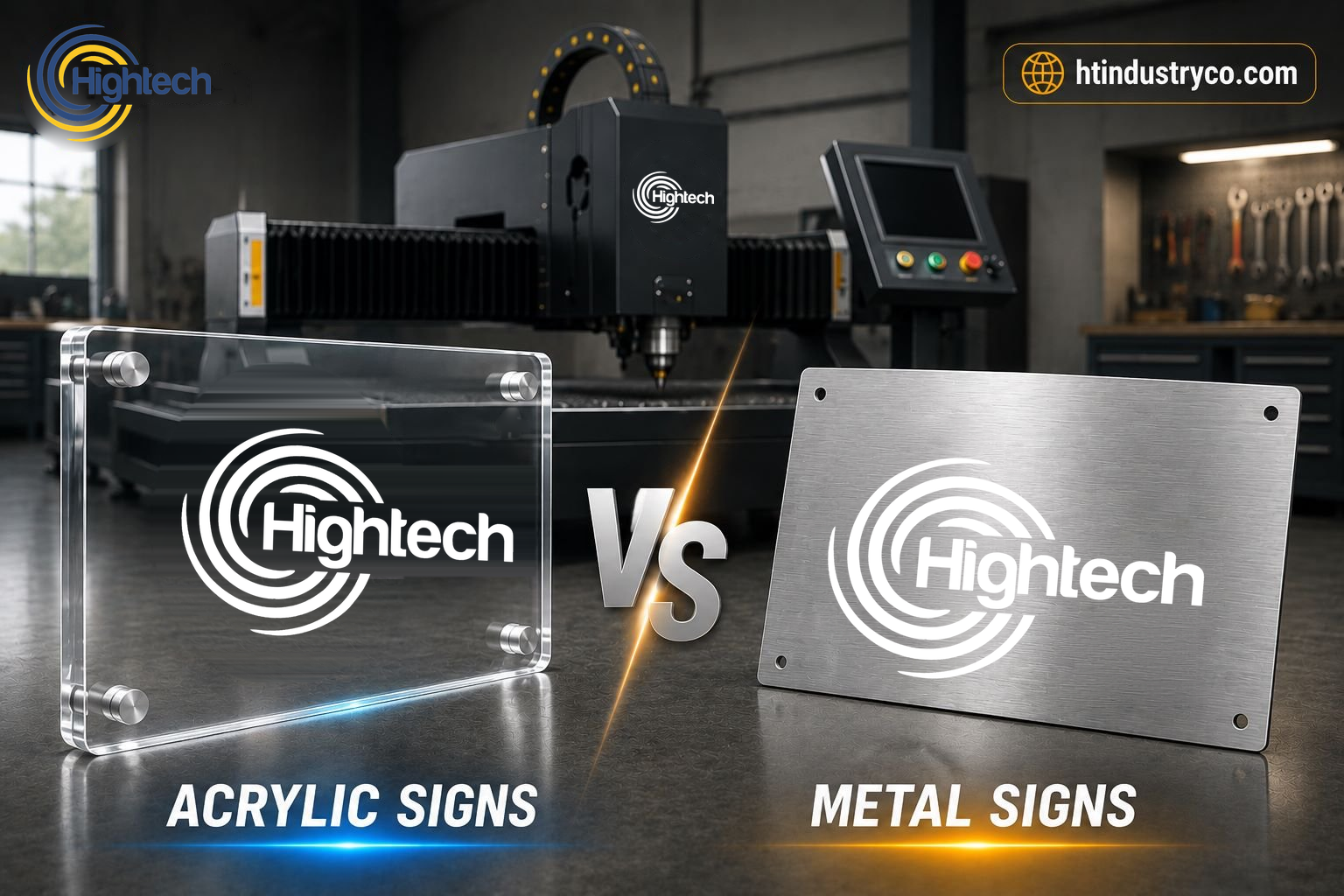
Table of Contents
Quick Answer
Acrylic signs are usually the better choice for indoor branding, illuminated displays, and projects that prioritize color, clarity, low weight, and easy customization. Metal signs, especially aluminum, aluminum composite panel (ACP), and stainless steel, are generally better for demanding outdoor use, high-traffic locations, impact resistance, and a permanent architectural look. The best choice depends on exposure, lighting, fabrication, installation, maintenance, and lifecycle value.
Acrylic Signs vs Metal Signs: Quick Comparison
|
Factor |
Acrylic Signs |
Metal Signs |
|---|---|---|
|
Best fit |
Indoor branding, illuminated/visual applications, lightweight installations | Long-term outdoor, architectural, industrial, high-traffic applications |
|
Appearance |
Clear, glossy, frosted, colored; modern and glass-like | Brushed, satin, polished, painted/coated; premium or industrial |
|
Weather exposure |
Suitable outdoors with the right grade and protection; exposure matters | Generally stronger for long-term weather exposure; metal and finish matter |
|
Impact / surface |
Can scratch, chip, or crack under hard impact | Less likely to crack; may dent, scratch, or mark |
|
Lighting |
Transmits or diffuses light | Opaque; strong for halo, backlit, and dimensional effects |
|
Fabrication |
CO2 laser and CNC routing are common | Fiber laser for many sheet metals; CNC routing common for ACP |
|
Weight / installation |
Usually light and easy to handle | Varies widely; solid metals may need stronger mounting |
|
Cost tendency |
Often lower upfront for many indoor applications | Often higher depending on alloy, finish, and fabrication |
|
Maintenance |
Gentle, non-abrasive cleaning | Depends on alloy/finish; inspect coatings and hardware outdoors |
|
Customization |
Strong for color, transparency, layering, printing, engraving | Strong for coatings, brushed/polished finishes, folding, welding, dimensional work |
Choosing between acrylic and metal affects more than appearance. The material changes how a sign is cut, finished, illuminated, mounted, and maintained. In an acrylic vs metal signage decision, it is also important to remember that “metal” covers several substrates: solid aluminum, ACP/ACM, and stainless steel do not have the same weight, rigidity, finish, or fabrication requirements.
What Are Acrylic Signs, and What Are Their Main Pros and Cons?
Acrylic, or PMMA, is a rigid plastic used for dimensional letters, lobby signs, panels, illuminated faces, plaques, and layered signage. It can be clear, colored, frosted, opal, printed, painted, engraved, routed, laser-cut, or thermoformed.
HT Industry’s Acrylic Sheets are offered in clear, opal, and several colors, with listed thickness options from 1.8 mm to 60 mm. The product page also specifies light transmittance up to 92%, which is useful when light must pass through or diffuse through a sign.
Its main advantages are visual clarity, low weight, broad finish options, and flexible fabrication. The main limitations are scratching, edge damage under hard impact, and heat sensitivity during processing. Outdoor performance depends on grade, UV resistance, exposure, edge treatment, and mounting, so acrylic should not be treated as either universally indoor-only or automatically equal to metal in harsh exterior conditions.
What Counts as a Metal Sign?
“Metal sign” is a category, not one material. Solid aluminum is relatively light, corrosion resistant, and commonly used for exterior panels, directional signs, and dimensional elements.
ACP (Aluminum Composite Panel) uses thin aluminum skins around a core. It is light and rigid for its thickness and is often routed or V-grooved for flat panels and folded structures. HT Industry’s ACP range lists standard and custom colors, brushed and mirror effects, printing, and PE, FEVE, and PVDF finishes.
Stainless Steel Sheets provide a heavier, architectural appearance and strong corrosion resistance when the correct grade and finish are selected. Stainless steel is common in premium lettering, plaques, and building identification. HT Industry’s current product page lists 201 and 304 alloys.
What Are the Main Pros and Cons of Metal Signs?
Metal signs offer rigidity, good weather performance, resistance to cracking, and premium brushed, satin, polished, painted, powder-coated, or mirror finishes. They are often the lower-risk choice for long-term exterior signage, high-traffic areas, and architectural applications.
Trade-offs include weight, fabrication complexity, and finish-specific requirements. Metal is opaque, so it cannot act as a light-transmitting face like acrylic. Cutting, bending, welding, coating, polishing, and mounting can also add production effort depending on the design.
Which Is More Durable Outdoors: Acrylic or Metal Signs?
For demanding outdoor exposure, metal is usually the safer default. Properly selected aluminum and stainless steel handle moisture, wind, temperature changes, and physical contact well. ACP can also work effectively outdoors when the panel specification and coating suit the environment.
UV-stable acrylic can be used outside, but its surface can scratch and its edges can be more vulnerable to hard impact or stress. Metal is less likely to crack, although it can dent, scratch, oxidize, or show coating failure. For exterior projects, evaluate UV, wind, rain or salt exposure, temperature swings, impact risk, mounting, and finish rather than relying only on the material name.
Which Material Looks Better for Different Brand Styles?
Acrylic suits bright, clean, contemporary branding. Clear or frosted sheets can create a glass-like effect, while colored or layered acrylic works well in reception areas, retail interiors, showrooms, and displays.
Metal creates a more architectural visual language. Brushed stainless steel feels premium, polished or mirror finishes look decorative, and painted or powder-coated aluminum can follow corporate color systems. Neither is universally better: acrylic leads for transparency, color, and layering; metal leads for structural presence, texture, and architectural finishes.
How Do Acrylic and Metal Signs Differ in Lighting Options?
Acrylic is more flexible when light needs to pass through the sign. Opal, translucent, colored, or clear acrylic can diffuse LEDs for illuminated faces, inserts, and lightboxes.
Metal is opaque, so lighting normally works around it. Metal letters and panels suit halo lighting, backlighting, edge effects, or cut-through details with acrylic inserts. Many illuminated signs therefore combine metal for the structure with acrylic for the light-transmitting element.
How Does Material Choice Change the Fabrication Workflow?
Acrylic is commonly processed with CO2 laser cutting and engraving or CNC routing. CO2 systems can produce detailed profiles and clean edges on suitable acrylic, while routers offer depth control and handle a broader range of rigid sign substrates. Heat buildup, tooling, feed rate, spindle condition, and required edge finish all matter.
For a deeper machine-selection framework, see How to Choose a CNC Router for Signage. ACP is frequently cut and V-grooved on a CNC router so sheets can be folded into trays and dimensional components. Accurate groove depth, tooling, and hold-down are important.
For stainless steel and many aluminum sheet workflows, fiber laser cutting is generally the more appropriate laser technology. Fiber systems are optimized for metals, while CO2 systems are strong on acrylic and other non-metals. Exact suitability still depends on material, thickness, machine configuration, and required finish. See Fiber Laser vs CO2 Laser for a more detailed technology comparison.
Which Costs More: Acrylic Signs or Metal Signs?
For many indoor signs, acrylic often has the lower upfront material and fabrication cost because it is light and efficient to cut, engrave, and mount.
Metal can cost more when a design uses stainless steel, thicker solid aluminum, specialty finishes, welding, bending, protective coatings, or heavier mounting. ACP can be more efficient than solid metal for some panel and folded-sign applications.
Compare the real cost drivers: dimensions, thickness, metal type, finish, printing, illumination, complexity, quantity, cutting time, folding or welding, hardware, access, and installation. A higher initial metal cost may deliver better lifecycle value outdoors, while acrylic may be more economical for protected indoor use.
Which Is Easier to Install and Maintain?
Acrylic is usually easier to lift and position because of its low weight. Drilled holes and edges still need careful handling, and cleaning should use soft cloths and non-abrasive products.
Metal installation depends on the substrate. ACP and thin aluminum can be light, while stainless steel or thick assemblies may require stronger anchors. Maintenance varies by finish; exterior metal signs should also be checked for coating damage, corrosion, loose hardware, and movement.
When Should You Choose Acrylic vs Metal Signs?
For businesses choosing between acrylic or metal signs, start with the application rather than the material name. The table below shows the usual starting point for common signage scenarios.
|
Application |
Best Starting Point |
Why |
|---|---|---|
|
Lobby / reception |
Acrylic |
Lightweight, polished-looking, easy to layer, print, or mount on standoffs. |
|
Retail interior |
Acrylic | Strong color and branding flexibility; easy to combine with illumination. |
|
Illuminated display / lightbox |
Acrylic | Transmits and diffuses light through the face. |
|
Storefront exterior |
Metal or hybrid | Metal handles exposure well; acrylic can be used for illuminated elements. |
|
Building identification |
Metal | Architectural finish, rigidity, and exterior durability. |
|
Parking / wayfinding |
Metal | Better suited to repeated outdoor exposure and physical contact. |
|
Industrial / facility signage |
Metal | Rigid, impact-resistant, and compatible with durable finishes. |
|
Premium architectural branding |
Stainless steel or hybrid | Brushed, polished, or mirror finishes create a permanent high-end look. |
|
High-traffic indoor area |
Metal or hybrid | Metal resists cracking; acrylic can still be used where protected. |
Can Acrylic and Metal Be Combined in the Same Sign?
Yes. Mixed-material signs let each material do the job it handles best. A design may use a metal frame or letter body with an acrylic illuminated face, a clear acrylic panel on metal standoffs, or stainless steel letters over an acrylic or ACP backer.
This is especially useful when a project needs both weather resistance and light transmission. For channel-letter-specific material selection, use the Best Channel Letter Material guide rather than treating this article as a channel letter component guide.
If the assembly uses a two-part adhesive, understanding what AB glue is can help you evaluate mixing, curing, and surface compatibility before bonding.
Acrylic or Metal Signs: Final Decision Checklist
Choose the material after answering these seven questions:
- Is the sign indoors, outdoors, or semi-protected?
- How much UV, rain, wind, temperature change, salt, or physical contact will it face?
- Does the brand need transparency and color, or a solid architectural finish?
- Must light pass through the material, or will the sign use halo/backlighting?
- Which cutting, routing, bending, welding, and finishing processes can your shop perform reliably?
- What are the weight, anchoring, access, and installation constraints?
- Which option gives the best balance of upfront cost, maintenance, and long-term value?
If the priority is indoor visual impact, illumination, low weight, and customization, acrylic is often the better starting point. If the priority is demanding outdoor use, structural presence, impact resistance, or an architectural finish, metal is often better. In many professional signs, combining both materials produces the strongest result.
Frequently Asked Questions
Is ACP the same as solid aluminum for signs?
No. ACP/ACM is a composite panel with thin aluminum skins around a core, while solid aluminum is a single metal sheet. They differ in rigidity, weight, routing and folding behavior, finishing, and ideal applications.
Can acrylic and metal be used together in one sign?
Yes. Metal can provide the structure, dimensional body, or mounting surface, while acrylic provides transparent, colored, printed, or illuminated elements.
Can the same machine cut acrylic and stainless steel signs?
Not usually with the same laser technology. CO2 lasers are commonly used for acrylic, while fiber lasers are designed for metals such as stainless steel and aluminum. Some CNC routers can process acrylic, ACP, and selected non-ferrous materials when the machine, tooling, cooling, and parameters are suitable.
Which material is better when the sign needs illumination?
Acrylic is usually better when light must pass through or diffuse through the sign face. Metal is opaque but works well for halo-lit, backlit, or dimensional designs where light is projected around or behind it.
Should a sign shop choose one material for every project?
No. Material choice should follow the application. Most sign shops benefit from working with acrylic plus multiple metal substrates so they can match exposure, lighting, finish, mounting, and fabrication requirements to each job.
Latest contents



Prefer a callback? Share your details and requirements below.
Your details will only be used to respond to this request.