

How to Start a Sign Company: A Step-by-Step Guide
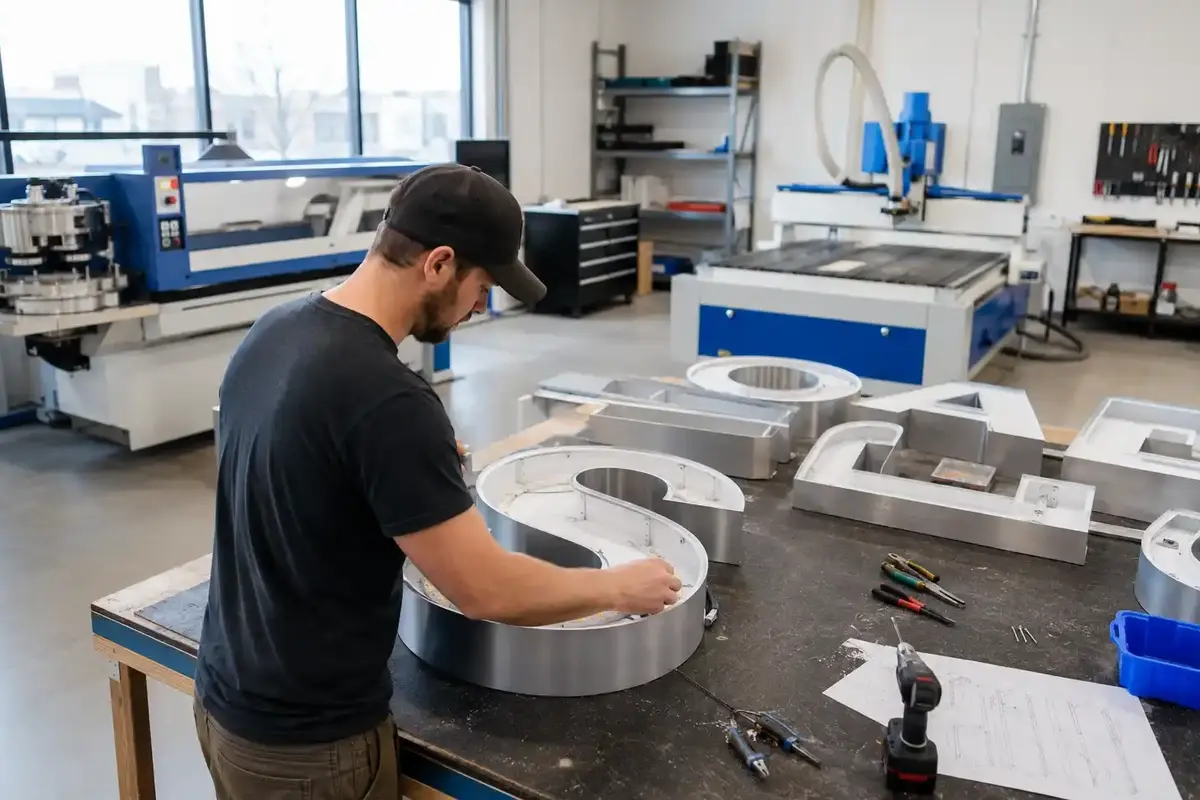
Table of Contents
Learning how to start a sign company involves more than registering a business and purchasing sign-making equipment. A professional sign company needs a focused product range, clearly defined customers, reliable pricing, an efficient production workflow, and enough working capital to complete projects before customer payments arrive.
This guide focuses specifically on building a scalable sign company with professional production capabilities. It explains how to evaluate local demand, select equipment according to the signs you intend to manufacture, decide which processes to outsource, price projects correctly, and expand production without investing in unnecessary machinery.
For a broader overview of business planning, legal setup, branding, and launching a signage business, read our complete guide on how to start a sign business.
Quick Answer: How Do You Start a Sign Company?
A successful sign company starts with a clear business model, defined target market, appropriate equipment, reliable production workflow, and effective customer acquisition strategy. Choose sign products based on local demand, calculate startup and operating costs, establish profitable pricing, and gradually bring more production processes in-house as order volume grows.
Step 1: Choose Your Sign Company Business Model
Your business model determines what you sell, who buys it, how orders are produced, and which capabilities must be available in-house. Instead of starting as a general-purpose supplier, define the type of sign company you want to build.
Common models include:
- A design-and-outsourcing company that sells signs but uses production partners
- A fabrication shop producing signs for local businesses
- A wholesale manufacturer supplying other sign companies
- A specialist company focused on one product category
- A full-service commercial sign company handling design, fabrication, delivery, and installation
An outsourcing-led model requires less initial machinery but gives the company less control over lead times, production quality, and supplier pricing. In-house manufacturing requires a larger investment, yet it can improve production control and margins once the company has sufficient order volume.
A hybrid model is often practical during the early stages. The company can manufacture its most frequent products internally and outsource specialized work until demand justifies additional equipment.
Decide Which Types of Signs to Offer
Product selection should come before equipment selection. Buying a machine first and then trying to find suitable work can leave the company with debt, maintenance expenses, and unused capacity.
Potential products include:
- Acrylic reception signs and dimensional logos
- Channel letters and illuminated storefront signs
- Routed letters and shaped sign panels
- Building identification and architectural signs
- Wayfinding and directory systems
- Printed graphics and promotional displays
- Vehicle graphics
- Safety, compliance, and industrial identification signs
- Custom metal sign components
Evaluate each category by considering local demand, selling price, material availability, production complexity, installation requirements, competition, and the likelihood of repeat orders.
Acrylic signs may be suitable for offices, retailers, restaurants, and interior designers. Channel letters can produce higher-value storefront projects but require additional forming, lighting, assembly, electrical, and installation capabilities. Architectural sign packages can create larger contracts but involve more extensive specifications, project coordination, and approvals.
Choose Your Target Customers
Your target customers influence almost every operational decision. A company serving small local retailers will have a different sales cycle and production workflow from one supplying property developers or national brands.
Possible customer groups include:
- Local retailers and restaurants
- Offices and professional practices
- Contractors and property managers
- Architects and interior designers
- Schools, hospitals, and public facilities
- Shopping centers and commercial developments
- Manufacturers requiring labels and identification products
- Other sign shops requiring wholesale production
Select customer groups whose needs match your planned capabilities. Contractors and property managers may generate recurring orders but expect dependable turnaround times. Architects may require detailed specifications and samples. Small businesses may make decisions more quickly but need greater support with design and material selection.
Your initial acquisition plan should also reflect the chosen market. A local company can use Google Business Profile, local SEO, referrals, and direct outreach. A wholesale manufacturer may gain more value from industry partnerships and direct contact with sign shops.
Start Focused Before Expanding
A narrow initial product mix makes quoting, purchasing, training, and quality control easier. It also helps the company build a portfolio that communicates a clear capability instead of presenting an unrelated collection of services.
For example, a new company could begin with acrylic office signs, routed letters, and branded wall displays. These products may share materials, design processes, cutting equipment, and finishing methods. The company can then add illuminated signs after establishing demand and developing the required fabrication skills.
Starting focused does not prevent future growth. It creates a controlled production foundation from which new products can be added deliberately.
If you plan to operate from a residential workshop rather than a commercial facility, the dedicated guide to starting a sign business from home covers garage setup, residential limitations, and home-based working conditions in greater detail.
Step 2: Research Your Local Sign Market
Market research should determine whether your proposed products address real customer demand. It should also reveal what competitors provide, what buyers value, and where existing suppliers perform poorly.
Research does not need to become a lengthy theoretical project. Its purpose is to help you make practical decisions about product selection, pricing, equipment, and customer acquisition before committing substantial capital.
Identify Customer Demand
Start by listing the organizations that regularly purchase signage within your intended service area. Look for new business openings, retail developments, offices, restaurants, property-management companies, construction projects, schools, healthcare facilities, and industrial businesses.
Speak directly with prospective customers and ask:
- Which signs do they purchase most frequently?
- What problems have they experienced with existing suppliers?
- Are turnaround time, installation, durability, or design support most important?
- Do they need one-off projects or recurring signage?
- Which materials and finishes do they commonly request?
- What approval and payment processes do they use?
Search behavior can indicate interest, but conversations with actual buyers provide more useful operational information. A property manager who regularly needs tenant panels and wayfinding updates may be more valuable than many one-time customers requesting small custom signs.
Analyze Local Competitors
Review competitors as businesses, not only as websites. Identify their main products, target customers, lead times, service areas, installation capabilities, review patterns, and apparent production strengths.
Requesting or studying sample quotations can reveal how companies package design, fabrication, delivery, and installation. Customer reviews may expose recurring gaps such as slow communication, missed deadlines, inconsistent installation, or limited material options.
Do not assume that a product with few competitors is automatically a good opportunity. The absence of suppliers may indicate limited demand. Conversely, a competitive category may remain attractive if demand is strong and your company can offer a clearer specialization or more reliable service.
Find Profitable Market Opportunities
The best opportunity usually sits at the intersection of customer demand, production capability, and acceptable margins.
Look for work that can be standardized or repeated, such as:
- Tenant and door-sign updates for property managers
- Multi-location branding for retailers
- Safety and identification signs for manufacturers
- Sign packages for contractors
- Reception signs for offices
- Wholesale components for other sign companies
Repeat orders can reduce selling and setup time. They also make material purchasing and production planning more predictable.
Before buying equipment for an opportunity, validate it through inquiries, sample orders, letters of intent, partnerships, or outsourced jobs. If outsourced CNC work repeatedly creates long lead times and margin pressure, bringing routing in-house may be justified. A few occasional orders are not sufficient evidence for a major equipment purchase.
Step 3: Plan Your Sign Company Startup Costs
The cost of starting a sign company varies considerably because different production models require different facilities, machinery, materials, and staffing. A design-and-outsourcing business may begin with limited equipment, while a commercial fabrication company may require industrial space and several production systems.
Instead of relying on a single startup-cost estimate, prepare three budgets:
- Initial setup costs
- Monthly fixed operating costs
- Direct costs associated with fulfilling orders
This separates the cost of opening the company from the ongoing cost of keeping it operational.
Business and Facility Costs
Initial business expenses may include registration, licenses, insurance, accounting support, contracts, website development, branding, software subscriptions, and marketing.
Facility requirements depend on the processes performed. A production shop may need:
- Suitable electrical capacity
- Ventilation or extraction
- Compressed air
- Material storage
- Assembly and finishing areas
- Safe loading access
- Equipment clearance
- Space for completed projects
- Appropriate fire and workplace safety measures
Confirm local licensing, building, electrical, environmental, and sign-installation requirements with the relevant authorities and qualified professionals. Exterior sign projects may also involve permits, site surveys, vehicles, lifting equipment, and additional insurance.
Do not select a facility based only on current rent. Electrical upgrades, extraction, machine installation, waste management, and restricted loading access can make an apparently inexpensive space costly to operate.
Equipment and Software Costs
Equipment expenses may include computers, design and estimating software, printers, vinyl cutters, laminators, CNC routers, laser machines, bending systems, finishing tools, welding equipment, compressors, extraction systems, vehicles, and installation tools.
Calculate the complete ownership cost of each machine:
- Purchase price or finance payments
- Shipping and installation
- Electrical and infrastructure requirements
- Operator training
- Software and compatible file preparation
- Tooling and consumables
- Maintenance and replacement parts
- Energy use
- Floor space
- Expected utilization
The best first machine is not necessarily the least expensive or most versatile. It is the machine that supports validated demand and removes a measurable production constraint.
Materials, Labor, and Working Capital
Opening inventory may include acrylic, aluminum composite panels, PVC, vinyl, wood, aluminum coils, LEDs, power supplies, adhesives, mounting hardware, inks, packaging, router bits, and other consumables.
Avoid purchasing large amounts of every available material. Begin with commonly specified colors, thicknesses, and sizes, then expand inventory according to actual order patterns. Excessive inventory locks up cash and may become damaged, obsolete, or difficult to store.
Labor should include time spent on sales, estimating, design, proofing, material preparation, machine setup, fabrication, finishing, assembly, quality control, packaging, delivery, and installation. Administrative work consumes capacity even when it is not directly visible on the finished sign.
Working capital is equally important. Commercial customers may pay deposits, settle invoices after delivery, or request credit terms. Meanwhile, the company must pay for materials, wages, rent, outsourced work, and transport. A sign company can have profitable orders and still face cash-flow problems if it cannot fund production while waiting for payment.
Step 4: Choose the Right Sign-Making Equipment
Equipment should be mapped to products and materials before quotations are requested. Prepare a production matrix listing each proposed sign, its materials, required processes, expected monthly volume, and whether each process will be completed internally or outsourced.
Keep a process in-house when regular volume, quality requirements, turnaround time, or outsourcing expenses justify ownership. Continue outsourcing when demand is irregular, the process requires specialized expertise, or the equipment would remain idle for most of the month.
CNC Routers for Cutting and Engraving
CNC routers and blade cutters can process acrylic, PVC, MDF, plywood, wood, polycarbonate, aluminum composite panels, and selected non-ferrous materials when the machine and tooling are properly configured.
A sign company can use a CNC router to produce dimensional letters, sign faces and backs, shaped panels, routed logos, templates, directories, and repeated components.
A router becomes a practical investment when outsourced cutting limits turnaround time, frequent orders provide sufficient machine utilization, or the company needs control over prototyping and revisions. Working area, spindle power, tooling, hold-down method, dust extraction, material thickness, and software compatibility should match the intended work.
CO₂ Laser Machines for Acrylic and Non-Metal Materials
CO₂ laser cutting and engraving machines are commonly used for acrylic, wood, MDF, plywood, paper, fabric, leather, rubber, and other approved non-metal materials.
For a sign company, a CO₂ laser can produce detailed acrylic letters, engraved plaques, interior signs, small logos, inserts, decorative panels, and prototypes. Its non-contact process is particularly useful for intricate shapes and fine engraving.
Machine selection should account for the working area, material thickness, required edge quality, extraction, cooling, maintenance, and typical sheet size. A compact machine may suit detailed components, while a larger bed is more appropriate when full sheets or larger sign faces are processed regularly.
Material compatibility must always be confirmed. Some plastics, coatings, and composite products can release hazardous gases or damage equipment when laser processed.
Fiber Laser Cutting Machines for Metal Sign Components
Fiber laser cutting machines are intended for processing suitable metals such as stainless steel, carbon steel, aluminum, brass, copper, and galvanized sheet, subject to the machine configuration.
They can support metal lettering, decorative panels, backplates, structural components, architectural signage, and fabricated sign assemblies.
Fiber laser ownership generally makes sense for companies with consistent metal-processing demand. The investment extends beyond the laser itself and may include extraction, cooling, assist-gas delivery, electrical infrastructure, material handling, safety measures, and trained operation.
A new sign company that only requires occasional metal components can initially outsource laser cutting. Bringing it in-house becomes more attractive when recurring volume, lead-time problems, confidentiality, or outsourcing costs justify the complete system.
Channel Letter Bending Machines for Illuminated Signs
Channel letter bending machines automate the feeding, slotting, and forming of metal returns used in dimensional and illuminated letters.
A complete channel-letter workflow normally combines cut faces and backs, formed returns, LEDs, power supplies, assembly, wiring, quality control, and installation. The bending machine does not produce the entire sign independently; it removes one labor-intensive and consistency-sensitive bottleneck.
Investment is most practical when channel letters are a core product rather than an occasional request. Model selection should reflect the metals, coil profiles, return heights, thicknesses, letter sizes, and daily volume the company expects to process.
Whatever equipment is selected, the production workflow should be documented from customer inquiry through design, quotation, approval, material preparation, fabrication, finishing, assembly, quality control, delivery, and installation. Standard job files and approval checkpoints reduce errors and make it easier to train employees as the company grows.
Step 5: Price Your Signs for Profit
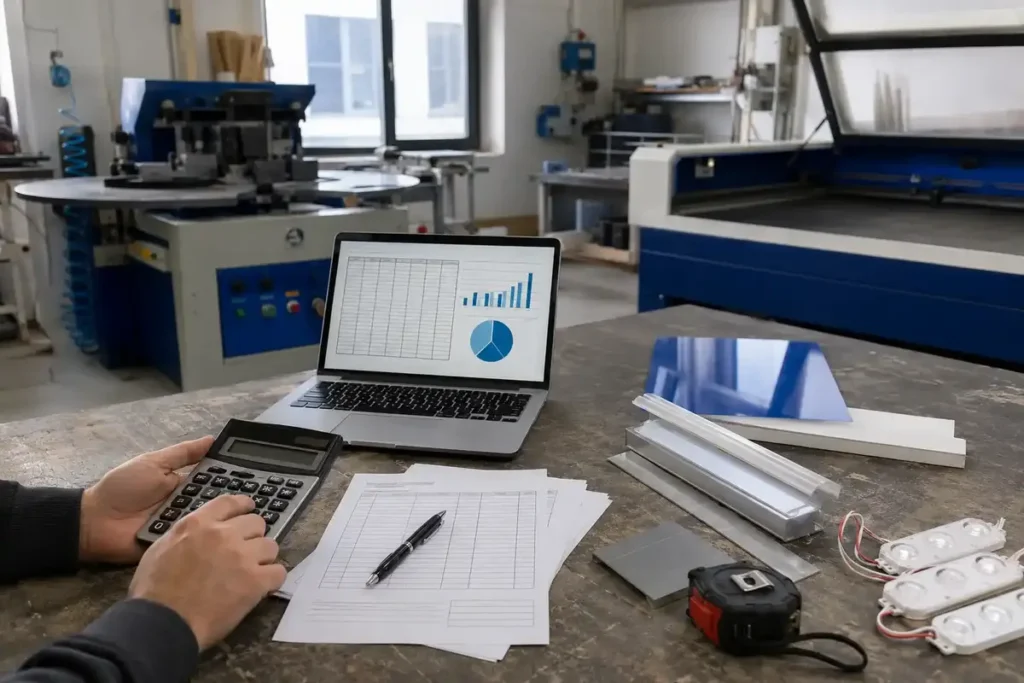
Profitable pricing must recover every cost required to complete and support a project. Quoting based only on material cost can produce attractive sales figures while leaving insufficient gross profit to cover the company’s overhead.
A quote should account for:
- Materials and expected waste
- Design and revision time
- Machine setup and operating time
- Direct fabrication labor
- Finishing and assembly
- Outsourced processes
- Packaging and delivery
- Site surveys and permits
- Installation labor and equipment
- Sales and administrative time
- Facility and operational overhead
- Warranty or rework risk
- Desired profit
Use minimum charges or setup fees for small custom jobs. Define the number of included revisions and obtain written approval for artwork, dimensions, materials, colors, spelling, mounting, and installation conditions before production begins.
After completion, compare estimated costs with actual material use, machine time, labor, and installation expenses. This feedback improves future quotes and reveals which product categories are genuinely profitable.
There is no universal margin or startup timeline for every sign company. Profitability depends on product mix, sales volume, fixed expenses, production efficiency, and equipment debt. The company reaches operational break-even when its gross profit consistently covers monthly overhead; positive cash flow may take longer if customers pay after completion.
The first customers often come from direct outreach, referrals, contractor partnerships, local search, and a credible visual portfolio. Photograph completed work professionally, request customer reviews, and document measurable project outcomes. For a new company, a small number of repeat commercial accounts can provide more stability than many unrelated one-time orders.
How to Scale a Sign Company
Scaling should increase profitable production capacity rather than simply increase the number of products offered. Before expanding, identify the current constraint.
If quotations are delayed, improve estimating templates. If design revisions consume too much time, strengthen the approval process. If production is restricted by an outsourced service, compare its annual cost and lead time with equipment ownership. If a machine is fully utilized, evaluate automation, additional shifts, or upgraded capacity.
A practical scaling sequence is:
- Standardize quoting and order documentation.
- Measure profitability by job type.
- Build repeat demand within the initial product range.
- Document production and quality-control procedures.
- Bring frequently outsourced processes in-house.
- Add employees around clearly defined roles.
- Introduce related products that use existing customers, materials, or equipment.
- Pursue higher-value commercial and multi-location contracts.
Equipment investment should solve proven demand. Review order volume, material requirements, labor hours, outsourcing costs, production bottlenecks, floor space, and expected payback before purchasing another machine.
Higher-value commercial work may require stronger project management, installation capabilities, insurance, credit control, and quality documentation. Growth can increase revenue while creating new cash-flow and operational risks, so production capacity and financial controls must expand together.
Conclusion: Building a Scalable Sign Company
Starting a professional sign company requires a coordinated plan for products, customers, costs, equipment, pricing, production, and sales. The strongest foundation is a focused business model supported by validated demand rather than an extensive equipment list purchased before orders exist.
Choose equipment according to the materials and signs you intend to manufacture. Outsource specialized or irregular processes during the early stage, then bring them in-house when regular demand, quality requirements, or lead-time savings justify ownership.
Accurate quoting, documented approvals, efficient production, and repeat commercial customers create the conditions for sustainable growth. By measuring real job costs and expanding capacity only when a clear constraint appears, a new sign company can develop from a focused operation into a scalable manufacturing business.
Frequently Asked Questions
How do I start a sign company?
Start by choosing the types of signs you want to produce and identifying the customers most likely to buy them. Research local demand, calculate startup and operating costs, define which processes you will outsource, and purchase only the equipment supported by regular order volume. You will also need a reliable workflow for quoting, design approval, production, quality control, delivery, and installation.
How much does it cost to start a sign company?
The cost depends on the company’s product range, facility, production volume, staffing, and equipment strategy. A design-and-outsourcing operation requires less initial investment than a company manufacturing channel letters, architectural signs, or metal components in-house. Calculate business registration, insurance, rent, software, equipment, materials, marketing, labor, maintenance, and working capital separately rather than relying on a single industry estimate.
What equipment do I need to start a sign business?
The required equipment depends on the signs you plan to manufacture. A startup may need design software, computers, hand tools, a vinyl cutter, printing equipment, finishing tools, and installation equipment. CNC routers are useful for routed panels and dimensional lettering, CO₂ lasers for acrylic and non-metal materials, fiber lasers for metal components, and channel letter bending machines for dimensional and illuminated letters.
Is owning a sign company profitable?
A sign company can be profitable when its pricing covers materials, labor, machine time, design, installation, overhead, and an appropriate profit margin. Profitability depends more on product demand, production efficiency, accurate quoting, repeat customers, and cost control than on revenue alone. Tracking the actual cost and profit of every completed job helps identify the company’s strongest products.
What types of signs are most profitable?
Channel letters, acrylic signs, dimensional lettering, architectural sign packages, wayfinding systems, and recurring commercial signage can offer strong profit potential. However, the most profitable products are those for which the company has consistent demand, efficient production capabilities, accurate pricing, and limited material waste or rework. A lower-priced repeat product may be more profitable than a complex one-off project.
Do I need a physical shop to start a sign company?
A physical production shop is not always necessary at the beginning. A company can initially manage design, sales, and project coordination while outsourcing manufacturing. However, industrial machinery, large materials, fabrication, finishing, and assembly generally require a suitable commercial facility with adequate electricity, ventilation, storage, loading access, and safety provisions. Home-based operations must also comply with local zoning and workspace restrictions.
How do I get my first sign company customers?
Begin with a professional website and portfolio, an optimized Google Business Profile, direct outreach to local businesses, and relationships with contractors, property managers, architects, designers, and commercial property contacts. Referrals and visible project content can also build credibility. Focus on a clearly defined customer group and demonstrate how your company solves its specific signage needs.
What machine is best for starting a sign-making business?
There is no single best machine for every sign company. A CNC router may be suitable for dimensional letters and shaped panels, while a CO₂ laser may be better for detailed acrylic products. A vinyl cutter or printer may be more practical for graphics-focused work. Select the machine that supports your validated product mix and removes the most important production bottleneck.
How can I scale a sign company?
Scale by standardizing quoting and production, measuring profitability by job type, building recurring customer demand, and documenting quality-control procedures. Bring frequently outsourced processes in-house only when order volume justifies the investment. Additional employees, automation, related product lines, and larger commercial contracts should be introduced around proven demand rather than assumed future sales.
Find the Right Machine for Your Application
Latest contents


Prefer a callback? Share your details and requirements below.
Your details will only be used to respond to this request.