

Best Laser Machines for Sign Shops: 2026 Buyer’s Guide
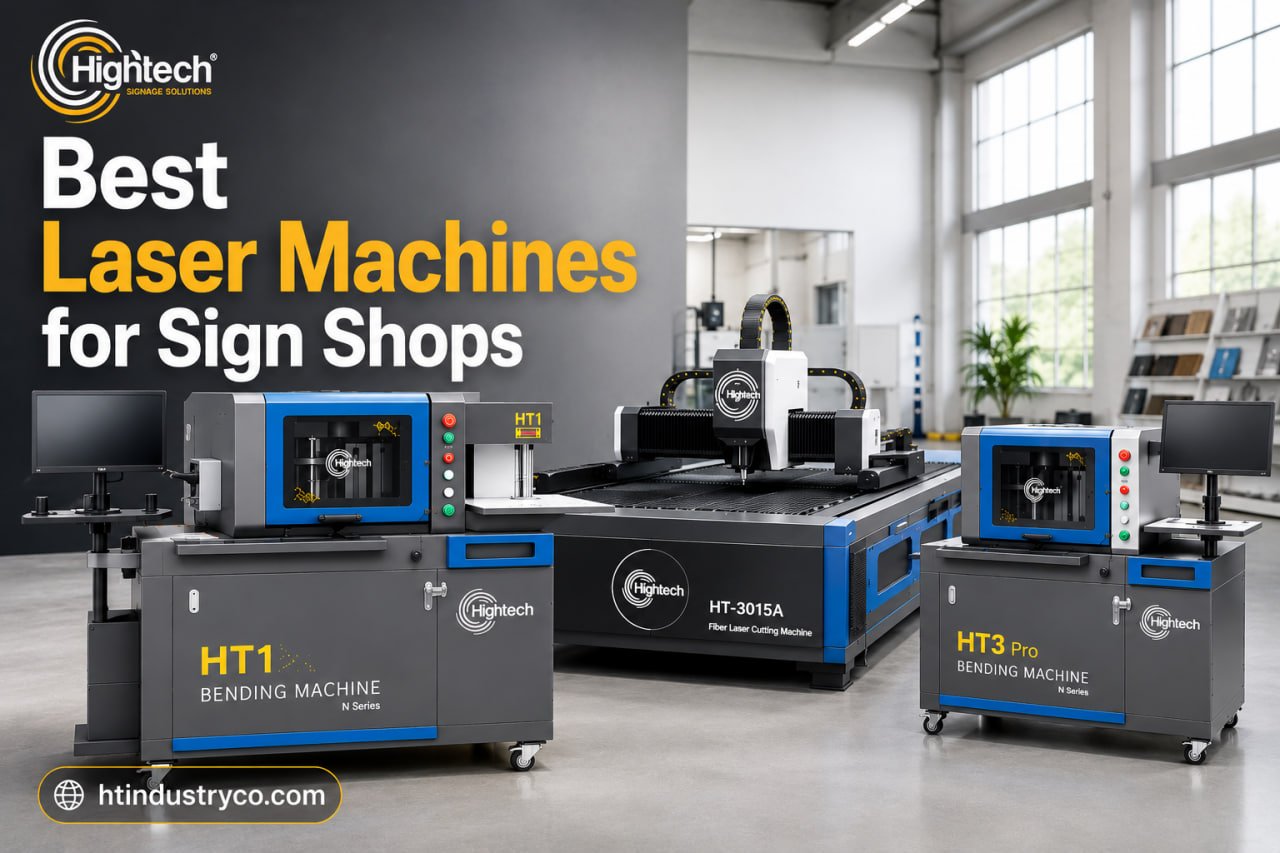
Table of Contents
Choosing the right laser machine starts with the sign products you plan to make—not with the highest wattage or the longest feature list. A shop cutting acrylic letters, wood panels and engraved plaques needs a different laser platform from a fabricator producing stainless-steel logos or aluminum sign components. If the work also includes fabricated metal letters, cutting is only the first operation: the parts may then need bending, welding, finishing and assembly.
This guide compares CO2 laser cutters, fiber laser cutters and laser welders from the perspective of a professional sign shop. It explains what each technology does, where it fits in production and which Hightech models are worth shortlisting. Because final performance depends on material grade, thickness, geometry, gas, settings and configuration, use the recommendations as a practical starting point and approve a machine only after testing your own files and materials.
Quick Answer: Which Laser Machine Is Best for a Sign Shop?
If you mostly cut non-metals (acrylic, PVC, wood, foam board): a CO2 laser like the HT CO2-1530 is the best fit. It handles large sheets and offers clean, polished acrylic edges that double as a finished sign surface.
If you make metal letters or dimensional metal signage: a fiber laser such as the HT FC-1325 cuts stainless, carbon steel, aluminum, and brass with burr-free edges.
If you build illuminated channel letters: add a channel letter bending machine like the HTZ5 or HT6 to form the metal returns automatically.
If you’re a new or small shop: start with a compact CO2 unit like the HT CO2-6040 and an entry bender like the HT1, then scale up as volume grows.
If you make metal letters or dimensional metal signage: a fiber laser such as the HT FC-1325 cuts stainless, carbon steel, aluminum, and brass with burr-free edges.
If you’re a new or small shop: start with a compact CO2 unit like the HT CO2-6040 and scale up as volume grows.
How to Choose the Best Laser Machine for Your Sign Shop
Seven factors decide whether a laser earns its place on your floor. Work through them in order before requesting a quote.
Laser Power (Wattage) for Sign Materials
CO2 power dictates how thick a material you can cut and how fast. Hightech’s CO2 platform — including the HT CO2-1530 — is available from 60W up to 250W. For typical sign acrylic up to 10–12 mm, 80–130W is the sweet spot; heavier production or thicker stock benefits from 150W and above. Fiber lasers are rated differently: power there governs metal thickness and cutting speed rather than engraving depth.
Work Area / Bed Size & Pass-Through for Large Signs
Match the bed to your largest common job. The HT CO2-1530 offers a 1500×3000 mm processing surface for oversized panels, while the CO2 HT-1325 covers a 1300×2500 mm area. Compact options like the HT CO2-6040 suit smaller signage and engraving jobs where floor space is tight.
Materials You'll Cut & Engrave
This is the single biggest decision driver. The HT CO2-1530 cuts and engraves acrylic, density board, double-color board, leather, paper, and wood — the core of non-metal sign making. For metal, the HT FC-1325 processes aluminum alloy, brass, carbon steel, copper, galvanized sheet, stainless steel, and titanium alloy.
Speed, Automation & Throughput
Hightech’s CO2 machines run engraving speeds up to 1200 mm/s and cutting up to 600 mm/s with locating precision of ±0.05 mm. On the metal side, the HT FC-1325 reaches cutting speeds up to 60 m/min with ±0.02 mm repeated positioning — throughput that pays off in high-volume shops. For metal production lines, the exchange-table HT FC-2040 ET keeps the laser cutting while the next sheet loads.
Software & Workflow Compatibility
Confirm that the controller accepts the file formats generated by your design and nesting workflow. If you cut printed graphics to registration marks, ask whether the exact configuration includes a compatible camera or CCD registration system; do not assume that every model supports contour cutting. Also check training, parameter storage, nesting options, remote support and how easily operators can recover from a stopped job.
Safety, Ventilation & Compliance
Industrial laser systems require a site plan covering extraction, cooling, electrical supply, fire precautions, gas storage and local laser-safety rules. Never process an unknown plastic or coated material until its composition and emissions are confirmed; some materials release corrosive or hazardous fumes when heated. Requirements vary by country and facility, so the quotation should identify voltage, enclosure, extraction and installation responsibilities for the destination site.
Total Cost of Ownership: Price, Consumables & Support
Look past the sticker price. CO2 tubes are consumable and need periodic replacement; fiber sources are largely maintenance-free with long service life. Hightech sells factory-direct, includes a 1-year warranty with lifetime after-sale technical support, and offers local support networks in the USA, Canada, and Mexico. Standard terms are a 30% deposit with the balance before shipment, and production typically runs 30–60 working days.
Which Laser Machine Fits Each Sign Product?
Sign product | Main process | Recommended machine | Selection logic |
Acrylic letters and sign faces | Cut or engrave acrylic, MDF or wood | CO2 laser cutter | Choose bed and power by sheet size, thickness and required edge quality. |
Stainless/aluminum letters and logos | Cut bare sheet metal | Fiber laser cutter | Match source power, bed size and assist gas to the metal and volume. |
Fabricated metal letters or returns | Join thin metal parts | Fiber laser welder | Validate alloy, fit-up, joint design, heat input and finish with sample welds. |
Illuminated channel letters | Cut faces/backs; form returns; join and assemble | CO2 or fiber cutter + bender + joining tools | This is a production line, not a one-machine task. |
Printed contour-cut signs | Read marks and cut printed media | Camera-capable laser, if configured | Confirm registration-mark recognition on the exact model and software. |
Thick foam or dimensional substrates | Route or shape in 2D/3D | CNC router | A router may be more suitable when depth and mechanical removal matter. |
Best Laser Machines for Sign Shops Compared (2026)
Machine | Laser Type | Laser Type | Power Range | Work Area | Best Materials | Best For |
|---|---|---|---|---|---|---|
HT CO2-1530 | CO2 | 60–250W | 1500×3000 mm | Acrylic, MDF, wood, leather, fabric | Large-format non-metal signage | |
HT CO2-1390 | CO2 | 60–250W | 1300×900 mm | Acrylic, wood, double-color board | General sign-shop cutting/engraving | |
CO2 HT-1325 | CO2 | 60–250W | 1300×2500 mm | Acrylic, MDF, leather, paper | High-volume acrylic & panel work | |
HT CO2-6040 | CO2 | Desktop class | 600×400 mm | Acrylic, wood, paper, leather | Entry-level / small sign shops | |
HT CO2-7050 Z | CO2 | Mid class | 700×500 mm | Acrylic, wood, engraving stock | Detailed engraving + Z-axis depth | |
HT FC-1325 | Fiber | Up to 60 m/min | 1300×2500 mm | Stainless, carbon steel, aluminum, brassContent | Metal letters & dimensional metal signage | |
HT FC-1530 | Fiber | Industrial | 1500×3000 mm | Carbon/stainless steel, aluminum | Large metal panels & fabrication | |
HT FC-2040 ET | Fiber | Industrial | 2000×4000 mm | Sheet metal, structural metal | High-throughput metal production |
Best CO2 Laser Machines for Acrylic and Non-Metal Signs
A CO2 laser cutting machine for signage is the usual choice when acrylic, MDF, wood, leather, paper or similar non-metal materials dominate the workload. It can combine cutting and engraving in one platform, but the correct model depends on sheet size, thickness, volume and the finish expected from the cut edge.
Best Large-Format CO2 Laser: HT CO2-1530
The HT CO2-1530 is the strongest candidate in this group when a shop regularly handles large sign faces or panels. Its published 1500 × 3000 mm processing area can reduce the need to divide large artwork into smaller sections and may improve nesting on full sheets. Hightech lists multiple power configurations, but the final tube, optics and cooling package should be chosen through material testing rather than by assuming that more wattage is always better.
Choose it when large-format non-metal work is routine and the floor plan can accommodate the machine, sheet handling and extraction. If most jobs are much smaller, a mid-format machine may provide a better balance of capacity and operating overhead.
Best Mid-Format CO2 Laser: HT CO2-1390
With a published 1300 × 900 mm work area, the HT CO2-1390 suits shops producing acrylic letters, engraved panels and general non-metal signage without needing a 3-metre bed. Hightech describes a reinforced cutting structure, belt transmission and several power configurations. In practical terms, the model may be a sensible middle path when a desktop unit is restrictive but large-sheet work is not frequent enough to justify the footprint of the CO2-1530.
Best Compact CO2 Options: HT CO2-6040 and HT CO2-7050 Z
The HT CO2-6040 has a published 400 × 600 mm processing surface and is intended for non-metal cutting and engraving. It can suit smaller sign components, samples, plaques and shops with limited space. The HT CO2-7050 Z offers a larger compact-format platform with vertical travel for work that needs additional clearance. Confirm the current work area, Z travel, source and compatible fixtures before choosing between them.
Best Fiber Laser Cutting Machines for Metal Signs
For a shop searching for a metal cutting machine for signs, fiber laser is normally the relevant technology for bare sheet metal. It can cut stainless steel, carbon steel, aluminum, brass and other supported metals when the source, assist gas and parameters are matched to the job. The goal is not merely to cut a part; it is to achieve the edge quality and repeatability needed for finishing, welding and installation.
HT FC-1325 for Metal Letters and Panels
The HT FC-1325 is positioned around a 1300 × 2500 mm metal-cutting format. That size may fit many letter, logo, plaque and decorative-panel jobs while requiring less floor space than a larger production table. Hightech lists an autofocus cutting head, fiber source and operation with air, oxygen or nitrogen, but the correct gas and configuration depend on the alloy, thickness, edge requirement and downstream finish.
This model is worth shortlisting when the shop needs in-house metal cutting but does not routinely process 1500 × 3000 mm or 2000 × 4000 mm sheets. Ask for sample parts that include tight internal corners, small letter details and the finish you plan to apply after cutting.
Best Large-Format Laser — CO2 HT-1325 & HT FC-1530 / HT FC-2040 ET
Shops running oversized work have two paths. For large non-metal panels, the CO2 HT-1325 delivers a 1300×2500 mm area. For large metal sheets and production volume, step up to the HT FC-1530 (1500×3000 mm) or the exchange-table HT FC-2040 ET (2000×4000 mm) for near-continuous cutting.
Best Channel Letter Bending Machines for Sign Shops
Cutting the letter face is only half the job. To build illuminated channel letters, you bend the metal return (the side wall) that gives the letter its depth and houses the LEDs. A channel letter bending machine automates that step, delivering precise, high-speed bending of metal letters and signage components for both small workshops and large production facilities.
Why add a bending machine to your shop:
• Save time and labor: automates the bending process and reduces manual effort.
• High accuracy: consistent bends produce professional-quality signage every time.
• Material flexibility: works with a range of metals and alloys — pair it with the right channel letter material.
• Higher production efficiency: handles repetitive tasks quickly to support greater output.
Hightech Channel Letter Bending Machine Range
Hightech offers five channel letter bending machines, from entry-level to fully automated. Choosing the right one depends on your production volume, the metals you bend, and how much fine control you need for intricate letter designs.
Machine | Positioning | Best For |
|---|---|---|
HTZ5 | Top-tier / fully automated | High-volume shops wanting maximum automation and speed |
HT PRO | Professional / advanced | Established shops needing fast, precise daily production |
HT6 | Mid-range workhorse | Growing sign shops with steady channel-letter output |
HT3 | Versatile mid-tier | Shops balancing precision and budget |
HT1 | Entry-level | New shops starting in-house channel-letter fabrication |
HTZ5 — top of the range. The HTZ5 Channel Letter Bending Machine is built for high-volume shops that want maximum automation and the fastest, most consistent letter fabrication.
HT PRO — professional production. The HT PRO channel letter bending machine suits established shops that need fast, precise output day in and day out.
HT6 — mid-range workhorse. The HT6 Channel Letter Bending Machine is a reliable choice for growing sign shops with steady channel-letter demand.
HT3 — versatile mid-tier. The HT3 channel letter bending machine balances precision and budget for shops scaling up their fabrication.
HT1 — entry-level. The HT1 Channel Letter Bending Machine is the starting point for new shops bringing channel-letter fabrication in-house for the first time.
Tip: for a flawless finish, cut clean, accurate letter faces first with a CNC router or blade cutter, so they fit perfectly within the bender’s automated parameters.
Complete Sign-Shop Workflow: Cut, Weld, Bend and Assemble
The phrase metal sign making machine can imply that one system completes the whole sign. In practice, the equipment is selected by operation:
Output | Suggested sequence |
Acrylic illuminated sign | CO2 cut or engrave the face/back → prepare lighting and mounting → assemble and test |
Flat-cut metal logo or plaque | Fiber cut the metal → deburr or finish as required → coat and mount |
Fabricated or channel letter | CO2 or fiber cut the face/back → form metal returns → laser/TIG weld or mechanically join as appropriate → install LEDs → assemble and test |
When a Channel Letter Bender Is Needed
A channel letter bending machine forms the metal return that creates the side wall and depth of an illuminated letter. It becomes relevant when a shop wants to bring return fabrication in-house and has enough repeat demand to justify automation. Model selection depends on the channel profile, alloy, thickness, bend radius, notching method, software and expected volume. Keep this step separate from laser selection: the laser cuts faces or metal parts, while the bender forms the return. Review Hightech’s dedicated channel letter bending machine guide and approve the chosen profile through a sample test.
Where a CNC Router Fits
A CNC router complements the laser when the shop works with thicker sheet, foam, ACP, polycarbonate or dimensional 3D features that are better produced by mechanical cutting. The decision is based on material response, depth, edge requirement, dust or fume control and the geometry of the part—not on the assumption that either technology replaces the other.
Find the Right Machine for Your Application
Frequently Asked Questions
What is the best laser machine for a sign shop in 2026?
What is a channel letter bending machine and do I need one?
Which Hightech channel letter bending machine should I choose?
CO2 or fiber laser — which is better for sign making?
Laser cutter vs. CNC router — which do I need?
What materials can a laser machine cut and engrave for signage?
What laser power (wattage) do I need for sign materials?
Is a laser machine a good investment for a small sign business?
How do I import an industrial laser or bending machine to the US (warranty & support)?
Latest contents


Prefer a callback? Share your details and requirements below.
Your details will only be used to respond to this request.