
What Is ATC in CNC Machines? How It Works and Key Benefits
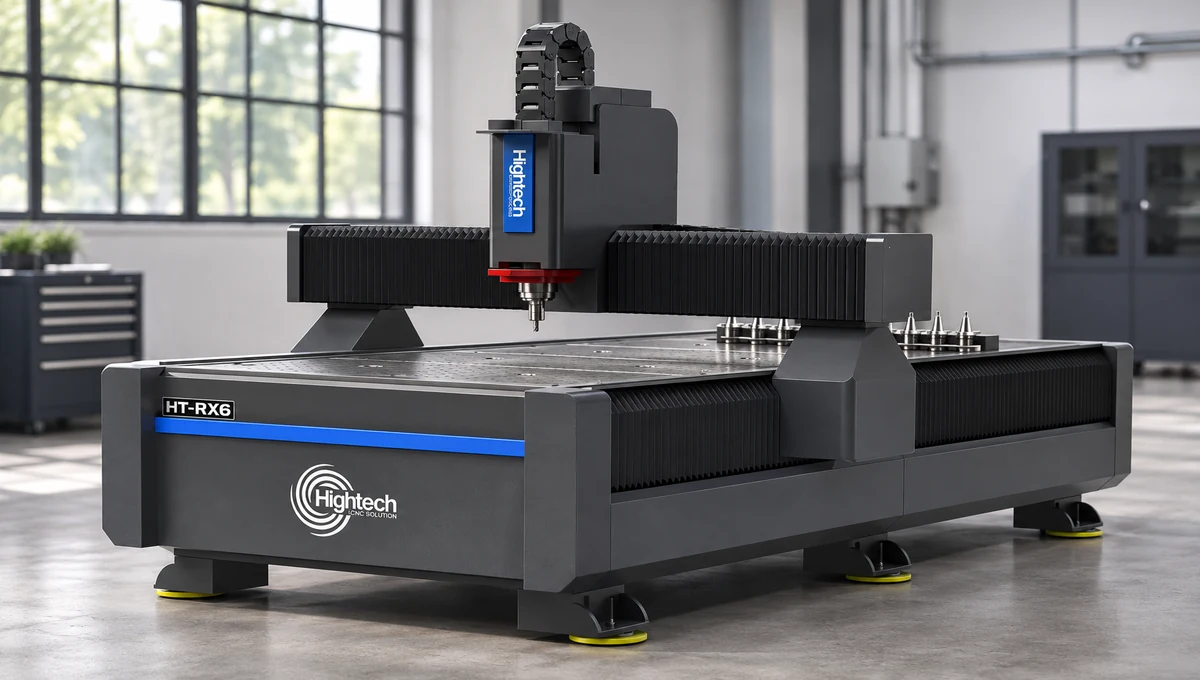
Table of Contents
Quick answer: ATC stands for Automatic Tool Changer. In a CNC machine, it replaces one cutting tool with another when the machining program calls for a different operation. An ATC CNC router can move between engraving, grooving and profiling without an operator manually swapping bits. It reduces tool-change interruptions; the real productivity gain depends on job complexity, setup and machine configuration.
Consider a sign panel that needs small lettering engraved, a decorative V-groove and an outer profile cut. These operations may require three cutters. Instead of stopping the router for each change, ATC lets the programmed sequence manage compatible tools automatically. Here is what that means in practice—and when the extra automation is worth having.
What Is ATC in a CNC Machine?
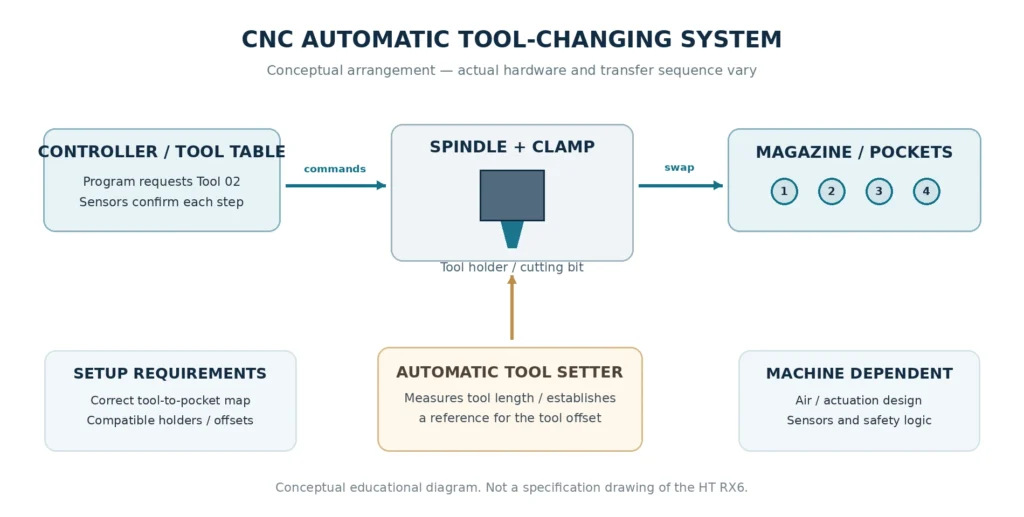
An automatic tool changer in a CNC machine is a coordinated system for storing, selecting, releasing and loading cutting tools under controller command. It works alongside the spindle, tool holders, machine controls and—where fitted—tool-measurement equipment. ATC is a feature of the machine, not another machining axis or a separate material-cutting method.
The CAM program still determines what shape to cut, the selected tool performs the cutting, and the workholding system secures the material. ATC handles the transition between tools. For a broader overview of router configurations, see the different types of CNC routers.
ATC vs manual tool change: what actually changes
On a manual-change router, an operator usually pauses machining, removes one cutter, installs the next and confirms the correct tool height before restarting. With ATC, the controller calls a preassigned tool and coordinates the exchange. People still prepare tooling, inspect holders, set the job and monitor the process; ATC removes a repeatable intervention rather than eliminating all setup work.
What Are the Main Parts of a CNC Automatic Tool Changer?
A CNC automatic tool changer relies on several interacting components. The exact hardware depends on the router and the chosen changer configuration.
Spindle, tool holders and clamping mechanism
The spindle drives the cutter during machining. A compatible tool holder keeps the cutter secured and presents a repeatable interface for pickup and release. The clamping or drawbar mechanism locks the holder in the spindle. Tool-holder type, cutter dimensions, permitted mass and retention hardware must match the specific machine—not just the nominal cutter diameter.
Tool magazine, transfer mechanism, controller and sensors
The magazine stores prepared tools in numbered pockets. A linear rack may place them along the side of the work area, while a rotating magazine brings a selected pocket to the exchange point. Some systems use a transfer arm. The controller tracks tool numbers and issues movements; position, clamp or presence sensors help verify that the exchange has completed. Pneumatic actuation and clean, correctly regulated air may be required, depending on the design.
Automatic tool setter: related, but not the changer
An automatic tool setter measures a tool reference, commonly its length, so the controller can apply an appropriate offset. It does not physically swap cutters. A router can have automatic measurement without ATC, or ATC with a separate tool-setting procedure. Both capabilities must be checked independently when comparing configurations.
How Does ATC Work in CNC Machines? Step by Step
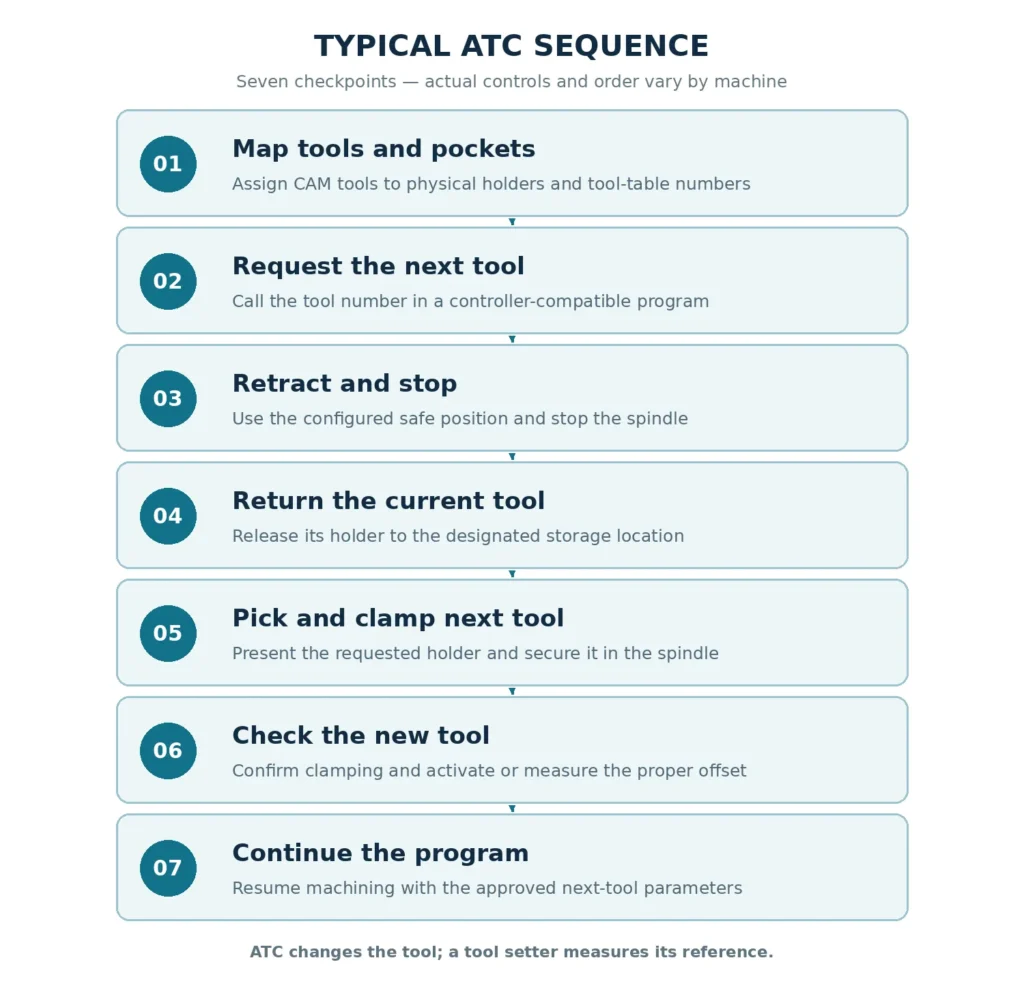
The working sequence begins before the first cut. CAM software assigns each operation a cutter; the postprocessor produces code that the CNC controller can interpret. The following seven steps describe a typical arrangement, not a universal HT RX6 cycle.
Before the run: set tools, tool numbers and offsets
- Prepare the tool map. Load the required cutters in approved holders and assign their physical pockets to the tool numbers used in the program. Verify the holder and bit are compatible with the selected spindle.
- Set the workpiece and tool references. Secure the material, establish work coordinates and measure or enter tool offsets following the machine procedure. Check that the program refers to the intended tools.
During the change: request, safe positioning, release and pickup
- Request the next tool. At a programmed tool change, the controller interprets the required tool number. Codes such as T02 and M06 are illustrative only and must be supported by the actual controller and postprocessor.
- Move to a safe exchange state. Cutting motion stops; the spindle stops and the machine follows its defined retract and tool-change position or path.
- Return and select tools. The current tool is released to its assigned storage location; the magazine or spindle then presents the requested replacement through the machine’s defined transfer motion.
After the change: clamping checks and program resumption
- Confirm the new holder and reference. The clamping system secures the new tool, required checks complete, and the appropriate tool-length offset is activated or measured as configured.
- Resume the programmed operation. The machine returns to the machining path and begins the next operation using the selected cutter and approved parameters.
Incorrect tool maps, offsets or postprocessor commands can cause collisions or scrap. Never attempt a first-run tool change without the machine-specific setup procedure and suitable safeguards.
What Are the Different Types of ATC in CNC Machines?
ATC systems are often described by magazine layout and transfer method. These are separate design choices: a chain or carousel describes how tools are stored, whereas an arm describes how a holder may be transferred. Five-axis machining is an axis configuration, not a tool-changer type.
Arrangement | How it works | Useful trade-off |
Linear / rack magazine | Tools are parked in fixed pockets; the spindle or another mechanism travels to a selected position. | Straightforward layout; requires accessible rack space and suitable travel. |
Carousel / drum magazine | A rotating assembly indexes tool pockets to a pickup or exchange location. | Compact storage for some layouts; access speed depends on indexing design. |
Chain magazine / arm transfer | A longer magazine or arm-based system transports holders between storage and spindle. | Can support more tools or specialized machines; generally adds mechanical complexity. |
A lathe turret also selects cutting tools, but it is not the same arrangement as the magazine and spindle exchange commonly discussed for CNC routers. Ask the supplier to identify the exact changer and its usable tool capacity for the quoted machine.
What Are the Benefits of ATC in CNC Machines?
The main benefits of ATC in CNC machines come from reducing pauses between operations that need different cutters. They are strongest where the machine repeats multi-tool programs over many parts.
Less manual tool-change downtime
Automatic exchanges can avoid the repeated walk-up, removal, installation and restart cycle of a manual setup. The difference is most meaningful when several changes occur within each job and those jobs repeat throughout a shift.
More consistent multi-operation workflows
A defined pocket-to-tool map and controlled exchange sequence can make production steps more predictable. Accurate results still depend on correct tools, workholding, program settings and measured offsets. The changer itself does not improve the spindle’s cutting power, feed rate or inherent positioning accuracy.
Reduced operator interventions — with limits
Operators may spend less time attending individual tool changes and more time on inspection, preparation or the next job. However, ATC adds holders, sensors and mechanical parts that need setup and maintenance. It cannot compensate for a poor toolpath, unsuitable cutter, wrong offset or inadequate extraction.
ATC CNC Router vs Manual Tool Change: Which Fits Your Work?
Neither option is automatically better. The right choice depends on how frequently tool changes interrupt your real production schedule, and whether your jobs can be standardized.
Decision factor | ATC CNC router | Manual tool-change router |
Work pattern | Repeated multi-tool jobs; programmed exchanges are valuable. | Simple, mostly one-tool jobs or low tool-change frequency. |
Operator involvement | Less hands-on involvement during changes; more tool mapping and setup checks. | Operator changes tools and reconfirms setup when needed. |
Equipment complexity | Magazine, clamping controls and more components to maintain. | Simpler tooling arrangement and usually lower initial complexity. |
Scheduling | Helps reduce interruptions within qualified repeat programs. | Works well when batch size is small or operations can be grouped by tool. |
Purchase decision | Evaluate overall delivered configuration and measured change time. | Compare lower system complexity against accumulated labour and idle time. |
Where Is ATC Useful in CNC Routing?
ATC is useful when a part genuinely requires several cutters or tool geometries. It is less valuable when all parts can be completed efficiently with one bit.
Sign making: profiling, V-grooving and engraving
A sign shop may engrave small text, use a V-bit for decorative grooves and profile-cut acrylic or PVC panels. Changing cutters automatically helps keep such a multi-step program moving. The best tooling depends on the substrate and finish, so see the guide to choosing a CNC router for sign making for wider buying criteria.
Cabinetry and woodworking: drilling, dados and panel profiling
Cabinet components may call for drilling, dado or pocket machining, and outside profiling. With an appropriate tool library and program, ATC can help route repeated MDF or wood panels with fewer interruptions. Workholding, drilling capability and dust handling still need to suit the job. Explore related CNC routers for cabinetry considerations.
Hightech example: HT RX6 with verified automatic bit change
Hightech lists the HT RX6 CNC Router Engraving Machine with automatic bit changing, auto bit calibration and an automatic tool setter, alongside a vacuum table and dust collection. Those published features make it a relevant model to evaluate for multi-tool signage or wood-panel work. The exact changer layout, pocket capacity, holder interface and delivered option set should be confirmed in the quotation; no cycle-time or magazine-capacity figure is assumed here.
Questions about workflow, tooling and daily utilization
Compare your jobs by tool count and repeat frequency, not only by machine price. If the work mostly uses one cutter or operators already batch jobs by tool, ATC may deliver little practical payback. Multi-tool repeat panels, on the other hand, make the potential reduction in stops easier to quantify.
Questions to ask about maintenance, safety and compatibility
Request the full configuration sheet, approved tool-holder specification, actual change procedure, controller compatibility and service plan. Have the supplier demonstrate a program using your planned tooling and explain how the system responds to missing tools or incomplete clamping.
Frequently Asked Questions About ATC in CNC Machines
Is ATC the same as an automatic tool setter?
No. ATC exchanges tools; an automatic tool setter measures a reference such as tool length. Some machines use both, but they serve different purposes.
Can a 3-axis CNC router have ATC?
Yes. Axis count describes the motion system, while ATC describes how cutters are changed. A three-axis router can be configured for automatic tool changing.
Does ATC make the cutting tool move faster?
Not by itself. ATC can reduce downtime between tools, but feed rate and cutting performance remain dependent on the machine, material, tool and programmed parameters.
Latest contents
Prefer a callback? Share your details and requirements below.
Your details will only be used to respond to this request.