
Laser Cutting Energy Consumption: How to Measure kWh and Cost per Part

Table of Contents
Quick answer
Laser cutting energy consumption is the electricity used by the cutting system over time, measured in kilowatt-hours (kWh). To compare machines fairly, meter the laser and relevant auxiliaries over the same job, record operating states and divide total energy by parts that pass inspection. A 6 kW laser rating describes optical output—not necessarily the machine’s grid draw.
Quick calculation If a metered cutting system averages 18 kW of electrical input for two hours, it uses 36 kWh.
What counts as laser cutting energy consumption?
Three quantities often get mixed together: laser output, electrical input and electricity used. Separating them is essential before comparing fiber laser power consumption or estimating operating cost.
| Measure | Unit | What it actually means |
|---|---|---|
| Rated laser optical output | kW | The laser-source beam rating (for example, 6 kW). It is not total electricity drawn from the grid. |
| Instantaneous system electrical demand | kW | Power being drawn at a given time by the defined machine and auxiliary loads. |
| Energy consumed during a job | kWh | Accumulated electrical use: average electrical kW × elapsed hours, or directly from an energy meter. |
| Specific electricity consumption | kWh / accepted part | Metered batch energy divided by units that pass the declared quality requirements. |
Choose the electricity measurement boundary first
A fair test defines what the energy meter includes. The simplest arrangement meters the whole laser machine supply and then identifies any separately powered auxiliaries. Some installations have a dedicated extractor and compressor; others share plant utilities across several cells. Record what is included, what is excluded and how any shared load is allocated. Never add a chiller’s energy twice if it is already on the main meter.
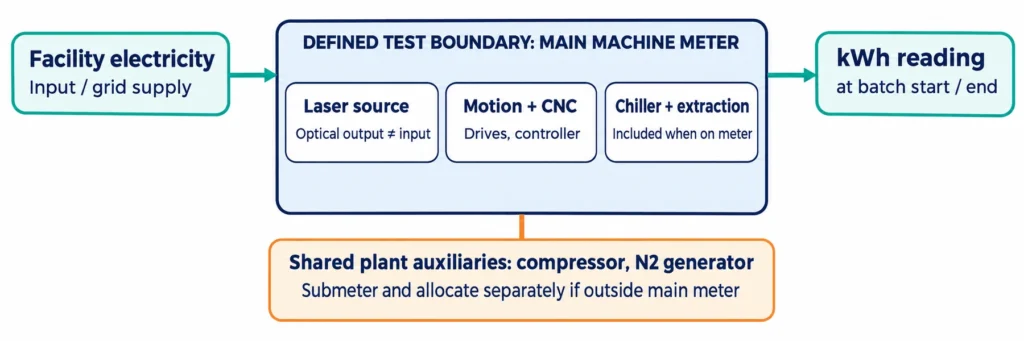
How much electricity does a fiber laser cutting machine use?
There is no defensible universal kWh-per-hour figure for a “3 kW”, “6 kW” or “12 kW” fiber laser. Those numbers describe optical power classes, while actual electrical demand varies with laser set point, material, thickness, piercing, cut path, chiller cycles, drives, extraction, standby periods and any outside air or nitrogen equipment. In one hour, the energy used equals the average measured electrical input in kW multiplied by one hour—not the rated optical output multiplied by one hour.
How to measure laser cutting energy consumption in a real workshop
The aim is a repeatable test that a workshop manager can audit and rerun. ISO 14955-2 addresses reproducible energy measurements for machine tools; ISO 14955-4 applies that evaluation framework to laser processing machine tools and related components.
Step 1 — Specify the job and acceptance criteria
Freeze the material grade, sheet thickness, CAD revision, total cut length, hole and pierce counts, nesting, part quantity, assist gas and edge-quality requirements. Document any post-cut cleaning or finishing the customer requires. A “successful part” must mean the same thing on every machine tested; otherwise the denominator changes with the inspection rule.
Step 2 — Install an appropriate meter safely
Use a suitably rated, calibrated electricity meter or power analyser at a clearly identified supply boundary. Only qualified electrical personnel should connect equipment inside panels. Record meter model, calibration status, test date, supply conditions and any submetered chiller, extractor, compressor or on-site nitrogen generator. If the plant utility is shared, explain the allocation method. Do not substitute an inverter screen’s laser-power display for a whole-machine energy reading.
Step 3 — Record operating states
Log start and end readings or time-interval kWh through start-up, warm-up, program loading, idle, piercing, cutting, repositioning, table change and shutdown—as appropriate to the production shift being studied. Note whether the batch begins with a warm machine or includes morning start-up. Industrial field research found that operating-state changes and chiller cooling cycles matter to the energy profile; a single “laser on” estimate misses this behavior.
Step 4 — Complete a stable batch and inspect output
Run the same approved process and retain the operator’s settings. Count parts produced, parts accepted and rejected parts; preserve the reasons for rejection. A part requiring additional energy-consuming rework should either have that energy included or be handled under a clearly defined separate process boundary.
Step 5 — Repeat and report uncertainty
Repeat enough runs to observe variation from nesting, machine state and cooling load. Report each trial rather than only the best result; present the average and the observed range. If the runs differ in batch size, operator procedure or external utilities, explain the difference instead of claiming a precise efficiency ranking.
A copyable shop-floor log
| Test ID | Machine / job | State & meter scope | Batch kWh | Made | Accepted | kWh / accepted |
|---|---|---|---|---|---|---|
| T01 | Model A; 2 mm SS | Full cell; batch | 30.0 | 100 | 90 | 0.333 |
| T02 | Model B; 2 mm SS | Full cell; batch | 27.0 | 100 | 75 | 0.360 |
| T03 | Repeat run | Same scope | — | — | — | — |
How to calculate kWh and energy cost per accepted part
Use metered batch energy and acceptable output rather than the headline source wattage. This turns a general laser cutting power consumption discussion into a production-cost calculation.
| Calculation | Formula |
|---|---|
| Batch energy (kWh) | End meter reading − start meter reading; add only genuinely separate auxiliary kWh. |
| Energy per accepted part (kWh/part) | Total allocated batch kWh ÷ accepted-part count. |
| Electricity cost per accepted part | (Allocated kWh × electricity rate per kWh) ÷ accepted-part count. |
Worked example: why rejected parts change the cost
Assume a meter shows 8,124.8 kWh at the beginning of a batch and 8,154.8 kWh at the end. The machine produces 100 components, of which 90 pass inspection. For illustration only, use an electricity rate of $0.18/kWh.
| Input or outcome | Illustrative value | Calculation |
|---|---|---|
| Batch electricity | 30.0 kWh | 8,154.8 − 8,124.8 |
| Accepted output | 90 parts | 100 produced − 10 rejected |
| Energy per accepted part | 0.333 kWh | 30.0 ÷ 90 |
| Batch electricity charge | $5.40 | 30.0 × $0.18 |
| Electricity per accepted part | $0.06 | $5.40 ÷ 90 |
Dividing by the 100 parts initially cut would give 0.300 kWh per part and understate the energy needed to deliver one acceptable part. If more output requires additional cutting, use the actual additional energy in the allocated batch total. This $0.06 figure covers electricity only—not material, nitrogen, labor, depreciation, optics, maintenance or finishing.
For electricity contracts with time-of-use rates, apply the rate for each relevant interval rather than one flat average. Monthly demand charges can also matter, but a demand charge is related to peak kW under the tariff rules and should not be silently folded into an illustrative per-kWh price. The U.S. Department of Energy distinguishes energy, demand and fixed charges.
What makes laser cutting electricity use rise or fall?
Material, thickness, geometry and piercing
Thickness and alloy affect the required energy delivery, cutting speed and assist-gas settings. Complex paths with numerous pierces can increase cycle time even when the same sheet area is processed. High optical power may shorten a job in some cases, but a faster process is not automatically more energy-efficient if auxiliary loads, quality losses or downtime increase. Use actual path and yield data before reporting an energy-per-metre or energy-per-kilogram figure.
Cooling, extraction, gas supply and idle time
The cooling system, controls, motion axes and fume extraction may draw electricity before, between and after cuts. On-site compressed-air or nitrogen generation can materially alter the electricity boundary, whereas delivered-gas purchase prices are a different cost category. Hightech’s nitrogen-versus-oxygen guide explains assist-gas selection; do not confuse the price of bought-in gas with kWh used by an on-site generator.
Nesting, rejects and batch size
A five-minute setup overhead spread across 10 parts contributes more energy per accepted part than the same overhead spread across 100 acceptable parts. Better nesting can also reduce the number of sheets or handling cycles, but any change should be checked against scrap, quality and actual electricity. The correct target is stable accepted output with less total energy—not simply maximizing feed speed.
How to optimize laser cutting energy consumption
1. Improve process settings without sacrificing quality
Start with material-specific cutting charts, then validate speed, focus, nozzle condition, gas pressure and piercing parameters on real parts. A cleaner edge may prevent rework, while a higher cutting speed may improve throughput; neither is an energy saving until the matched run shows fewer kWh per accepted part. Keep one change per trial where practical, or document multiple changes explicitly.
2. Reduce nonproductive electrical load safely
Measure how much electricity is consumed during program loading, breaks, table changes and between batches. Use only manufacturer-approved standby settings, automatic scheduling and cooling/extraction controls. Never bypass laser interlocks, disable required ventilation or compromise temperature protection to save power. Maintenance of filters and cooling systems should follow the machine and facility procedures.
3. Match the configuration to the workload
A compact Hightech FC-1325 may suit smaller sheets and shorter runs; the FC-1530 and FC-2040 address larger sheet formats; the HT FC-2040 Exchange Table is designed around production continuity; and the HT 3015 ST adds sheet-and-tube capability. These configuration differences matter to handling time and workflow, but their electricity savings must be established with compatible tests—not inferred from the product names or bed dimensions.
4. Track results per accepted part over time
Maintain a basic dashboard showing batch kWh, accepted yield, kWh per accepted part, idle share, material/thickness and the operator-approved settings revision. Review the same representative jobs after any software, nesting, gas, maintenance or operating-schedule change. A useful report states the baseline, new value, number of repeat runs and known limitations.
Frequently asked questions
Is laser output power in kW the same as electricity consumption?
No. Laser output is optical power. The laser source needs electrical input, and the machine also operates cooling, motion, control and other systems. Electricity consumption accumulates over time and is recorded in kWh.
How many kWh does a 6 kW fiber laser use in one hour?
You cannot determine that from the 6 kW optical rating alone. Measure the full system’s average electrical input. For example, if an installation averages an illustrative 18 kW from the grid for one hour, the recorded electricity is 18 kWh. That is not a verified figure for the Hightech HT 4015H.
Does a higher-power fiber laser always use more electricity per finished part?
No. A higher-power configuration can draw more electricity while operating but may complete a suitable job faster. The outcome depends on batch time, auxiliaries and accepted yield. Only a matched kWh-per-accepted-part comparison answers the question.
How do you calculate kWh per part when some parts are rejected?
Divide total allocated batch kWh by the number of pieces that pass the specified acceptance criteria. For 30 kWh and 90 accepted parts, the result is 0.333 kWh per accepted part. Rejects remain in the electricity numerator.
Sources and related reading
Latest contents

Prefer a callback? Share your details and requirements below.
Your details will only be used to respond to this request.