


Is Owning a Sign Shop Profitable? Costs & Profit Guide
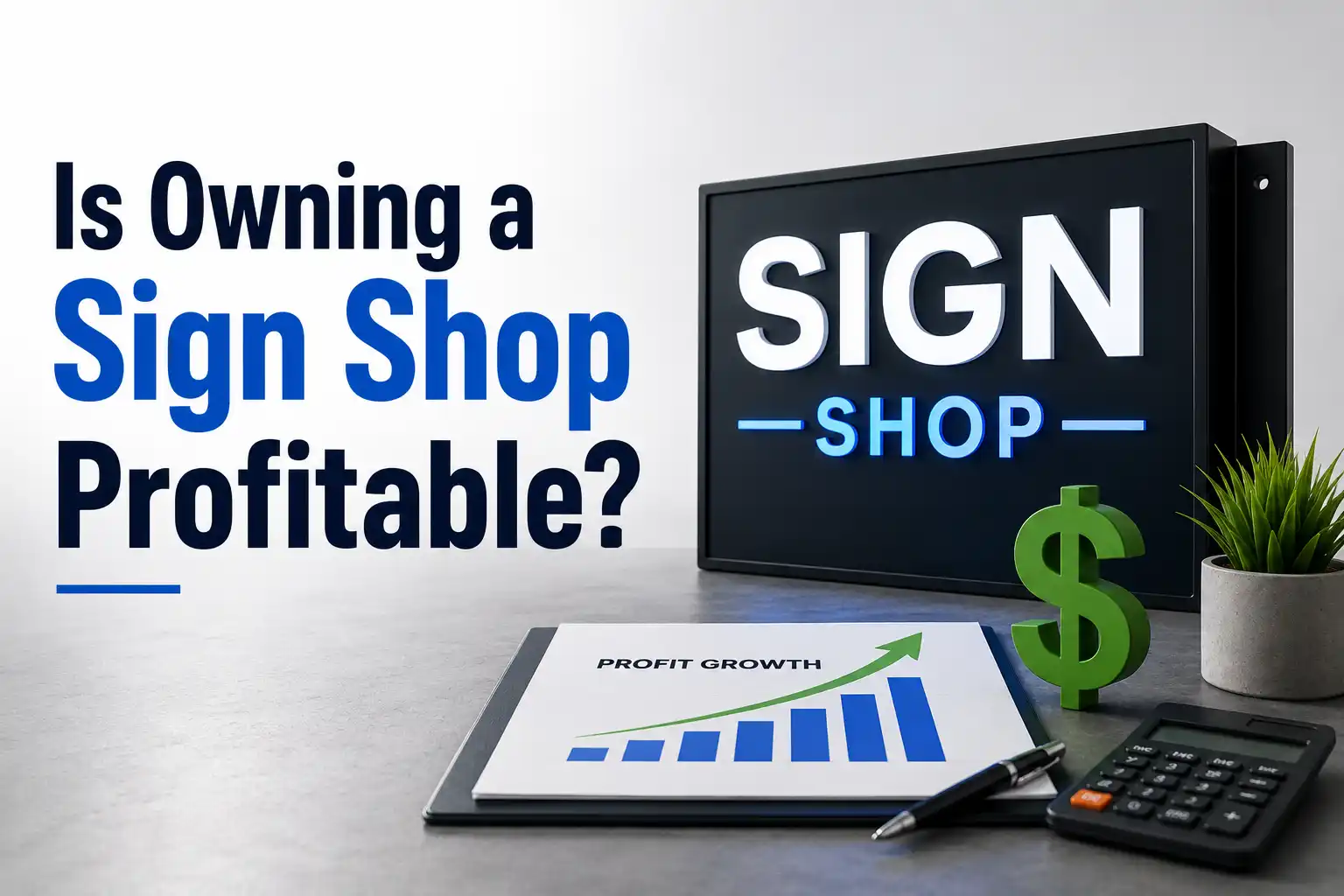
Table of Contents
Yes, owning a sign shop can be profitable when pricing, production costs, and overhead are properly controlled. As an illustrative planning benchmark, value-added sign work may target gross margins of approximately 40% to 70%, while a well-managed shop may aim to retain around 10% to 25% as net profit. These ranges are not universal industry averages; actual results vary significantly based on product mix, labor costs, equipment utilization, local demand, competition, and the amount of work performed in-house.
A small operation producing acrylic signs or vinyl graphics may have relatively low overhead, while a full-service shop producing channel letters and architectural signage can win larger contracts but face higher equipment, labor, facility, and installation costs. Therefore, profitability should be evaluated using gross profit, operating expenses, and net profit—not revenue alone.
How Profitable Is the Sign Industry?
There is no single profit-margin figure that applies to every sign shop. A home-based business producing small custom signs has a different cost structure from a commercial manufacturer handling illuminated signs, permits, site surveys, and installation.
Sign shop profit margins also vary by product. A high-priced project may generate substantial revenue but deliver a weak net profit after design revisions, materials, outsourced fabrication, installation, and overhead are deducted. Conversely, a smaller, repeatable product may provide a stronger margin because it requires less selling, setup, and production time.
Owners should monitor three separate figures:
- Revenue: the total amount charged to customers.
- Gross profit: revenue remaining after direct production costs.
- Net profit: the amount remaining after overhead and other operating expenses.
The following ranges can be used for initial planning, but they should not replace actual job-costing data:
| Metric | Illustrative Planning Range |
|---|---|
| Gross margin for value-added sign work | Approximately 40%–70% |
| Net profit margin for a well-managed shop | Approximately 10%–25% |
These figures are broad planning benchmarks rather than verified averages for every sign company. A shop’s results may fall above or below these ranges depending on its services, market, operating model, labor efficiency, debt, and overhead.
For example, if a sign project is sold for $6,000 and its materials, direct labor, installation, and allocated overhead total $4,400, the estimated operating profit is $1,600. That equals approximately 26.7% of the selling price. The calculation is only reliable when every relevant cost—including design and revision time—is included.
Market Demand and Industry Growth
Demand for signage is supported by the continuing need for physical identification, advertising, navigation, safety communication, and brand visibility. Retailers require storefront signs, offices need reception displays and directories, property managers order tenant and wayfinding signs, and manufacturers use safety labels and equipment identification plates.
New business openings, relocations, rebranding, damaged-sign replacement, construction projects, and changing tenant occupancy can all create additional demand. Many signs also require maintenance, updated graphics, new lighting components, or eventual replacement.
Revenue capacity in a sign shop is closely connected to employee productivity, equipment utilization, average order value, and the percentage of production completed in-house. However, higher output does not automatically create higher profit. Owners must compare additional revenue with labor, equipment, material, facility,
The strength of the opportunity still depends on the local market and selected niche. A shop in a growing commercial area may find stronger demand for exterior signage and channel letters, while another market may offer better opportunities in acrylic signs, vehicle graphics, event displays, or industrial identification products.
Factors Driving Long-Term Profitability
Long-term profitability depends on more than finding individual customers. Successful shops generally build systems that make quoting, design, production, approval, and delivery more consistent.
Important factors include:
- A clearly defined target market
- Accurate job costing and pricing
- A balanced range of repeatable and high-value products
- Reliable production equipment
- Low rates of material waste and rework
- Repeat commercial customers
- Consistent lead generation
- Controlled overhead
- Well-timed investments in equipment and staff
Customer retention is particularly important. Serving an existing property manager, contractor, retailer, or manufacturer again usually requires less sales effort than acquiring a new customer. Recurring accounts can also make purchasing, staffing, and production schedules more predictable.
What Determines a Sign Shop's Profitability?
A sign shop becomes profitable when the gross profit generated by its projects is sufficient to cover operating expenses and leave an acceptable return for the owner. To achieve this, the business must understand where its revenue comes from, what each job truly costs, and how efficiently orders move through production.
Revenue Sources
Sign shops can earn revenue from more than fabrication. Depending on their capabilities, they may charge for:
- Design and file preparation
- Site surveys and measurements
- Sign fabrication
- Printing, cutting, routing, or engraving
- Permit administration
- Delivery and installation
- Maintenance and repair
- Replacement signs and graphics
- Rush production
Product selection also influences revenue potential. Small engraved signs and decals may provide frequent orders, while channel letters and architectural signage may offer higher contract values. A balanced product mix can combine regular cash flow with larger commercial projects.
Sales channels matter as well. A shop may attract customers through local search, referrals, direct outreach, partnerships, social media, online marketplaces, or relationships with contractors and marketing agencies. Depending on one channel can make revenue vulnerable to seasonal or competitive changes.
Operating Costs
The biggest sign shop expenses typically include equipment, materials, labor, facilities, marketing, and maintenance.
Equipment costs may include computers, software, printers, vinyl cutters, laminators, CNC routers, laser machines, channel letter equipment, finishing tools, vehicles, and installation equipment. Owners must account for purchase or financing costs as well as training, electricity, maintenance, tooling, and downtime.
Material expenses can include acrylic, aluminum, vinyl, wood, LEDs, power supplies, inks, adhesives, laminates, fasteners, and packaging. Poor storage, cutting errors, ineffective sheet nesting, and remakes can increase these costs.
Labor extends beyond machine operation. Quoting, design, customer communication, proofing, setup, finishing, installation, and administration all consume time. Rent, insurance, utilities, software, marketing, and professional services must also be recovered through project pricing.
Startup investment depends heavily on the operating model. A home-based shop that outsources most fabrication may begin with relatively limited equipment. A print-and-cut shop requires a moderate investment in printing, cutting, laminating, software, and finishing systems. A fabrication or full-service shop typically requires more capital for machinery, workspace, trained operators, vehicles, installation equipment, and inventory.
A practical break-even calculation helps determine the minimum revenue required to support these expenses:
Break-Even Revenue = Monthly Fixed Costs ÷ Contribution Margin Ratio
For example, a shop with $15,000 in monthly fixed costs and a 50% contribution margin needs approximately $30,000 in monthly revenue to break even.
Production Efficiency
Production efficiency directly affects sign shop profit margins. Two businesses may charge the same price for an identical product, yet the shop that completes it with less labor, waste, and rework will retain more profit.
Efficiency can be improved through organized material storage, reusable templates, documented job instructions, accurate design files, batch production, preventive maintenance, and effective quality control. Clear customer approval procedures also reduce costly remakes caused by incorrect dimensions, spelling, colors, or materials.
Machine downtime, underused capacity, equipment financing, design revisions, installation travel, and remakes must be included in profitability calculations. These costs can gradually eliminate the expected margin when they are not assigned to individual projects or recovered through pricing.
Automation can improve repeatability and reduce manual bottlenecks, but only when equipment matches actual demand. A machine that remains idle creates financing, workspace, training, and maintenance expenses without producing enough revenue.
Buying equipment can improve profitability when predictable order volume, recurring outsourcing expenses, and faster turnaround justify the investment. Before purchasing, compare the total equipment investment with annual outsourcing savings and the additional profit the machine is expected to generate.
Payback Period = Total Equipment Investment ÷ Annual Net Savings or Additional Profit
This calculation should include installation, tooling, training, financing, maintenance, consumables, operator labor, and expected utilization—not only the advertised purchase price.
How Much Revenue Can a Sign Shop Generate?
Revenue varies too widely for one estimate to represent every sign business. Location, customer base, product range, staffing, production capacity, installation capabilities, and contract size all influence annual sales.
Instead of starting with a broad revenue claim, owners should estimate potential sales from realistic production capacity. For example, calculate how many jobs the shop can complete each month, the average order value, expected material and labor costs, and the percentage of available capacity likely to be sold.
Small Sign Shops.
A small or home-based sign shop may focus on vinyl lettering, engraved signs, acrylic products, banners, or online custom orders. Lower facility and staffing costs can make it easier to reach break-even, although production capacity and order values may be limited.
Such a business may become profitable sooner if the owner already has equipment, skills, or an existing customer base. However, owner income can remain constrained when one person must handle sales, design, production, and fulfillment.
Growing Sign Businesses
A growing shop may add commercial space, employees, production equipment, installation services, or a broader product range. These additions can increase revenue capacity but also raise fixed monthly expenses.
Growth should therefore follow validated demand. Before purchasing machinery or hiring staff, the owner should determine whether the change will increase profitable output, reduce outsourcing costs, shorten lead times, or remove a measurable production bottleneck.
Established Commercial Sign Companies
Established sign companies may serve contractors, franchises, property managers, institutions, manufacturers, and multi-location businesses. These customers can generate larger or recurring contracts involving design, fabrication, permitting, installation, and maintenance.
Commercial work can support substantial revenue, but it may also involve competitive bidding, complex project management, insurance requirements, credit terms, and delayed payments. Strong cash-flow management is therefore just as important as winning large contracts.
What Are the Most Profitable Sign Products?
No sign product is automatically the most profitable in every market. Profit depends on selling price, demand, material waste, labor requirements, production speed, installation risk, competition, and the shop’s existing capabilities.
Products and services with strong profit potential may include channel letters, dimensional signs, installation, repair and maintenance, vehicle graphics, and recurring commercial signage. Their actual profitability must be confirmed through job-level cost tracking.
Acrylic Signs
Acrylic signs are used for reception areas, office logos, directories, retail displays, room identification, and decorative branding. They can be cut, engraved, printed, layered, illuminated, or combined with other materials.
Their profit potential comes from customization and perceived visual value. Clean cutting, accurate mounting, effective sheet nesting, and standardized designs can help control production costs.
Channel Letters
Channel letters are dimensional signs commonly installed on storefronts and commercial buildings. They can command higher project values because they involve custom fabrication, lighting components, electrical considerations, and installation.
However, profitability depends on accurate estimates for materials, bending and assembly labor, LEDs, power supplies, permits, transport, and installation. Shops with sufficient order volume may improve capacity and repeatability by bringing more of the channel-letter workflow in-house.
Before investing in automation, compare channel letter bending machines against your material mix, order volume, and expected labor savings.
Commercial and Architectural Signage
Commercial and architectural signage may include building identification, directories, wayfinding systems, dimensional logos, safety signs, and coordinated sign packages. These projects can be valuable because one customer may require multiple related products.
They can also create recurring work when businesses expand, tenants change, or signs require updates. Profitability improves when the shop manages specifications, approvals, fabrication, and installation through a consistent workflow.
How to Increase the Profitability of Your Sign Shop
Begin by tracking estimated and actual material use, labor hours, machine time, outsourcing expenses, revisions, and installation costs for every job. This reveals which products produce healthy margins and which are being underpriced.
Establish minimum order values or setup fees for small custom jobs. Define how many design revisions are included, require customer approval before production, and charge separately for rush work, installation, delivery, or permit administration.
Develop repeat commercial relationships with property managers, contractors, retailers, manufacturers, schools, and marketing agencies. Recurring customers can lower acquisition costs and make production demand more predictable.
Equipment investment should be based on proven workflow needs. Automation can increase capacity, improve consistency, and reduce manual labor, but it should solve a real bottleneck. Compare equipment payments, maintenance, operator time, and workspace requirements with the cost and limitations of continued outsourcing.
If you are still developing the business, Hightech’s guide on how to start a sign business explains how to choose a niche, estimate startup costs, select equipment, and plan the operation step by step.
Conclusion: Building a More Profitable Sign Shop
Yes, owning a sign shop can be profitable, but revenue alone does not determine success. Illustrative targets of 40% to 70% gross margin and 10% to 25% net profit may assist with planning, but actual performance must be measured from the shop’s own job-costing records.
Accurate pricing, controlled waste, repeat commercial customers, efficient production, and high equipment utilization can strengthen margins. By tracking the full cost of every job and investing only when demand supports expansion, a sign shop can become a stable and scalable business.
Find the Right Machine for Your Application
Frequently Asked Questions
Is owning a sign shop profitable?
Yes. A sign shop can be profitable when it prices jobs using complete cost data, controls material waste and labor time, maintains sufficient production volume, and sells products with consistent demand. Profitability depends more on retained margin and cash flow than on revenue alone.
How much money can a sign shop make?
A sign shop’s revenue depends on its location, product mix, production capacity, customer base, and average project value. A small owner-operated shop may generate modest revenue from local and online orders, while an established commercial company can handle larger contracts and recurring multi-location projects. Revenue alone does not represent owner income; materials, labor, rent, equipment payments, marketing, and other operating expenses must first be deducted.
What is the average profit margin for a sign business?
There is no reliable margin that applies to every sign business. As an illustrative planning range, value-added sign work may target gross margins of roughly 40% to 70%, while a well-managed shop may aim for a net margin of around 10% to 25%. Actual results depend on the product mix, market, staffing, debt, and overhead.
What are the most profitable types of signs?
Acrylic signs, channel letters, architectural sign packages, dimensional lettering, wayfinding systems, and recurring commercial signage can offer strong profit potential. However, the most profitable signs are those with consistent demand that the shop can produce efficiently, price accurately, and deliver with limited waste, rework, and outsourcing.
How long does it take for a sign shop to become profitable?
There is no standard timeline. A home-based shop with existing equipment and customers may reach break-even faster than a commercial operation carrying rent, payroll, vehicle, and machinery expenses. Profitability generally arrives when recurring gross profit consistently covers fixed operating costs. New owners should calculate their monthly break-even point and maintain sufficient working capital rather than relying on a fixed timeframe.
What equipment improves sign shop profitability?
Equipment that removes a proven production bottleneck can improve profitability. Depending on the product mix, this may include a CNC router, CO₂ laser cutter, vinyl cutter, printer, laminator, channel letter bending machine, or automated finishing equipment. The investment should reduce labor, outsourcing costs, waste, or lead times and have enough regular work to justify its full ownership cost.
Is the sign industry growing?
Demand continues to be supported by new businesses, construction, rebranding, tenant changes, safety requirements, and the replacement or maintenance of existing signs. Growth opportunities differ by location and product category, so shop owners should validate demand within their target market instead of assuming that every signage niche is expanding at the same rate.
Latest contents




Prefer a callback? Share your details and requirements below.
Your details will only be used to respond to this request.