


What Is a Nitrogen Generator Used For? Applications, Benefits & Industries
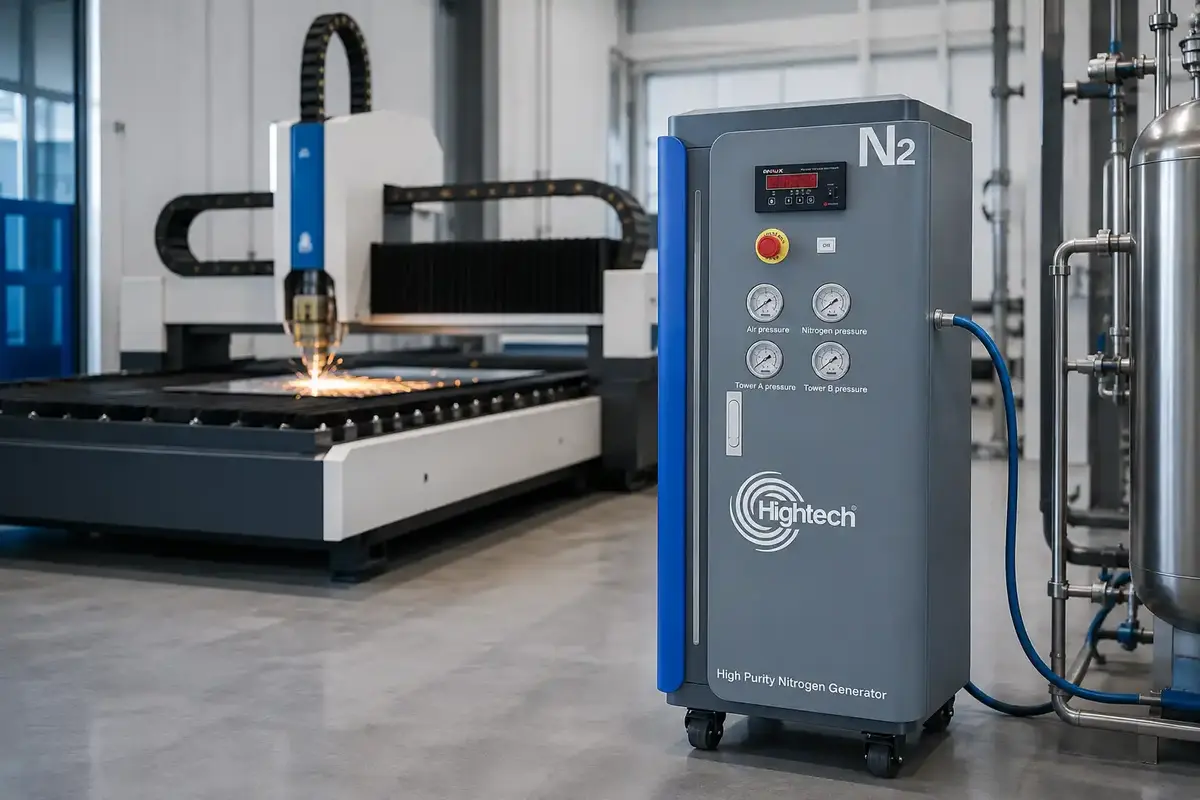
Table of Contents
A nitrogen generator produces nitrogen gas on-site for industrial processes that require a controlled, reliable, and often high-purity supply. Common nitrogen generator applications include laser cutting, food packaging, electronics manufacturing, pharmaceuticals, chemical processing, heat treatment, oil and gas operations, and other processes that require an inert or low-oxygen environment.
What Is a Nitrogen Generator Used For?
A nitrogen generator separates nitrogen from the surrounding air and supplies it directly to equipment or production lines. Industries use nitrogen because it is dry, chemically stable, and suitable for displacing oxygen in processes where oxidation, combustion, contamination, or moisture could affect the final result.
Although nitrogen is used across many industries, the required purity, pressure, and flow rate are not the same for every application. A laser cutting system, for example, may need a high-pressure and high-flow nitrogen supply, while a packaging line may prioritize consistent purity and continuous availability.
Understanding the actual process requirements is therefore essential before selecting a generator.
Nitrogen for Laser Cutting and Metal Fabrication
Nitrogen is commonly used as an assist gas when fiber laser machines cut metals such as stainless steel and aluminum. It helps expel molten material from the kerf while reducing the exposure of the hot cutting edge to oxygen.
Because nitrogen does not intentionally support oxidation, it can produce a clean, bright edge when the machine parameters and gas supply are properly configured. This may reduce secondary processing when the parts must be painted, welded, coated, or used with a visible finish.
Gas demand depends on several variables, including:
- Material type and thickness
- Laser power
- Nozzle diameter and condition
- Cutting pressure
- Cutting speed
- Piercing strategy
- Number of machines operating simultaneously
Nitrogen is not automatically the best assist gas for every metal-cutting job. Oxygen or compressed air may be more appropriate in certain applications depending on the material, thickness, required speed, operating cost, and acceptable edge condition. The article on Nitrogen vs Oxygen in Laser Cutting explains these differences in more detail.
Nitrogen for Food Packaging and Preservation
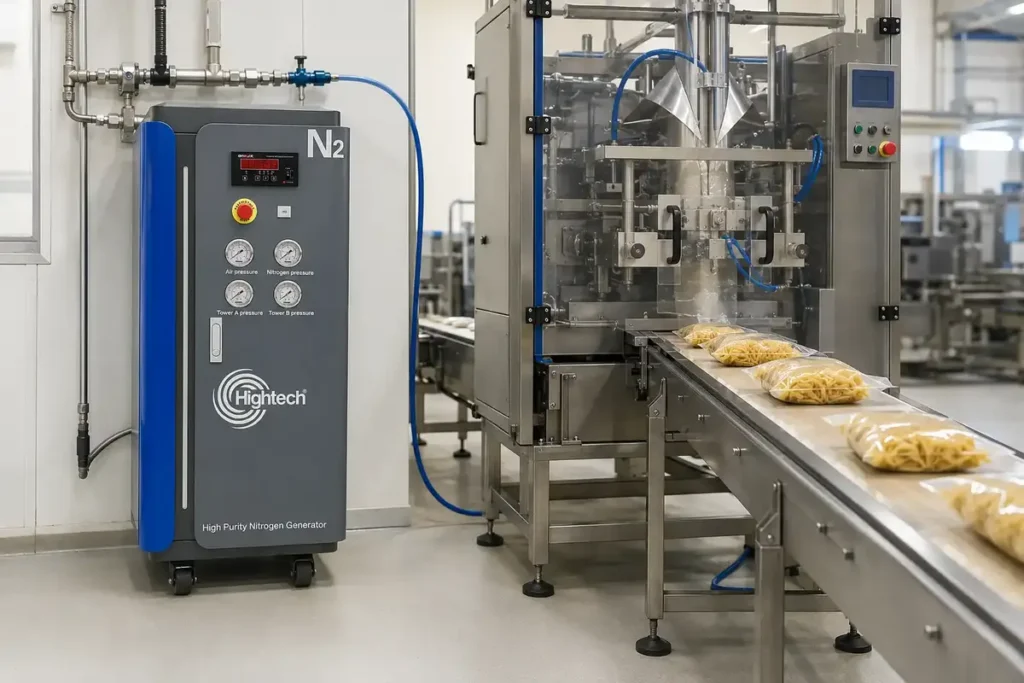
Food manufacturers use nitrogen to displace oxygen from packaging and processing environments. Lowering the amount of oxygen inside a package can slow oxidation, help preserve flavor and color, and support a longer usable shelf life.
In modified-atmosphere packaging, nitrogen may be introduced into bags, containers, or packaging lines for products such as snacks, coffee, nuts, oils, and other oxygen-sensitive foods. It can also help protect delicate products by maintaining package volume.
The required gas quality depends on the product, packaging process, applicable standards, and acceptable residual oxygen level. Food manufacturers must therefore select equipment and gas-treatment components suitable for their quality and compliance requirements.
Nitrogen for Electronics Manufacturing
Electronics manufacturers use nitrogen to create a more controlled atmosphere during processes such as soldering, reflow, selective soldering, and component production. Reducing oxygen can limit oxidation on metal surfaces and improve process consistency.
Nitrogen may also be used to protect sensitive components, purge equipment, or maintain controlled conditions during manufacturing and storage. The value of an on-site system depends on consumption patterns, required purity, and whether the production line needs nitrogen continuously or only during selected operations.
Nitrogen for Chemical and Pharmaceutical Processes
Chemical and pharmaceutical facilities use nitrogen for blanketing, purging, transferring materials, and maintaining low-oxygen environments. Nitrogen can be introduced into tanks, vessels, pipelines, and process equipment to reduce contact with oxygen or moisture.
These applications may support product stability, process control, and safer handling of certain materials. However, purity, monitoring, system design, and regulatory requirements can be particularly important. A nitrogen generator must be selected as one part of the complete process rather than as an isolated gas source.
Nitrogen for Heat Treatment and Industrial Manufacturing
Heat-treatment and metal-processing operations use nitrogen to help establish controlled furnace atmospheres and protect materials during heating or cooling. Depending on the process, nitrogen may reduce oxidation, scaling, or unwanted reactions on the material surface.
Manufacturers also use nitrogen for purging machinery, protecting stored materials, pressure testing suitable systems, and creating inert conditions in production environments. The necessary purity varies considerably: some general industrial processes can operate effectively at lower purity, while sensitive applications may require much higher nitrogen concentrations.
Nitrogen for Oil, Gas, and Other Industrial Applications
Oil and gas operations use nitrogen for pipeline purging, tank blanketing, pressure-related operations, and the displacement of oxygen or combustible gases from selected systems. Nitrogen is also used in laboratories, automotive manufacturing, tire inflation, additive manufacturing, and analytical instruments.
In each case, nitrogen serves a specific process function. Businesses should evaluate that function, required gas quality, consumption rate, and safety requirements instead of choosing a generator based only on its nominal output.
Why Do Businesses Generate Nitrogen On-Site?
Businesses generate nitrogen on-site to gain greater control over gas availability and reduce their dependence on scheduled cylinder or bulk-gas deliveries. A generator takes in compressed air, removes selected components, and supplies nitrogen at the purity and flow range supported by the system.
Two commonly used technologies are pressure swing adsorption and membrane separation. PSA generators generally separate nitrogen by using adsorbent material that preferentially captures oxygen and other molecules during alternating pressure cycles. Membrane systems use selective hollow-fiber membranes that allow gases to permeate at different rates.
For a fuller explanation of the separation process and system components, see How a nitrogen generator works?.
On-site generation can be valuable when nitrogen is used regularly, but it does not eliminate every operating requirement. The facility still needs suitable compressed air, filtration, drying, storage, controls, maintenance, ventilation, and electrical infrastructure.
Reduce Dependence on Nitrogen Cylinders
Cylinders can be practical for businesses with low or intermittent nitrogen demand. They require relatively little on-site generation equipment and allow companies to purchase gas as needed.
As consumption increases, however, cylinder replacement, storage, handling, delivery scheduling, and supply management can become more demanding. An on-site generator can reduce the number of cylinders required by producing nitrogen from the air already available at the facility.
Maintain a More Consistent Nitrogen Supply
On-site generation allows the business to produce nitrogen according to the capacity of its installed system. This can help operations that require a continuous gas supply or experience predictable production shifts.
Consistency still depends on correct system sizing. The generator, air compressor, treatment equipment, receiver tanks, and pressure controls must collectively support both average consumption and short periods of peak demand.
Control Nitrogen Availability and Production Downtime
Running out of nitrogen can interrupt cutting, packaging, purging, or other gas-dependent processes. Producing nitrogen on-site can reduce exposure to missed deliveries, cylinder shortages, or frequent replacement.
Redundancy may still be necessary for critical operations. Some businesses maintain backup cylinders or another supply arrangement so production can continue during maintenance or unexpected equipment downtime.
Potential Long-Term Operating Cost Benefits
Generating nitrogen on-site may reduce long-term gas costs when consumption is sufficiently high and consistent. The financial result depends on electricity prices, compressed-air efficiency, maintenance, required purity, operating hours, financing, and the cost of the existing gas supply.
Higher purity usually requires more energy or reduces the amount of nitrogen recoverable from the incoming air. Specifying greater purity than the process requires can therefore increase both equipment and operating costs.
A proper comparison should include:
- Current gas price and delivery charges
- Cylinder rental, handling, and labor
- Bulk storage and infrastructure expenses
- Generator purchase or financing
- Compressor and dryer energy consumption
- Filters and scheduled maintenance
- Expected operating hours
- Backup supply requirements
How to Choose a Nitrogen Generator for Your Application
Choosing the right generator begins with the process—not with the advertised maximum output of a particular machine. The required purity, flow, pressure, consumption pattern, and operating environment must be defined before equipment is selected.
Required Nitrogen Purity
Nitrogen purity should match the minimum level needed to achieve the desired process result. Food packaging, laser cutting, electronics, chemical processing, and general purging can all have different purity requirements.
Selecting excessively high purity may increase energy use and equipment size without improving the application. Conversely, insufficient purity may affect cutting quality, shelf life, product stability, or process control.
The correct level should be confirmed through equipment specifications, process testing, applicable standards, and supplier guidance.
Flow Rate and Gas Consumption
Flow rate indicates how much nitrogen the process consumes over a specified period. Generator sizing should account for both normal demand and peak consumption.
Laser cutting can create rapidly changing gas demand as the machine switches between materials, thicknesses, nozzles, and cutting programs. A facility with several machines must also consider the possibility of simultaneous operation.
Historical gas consumption, machine data, shift duration, expansion plans, and duty cycle provide a better sizing basis than a single maximum-flow figure.
Operating Pressure
The generator must be integrated with a system capable of delivering nitrogen at the required working pressure. Some applications operate at relatively modest pressures, while laser cutting may require substantially higher delivery pressure.
Compressors, storage tanks, boosters, dryers, filtration, piping, regulators, and safety controls all affect the final pressure and usable flow available at the process.
Application and Production Volume
An operation using nitrogen occasionally may find cylinders more practical. A business with stable daily consumption may obtain greater operational value from on-site generation.
Production growth should also be considered. A system sized only for current average use may become a bottleneck when another shift, production line, or laser machine is added. Excessive oversizing, however, can unnecessarily increase investment and operating costs.
PSA vs. Membrane Nitrogen Generation
PSA and membrane generators can both produce nitrogen on-site, but their suitability depends on the application.
PSA systems are commonly considered when higher nitrogen purity is required. Membrane generators may offer a relatively straightforward approach for applications that can operate at moderate purity. Actual performance depends on system design, inlet-air conditions, pressure, flow, and the selected operating point.
The choice should therefore be based on verified process requirements and total operating cost rather than technology name alone.
Nitrogen Generators for Fiber Laser Cutting
Fiber laser cutting can create a demanding nitrogen application because the process may require both high gas flow and high pressure. The supply system must keep pace with the laser machine without causing pressure instability or avoidable production interruptions.
When Nitrogen Is Used as a Laser Assist Gas
Nitrogen is often selected when cutting stainless steel, aluminum, and other materials for which a clean, low-oxidation edge is required. It pushes molten metal out of the cut while limiting oxidation at the edge.
This can be useful when appearance matters or when components will proceed directly to welding, painting, coating, or assembly. However, material thickness, productivity targets, and operating costs must be considered before specifying nitrogen for every job.
How Nitrogen Affects Cutting Quality
Adequate nitrogen purity, pressure, and flow contribute to stable removal of molten material and cleaner edges. Poor gas delivery can lead to dross, inconsistent cuts, discoloration, or reduced cutting performance.
Gas quality alone does not determine the result. Focus position, nozzle alignment, nozzle diameter, optics condition, laser power, speed, and material quality must also be controlled. The assist-gas system and cutting parameters should be treated as parts of one production process.
Matching Nitrogen Supply to Laser Production
The nitrogen system should be sized using actual cutting conditions. Important inputs include the laser machine’s power, materials and thicknesses, nozzle sizes, working pressure, daily cutting hours, expected utilization, and future capacity.
A complete nitrogen generation system may include more than the generator itself. Depending on the required configuration, compressed-air treatment, storage, boosting, filtration, control, and distribution equipment may also be necessary.
Is an On-Site Nitrogen Generator Worth It?
An on-site nitrogen generator may be worthwhile when a business uses nitrogen regularly, experiences high delivery or cylinder-handling costs, needs greater control over availability, or wants to integrate gas production into an automated workflow.
It may be less attractive when consumption is low, demand is unpredictable, required infrastructure is unavailable, or the existing supply method remains more economical. The decision should be supported by a consumption audit and a total-cost comparison rather than by gas price alone.
Businesses should evaluate:
- Annual and peak nitrogen consumption
- Required purity, flow, and pressure
- Current delivery and rental expenses
- Compressor capacity and energy efficiency
- Installation and maintenance costs
- Production losses associated with supply interruptions
- Expected growth and equipment utilization
- Required payback period
Conclusion: Understanding the Right Nitrogen Generation Application
A nitrogen generator is used to provide an on-site supply for industrial processes that need controlled nitrogen purity, flow, and pressure. Its applications range from laser cutting and metal fabrication to food packaging, electronics, pharmaceuticals, chemical processing, heat treatment, and oil and gas operations.
On-site generation can reduce dependence on delivered gas and provide greater control over availability, but it is not automatically the right solution for every facility. The investment should be based on actual nitrogen consumption, process requirements, existing infrastructure, operating costs, and anticipated production growth.
The right system is the one that reliably supports the application without specifying unnecessary purity or excessive capacity. By evaluating the complete workflow—not only the generator—businesses can determine whether on-site nitrogen production offers practical and long-term operational value.
Frequently Asked Questions
What does a nitrogen generator do?
A nitrogen generator separates nitrogen from compressed air and supplies it for industrial use. It allows a facility to produce nitrogen on demand at a defined purity, pressure, and flow instead of relying entirely on delivered cylinders or bulk liquid nitrogen.
Why do industries use nitrogen generators?
Industries use them to maintain an inert or low-oxygen environment, reduce oxidation, protect materials, preserve packaged products, improve process consistency, and control nitrogen availability. Common applications include laser cutting, food packaging, electronics, pharmaceuticals, chemical processing, and heat treatment.
How does an industrial nitrogen generator work?
An industrial generator uses technologies such as PSA or membrane separation to remove oxygen and other components from compressed air. The separated nitrogen is then filtered, stored, regulated, and delivered to the production process at the required operating conditions.
Why is nitrogen used for laser cutting?
Nitrogen is used as an assist gas to remove molten material while limiting oxidation at the cut edge. It is commonly selected for stainless steel and aluminum when clean edges and a bright surface appearance are important.
Is it cheaper to generate nitrogen on-site?
It can be cheaper for operations with stable or high nitrogen consumption, but the result depends on energy use, purity, maintenance, equipment investment, and current delivery costs. A total-cost and consumption analysis is required to determine the likely payback.
What is the difference between a nitrogen generator and nitrogen cylinders?
A generator produces nitrogen at the facility from compressed air, while cylinders contain nitrogen produced elsewhere and delivered to the user. Cylinders may suit low-volume demand; generators can provide greater supply control for regular industrial consumption.
How do I choose the right nitrogen generator?
Define the required purity, flow, pressure, operating hours, peak demand, compressed-air conditions, and expected growth. Then compare PSA and membrane technologies and evaluate the complete system, including air treatment, storage, boosting, maintenance, and backup supply.
Find the Right Machine for Your Application
Latest contents




Prefer a callback? Share your details and requirements below.
Your details will only be used to respond to this request.