

Laser Cutting: A Complete Guide (How It Works)
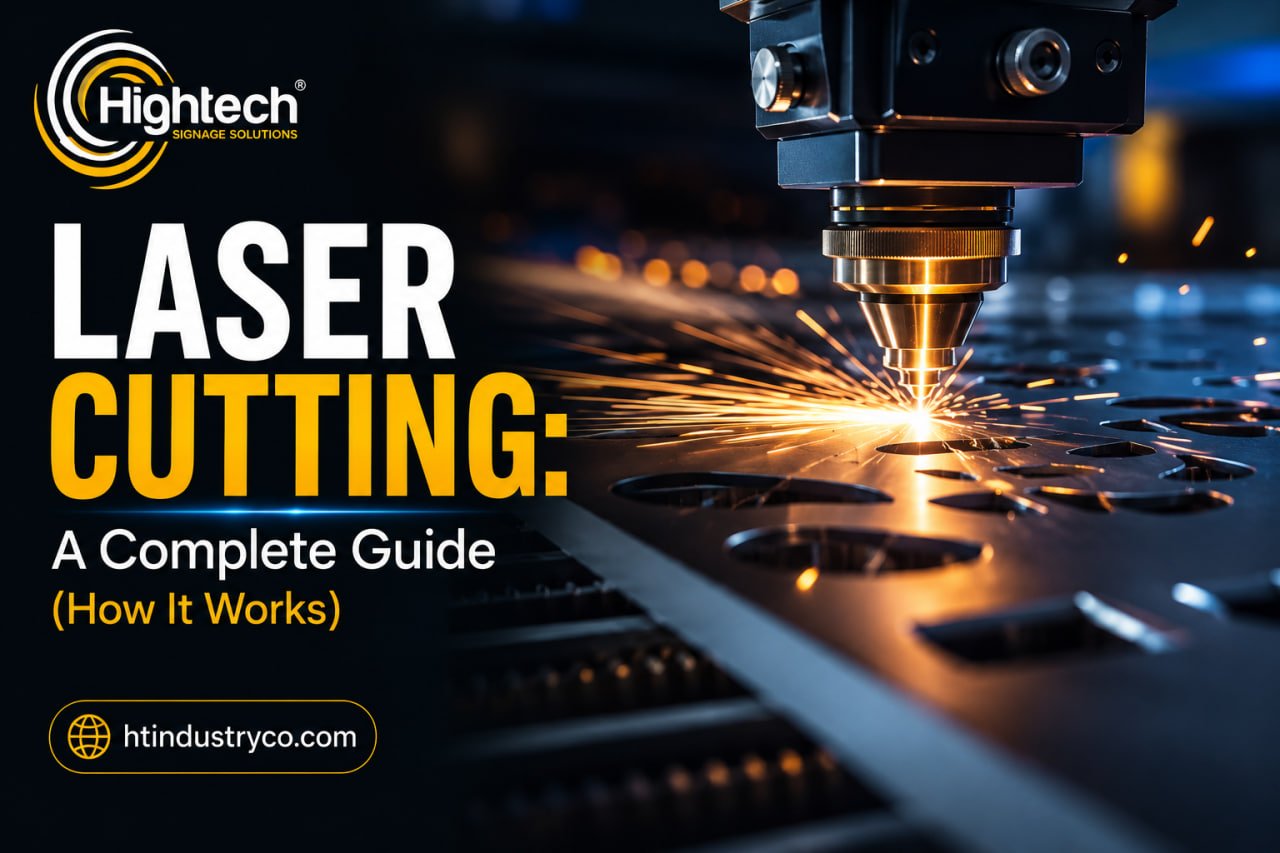
Table of Contents
Laser cutting has become an essential technology for manufacturers that need fast, precise, and repeatable material processing. By directing a focused beam along a CNC-controlled path, a laser cutting machine can create detailed shapes with a narrow kerf, limited material waste, and minimal physical contact with the workpiece.
Choosing the right laser cutting machine for signage depends mainly on the materials being processed. Fiber laser systems are used for metal sign components made from stainless steel, aluminum, carbon steel, brass, and copper. CO₂ lasers are better suited to acrylic, wood, MDF, leather, fabric, and other non-metal materials commonly used in illuminated and decorative signs.
This guide explains how laser cutting works, compares fiber and CO₂ technology, reviews compatible materials and assist gases, and shows how sign manufacturers can choose the right system for channel letters, logos, display panels, and custom advertising projects.
Quick Facts
- Laser cutting is a non-contact process that uses a focused beam of light to melt, burn, or vaporize material along a CNC-programmed path.
- Two main industrial types: fiber lasers (~1.06 µm, for metals) and CO2 lasers (~10.6 µm, for non-metals).
- Typical kerf is narrow — roughly 0.1–0.5 mm — so little material is lost and edges need minimal finishing.
- Industrial systems hold tight tolerances; Hightech’s HT FC-2040 repeats to ±0.02 mm and positions to ±0.05 mm.
Best signage fit: fiber for metal channel letters and returns; CO2 for acrylic faces on illuminated letters.
What is Laser Cutting?
Laser cutting has become one of the most important precision technologies in modern manufacturing and signage. By using a highly focused laser beam, this method allows clean, accurate, and efficient cutting across a wide range of materials. For industries such as signage and channel letter fabrication, laser cutting provides unmatched speed and quality compared to traditional tools.
Understanding how this technology works, the machines available, and the benefits for specific applications can help businesses make the right investment.
How Does Laser Cutting Work?
To understand what is laser cutting, imagine a focused beam of light powerful enough to melt or vaporize materials along a chosen path. This process is carried out by a laser cutting machine, which directs the beam through mirrors and lenses to achieve maximum precision. Because there is no direct physical contact, the cut edges remain smooth and consistent.
In practice, the process follows five steps:
- A laser source generates a high-energy beam (fiber or CO2).
- Optics and a focusing lens concentrate the beam to a fine point on the material surface.
- The focused beam melts, burns, or vaporizes the material at that point.
- An assist-gas jet (nitrogen, oxygen, or compressed air) blows the molten material out of the kerf, leaving a clean edge.
- The CNC system guides the head along the CAD/CAM toolpath, cutting the full part or nest.
Kerf is the width of material removed by the beam. Because laser kerf is narrow, parts can be nested close together — though leaving roughly 2 mm of spacing between parts helps avoid heat build-up and edge defects on tight nests.
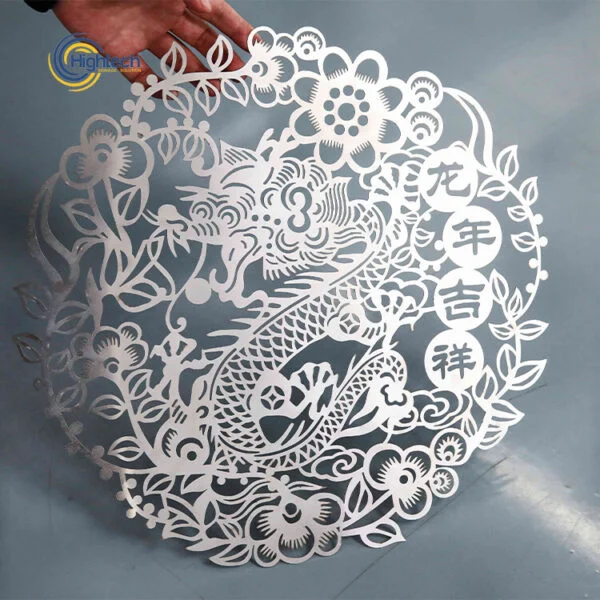
Types of laser cutting
The two laser types used in industrial signage and metal work are fiber and CO2. They differ mainly in wavelength, which determines what each one cuts well. Fiber lasers (~1.06 µm) are absorbed efficiently by metals; CO2 lasers (~10.6 µm) are better suited to non-metals such as acrylic, wood, and leather.
|
Type |
Wavelength |
Best materials |
Metal? |
Maint. |
Signage fit |
|---|---|---|---|---|---|
|
Fiber |
~1.06 µm | Stainless, aluminum, carbon steel, brass, copper | Excellent | Low | Metal channel letters |
| CO2 | ~10.6 µm | Acrylic, wood, leather, glass, plastics | Limited | Higher | Acrylic / illuminated letters |
Fiber laser cutting
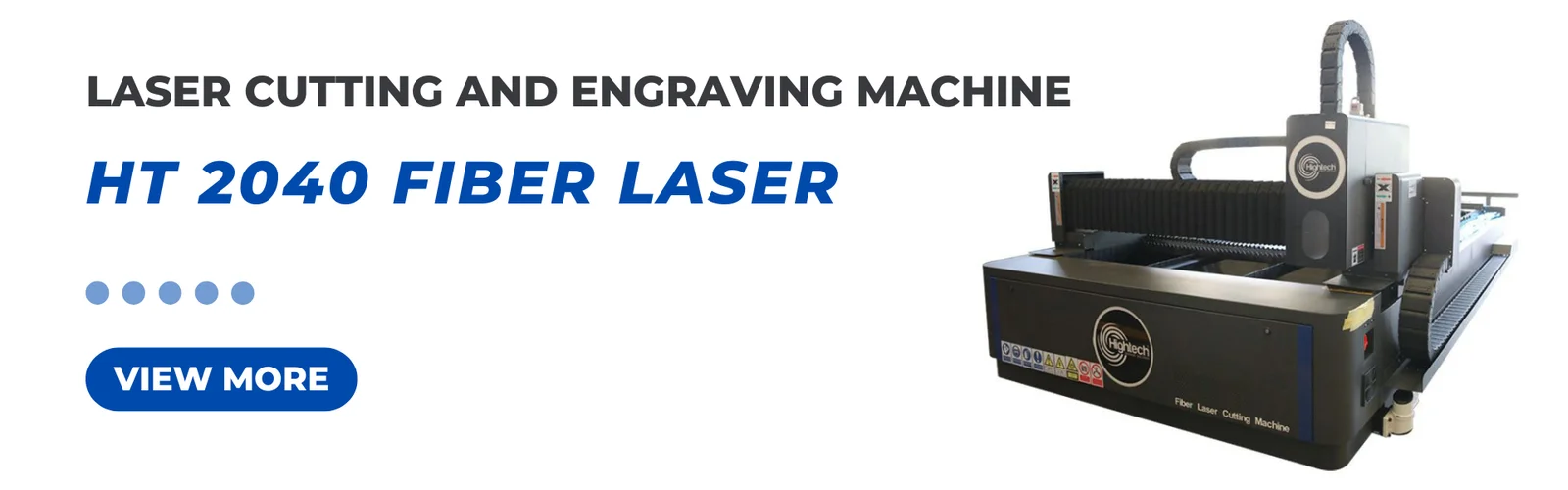
Fiber lasers generate the beam in an optical fiber doped with rare-earth elements, producing a ~1.06 µm wavelength that metals absorb readily. This makes them fast and efficient on stainless steel, aluminum, carbon steel, brass, and copper, with low maintenance and no mirrors to align. Hightech’s HT FC-2040 Exchange Table and HT FC-1530 fiber laser run on air, oxygen, or nitrogen and cut the full range of common signage metals. Browse the full fiber laser cutting machines range for working-area and power options.
CO2 laser cutting
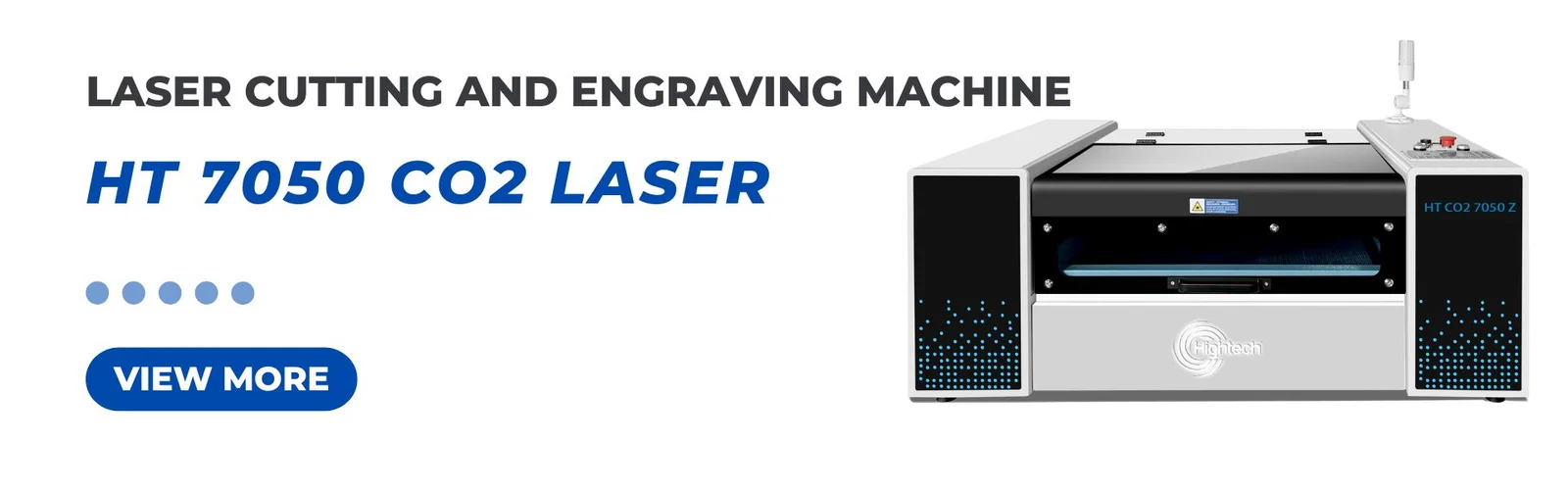
CO2 lasers excite a carbon-dioxide gas mixture to produce a ~10.6 µm infrared beam. That longer wavelength is absorbed well by organic, non-metal materials — acrylic, wood, leather, paper, and many plastics — which is why CO2 is the standard choice for acrylic faces on illuminated channel letters. CO2 can cut thin metal only at high power with assist gas, and is generally best reserved for non-metals. See the HT CO2-7050-Z and the wider CO2 Laser Cutting and Engraving range.
Cutting modes: fusion, oxidation, and vaporization
Laser cutting separates material in one of three modes depending on the material and assist gas. Fusion cutting uses an inert gas (usually nitrogen) to melt the material and blow it clear, producing clean, oxide-free edges. Oxidation cutting uses oxygen, whose exothermic reaction with the metal adds energy and speeds up carbon-steel cutting. Vaporization cutting boils the material away directly and is typical for thin organics like acrylic and wood on CO2 systems.
What gas is used in laser cutting?
Assist gas does two jobs: it clears molten material from the kerf and, depending on the gas, changes the cut chemistry. The three common choices are nitrogen, oxygen, and compressed air.
- Nitrogen produces clean, oxidation-free edges on stainless steel and aluminum, but it costs more and consumes higher volumes.
- Oxygen speeds up carbon-steel cutting through an exothermic reaction, at the cost of an oxidized edge.
- Compressed air is the low-cost option for thin or non-critical parts where edge quality is less demanding.
Laser cutting materials: what can and can't be cut
Material choice follows the laser type. Fiber handles metals; CO2 handles non-metals. A small group of materials should never be laser cut at all because of the fumes they release.
Materials fiber lasers cut (metals)
Carbon steel, stainless steel, aluminum, brass, copper, galvanized sheet, and titanium alloy. Highly reflective metals like copper and brass cut best on fiber with correct settings; they are difficult or unsafe on CO2.
Materials CO2 lasers cut (non-metals)
Acrylic, wood, MDF, leather, paper, fabric, and many plastics. Acrylic in particular cuts with a flame-polished edge, which is why CO2 is preferred for illuminated sign faces.
Materials that cannot be laser cut
Avoid these entirely:
- PVC, vinyl, and PU/faux leather — release toxic chlorine gas that harms lungs and corrodes machine components.
- Polycarbonate — burns, discolors, and yellows rather than cutting cleanly.
- Highly reflective metals on CO2 — reflect the beam back into the optics; use fiber with proper settings instead.
Always confirm a material’s composition and safety data before cutting. When in doubt, test on scrap with full extraction running.
How accurate is laser cutting?
Laser cutting is highly precise, holding tight tolerances with a narrow kerf and a minimal heat-affected zone, so parts usually need little or no edge finishing. On Hightech’s HT FC-2040, that translates to a repeatability of ±0.02 mm and positioning accuracy of ±0.05 mm. Across the industry, high-end systems can resolve features down to roughly 5 microns, which is why laser-cut signage parts fit together with minimal rework.
Accuracy flags: on thin or brittle materials, excess power or speed can enlarge the heat-affected zone or leave brittle edges. For tight nests, allow roughly 2 mm of spacing between parts so accumulated heat doesn’t distort neighbouring cuts.
Laser cutting safety
Laser cutting is safe when the machine is operated correctly, but the beam, fumes, and fire risk all demand respect. Four practices matter most:
- Fume extraction: run filtered extraction at all times, and never cut chlorine-releasing materials (PVC, vinyl, PU leather).
- Eye protection: use the correct wavelength-rated eyewear; fiber and CO2 require different ratings, and enclosed machines should stay closed during operation.
- Never leave a running laser unattended: cutting organics can ignite, so an operator and a CO2 fire extinguisher should always be present.
- Maintain the machine: keep optics clean, filters serviced, and interlocks functional.
How to Choose a Laser Cutting Machine for Signage
Selecting a laser cutting machine for signage starts with identifying the materials and products your business manufactures most often. No single laser technology is suitable for every sign-making application.
A fiber laser is the preferred option for cutting metal letters, sign cabinets, mounting plates, decorative panels, and channel letter components made from stainless steel, carbon steel, aluminum, brass, or copper. Its shorter wavelength is efficiently absorbed by metal, allowing precise cutting with narrow kerfs and repeatable results.
A CO₂ laser is more suitable for acrylic sign faces, wooden signs, MDF lettering, display products, engraved plaques, and other non-metal materials. It can produce smooth acrylic edges and detailed engraving, making it particularly useful for illuminated signs and customized advertising products.
When comparing machines, sign manufacturers should consider:
- Material type and thickness
- Maximum sheet dimensions
- Laser power
- Cutting and engraving requirements
- Working-area size
- Assist-gas or extraction requirements
- Software compatibility
- Production volume
- Maintenance and technical support
The best machine is not necessarily the system with the highest power. It is the one that matches the company’s material mix, product dimensions, daily workload, and required finish quality.
Benefits of Laser Cutting for Channel Letter Fabrication
Laser cutting provides significant advantages for producing channel letters with high precision and efficiency. This technology allows sign makers to achieve clean edges, consistent shapes, and faster production times compared to traditional cutting methods. By using laser cutting machines, shops can reduce errors, minimize material waste, and create professional-quality signage that meets modern industry standards.
Key benefits include:
- High Precision and Accuracy – Laser cutting produces smooth, detailed edges that require little to no finishing, ensuring each letter matches the design perfectly.
- Speed and Efficiency – Cuts complex shapes quickly, allowing higher production volumes without compromising quality.
- Material Flexibility – Works with metals like aluminum and stainless steel, as well as acrylic and other non-metallic materials for illuminated letters.
- Consistent Production – Every cut is identical to the programmed design, ensuring uniformity across multiple letters.
- Reduced Waste and Costs – Optimized cutting paths minimize material loss, making projects more cost-effective.
Materials Compatible with Laser Cutting for Channel Letters
One of the main strengths of laser cutting is its ability to handle a wide range of materials used in signage. Metals such as aluminum and stainless steel are among the most common choices because they offer durability and a professional finish. Aluminum is lightweight and easy to cut, while stainless steel provides strength and corrosion resistance for long-lasting signs.
In addition to metals, non-metallic materials like acrylic are frequently used for illuminated letters, as they allow light to pass through and create vibrant effects. This versatility makes laser cutting the go-to method for modern channel letter fabrication, giving sign makers the flexibility to bring creative designs to life.
Applications of Laser Cutting in Signage and Advertising
Laser cutting has become a crucial tool in modern signage and advertising, allowing businesses to produce high-quality, visually appealing signs with precision and efficiency. Its ability to handle intricate designs and various materials makes it ideal for creative and professional applications.
Key applications include:
- Channel Letter Fabrication – Creates precise metal and acrylic letters for storefronts, office buildings, and illuminated signs, ensuring clean edges and consistent shapes.
- Custom Logos and Shapes – Produces detailed and complex designs that are difficult to achieve with traditional cutting methods, enhancing branding and visual appeal.
- Illuminated Signage – Works with acrylic and LED-compatible materials to craft bright, professional lighting effects that attract attention.
- Advertising Displays – Cuts exhibition stands, point-of-sale displays, and promotional boards accurately and efficiently.
- Prototyping and Small-Batch Production – Ideal for rapid prototyping and custom orders, reducing setup time while maintaining high precision.
This versatility makes laser cutting an essential part of modern channel letter laser cutting and broader signage production.
Find the Right Machine for Your Application
Frequently asked questions
How does laser cutting work?
A laser source generates a high-energy beam, optics focus it to a tiny point, and CNC control guides it along a programmed path. The beam melts, burns, or vaporizes the material while an assist-gas jet blows the molten material out of the cut, leaving a clean edge.
What is the difference between fiber and CO2 laser cutting?
Fiber lasers (~1.06 µm) excel at metals — stainless, aluminum, carbon steel, brass, copper — with high speed and low maintenance. CO2 lasers (~10.6 µm) suit non-metals like acrylic, wood, and leather. For metal signage choose fiber; for illuminated acrylic letters choose CO2.
Can a laser cutter cut metal?
Yes — fiber lasers cut metals efficiently, including stainless steel, aluminum, carbon steel, brass, and copper. CO2 lasers can cut thin metal only at high power with assist gas and are generally better reserved for non-metals.
What materials cannot be laser cut?
Avoid PVC, vinyl, and PU/faux leather — they release toxic chlorine gas that damages lungs and machines. Polycarbonate burns and yellows, and highly reflective metals require fiber lasers with proper settings. Always confirm material safety before cutting.
What gas is used in laser cutting?
Nitrogen produces clean, oxidation-free edges on stainless steel and aluminum but costs more. Oxygen speeds carbon-steel cutting through an exothermic reaction. Compressed air is a low-cost option for thin or non-critical parts.
How accurate is laser cutting?
Laser cutting is highly precise, holding tight tolerances with a narrow kerf and minimal heat-affected zone. Industrial systems can produce features down to roughly 5 microns, and machines like the HT FC-2040 repeat to ±0.02 mm — so little or no edge finishing is needed for signage parts.
Is laser cutting good for channel letters?
Yes. It delivers clean edges, consistent repeatable shapes, and minimal finishing — ideal for metal and acrylic channel letters. Fiber lasers handle metal returns and faces; CO2 lasers cut acrylic faces for illuminated letters.
What is the best laser cutting machine for signage
The best laser cutting machine for signage depends on the materials being processed. Fiber lasers are generally preferred for metal letters and sign components, while CO₂ lasers are more suitable for acrylic, wood, MDF, leather, fabric, and other non-metal sign materials.
Latest contents


Prefer a callback? Share your details and requirements below.
Your details will only be used to respond to this request.